Astronomy
All articles →-
Astronomy
After 50 years, astronomers catch our galaxy's black hole exhaling
Sagittarius A* is a famously quiet black hole, but new ALMA observations have finally revealed powerful winds streaming from it — the outflow astronomers spent half a century hunting for.
-
Astronomy
The most massive black hole pair ever found is hiding in a starless void
Two ultramassive black holes totalling roughly 60 billion solar masses sit at the heart of a distant galaxy, spiralling toward a merger that would create one of the largest black holes known.
-
Astronomy
Webb peers into a nearby galaxy's heart and settles a 30-year argument
Using a clever masking technique, Webb resolved the dusty core of the Circinus Galaxy and found that almost all its hot-dust glow comes from right beside the black hole — overturning a long-standing assumption.
-
Astronomy
Webb finds a black hole that grew too big, too fast, too early
Inside a 'little red dot' just 570 million years after the Big Bang, Webb has caught a supermassive black hole feeding voraciously — and far too large for its host galaxy, deepening a puzzle about early cosmic growth.
-
Astronomy
Measuring a strain of 10⁻²¹: how gravitational-wave detectors work
LIGO detects spacetime distortions a thousandth the width of a proton across a four-kilometre arm. The instrument is an exercise in suppressing every other effect on Earth — and it has opened a genuinely new way of observing the universe.
-
Astronomy
Why the most powerful telescope ever built has to freeze itself
Webb's gold mirror, tennis-court sunshield, and orbit a million and a half kilometres from Earth all follow from one requirement: to see the first galaxies, it must observe in the infrared — and an infrared telescope that is even slightly warm is blind.
-
Astronomy
NASA's next great observatory, Roman, gets an August launch date
The Nancy Grace Roman Space Telescope is now set to launch August 30 on a Falcon Heavy — ahead of schedule and under budget. Its wide-field infrared survey could catalogue around 100,000 exoplanets.
-
Astronomy
A giant galaxy that doesn't spin is forcing a rethink of how they form
Webb found a massive galaxy from less than two billion years after the Big Bang whose stars move at random, with no rotation at all — a 'slow rotator' that theory says should not exist so early.
-
Astronomy
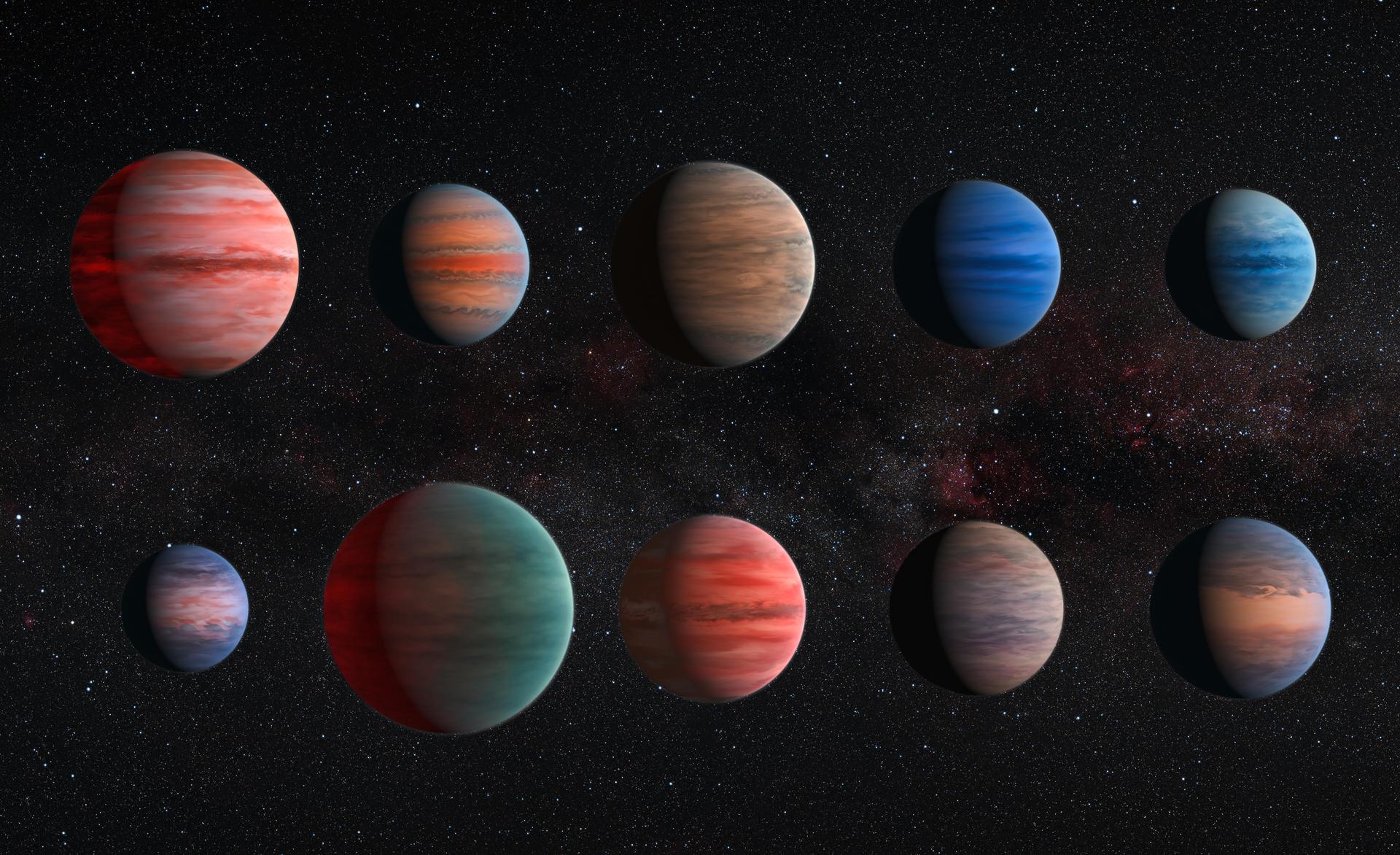
On this hot Jupiter, rock clouds form by morning and burn off by night
Webb resolved the day–night weather of WASP-94A b, a gas giant 700 light-years away: magnesium-silicate clouds blanket the morning side and vanish on the scorching evening side — and the planet is far less exotic than thought.