
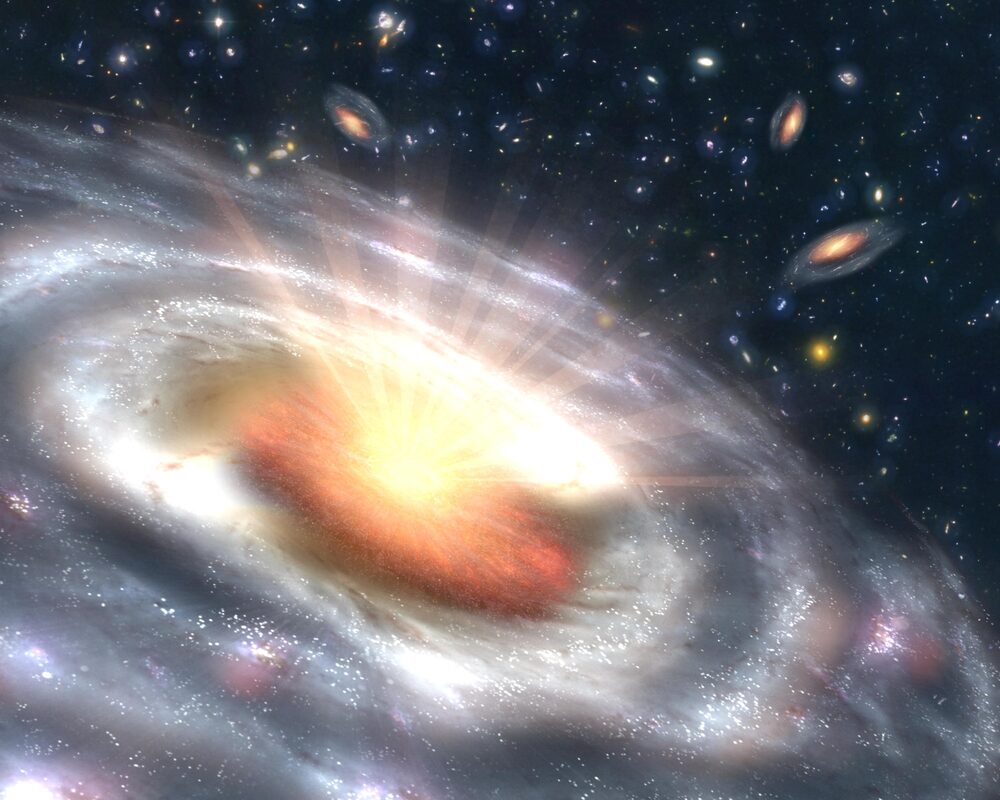
Somewhere in the earliest few hundred million years of the universe's history, black holes weighing hundreds of millions to billions of times the mass of the sun were already blazing away, feeding on infalling gas and outshining every star in their host galaxies combined. How they got so big, so fast, remains one of the more stubborn puzzles in cosmology. A new haul of data from ESA's Euclid space telescope has just handed astronomers a much bigger sample to work with.
Euclid has discovered 31 new quasars dating to the universe's infancy, according to results published July 6, 2026, in the journal Astronomy & Astrophysics and announced simultaneously by ESA and NASA. The find more than doubles the number of known quasars from this period of cosmic history — objects whose light has been traveling toward Earth for over 13 billion years.
Two of the newly identified quasars set new distance records. EUCL J172902.75+641018.1 sits at redshift 7.77, and EUCL J125308.55+705432.3 follows close behind at redshift 7.69. Both surpass the previous record holder, a quasar at redshift 7.64 identified back in 2021. In redshift terms, higher numbers mean more ancient and more distant — the light from these two objects left its source when the universe was roughly 5% of its current age, around 670 million years old.
Twelve of the 31 quasars in the new sample date to within the universe's first 770 million years, placing them firmly in the era astronomers call cosmic dawn, when the first generations of stars, galaxies, and black holes were assembling out of primordial gas.
How Euclid Found Them
Quasars are the extraordinarily luminous cores of galaxies powered by supermassive black holes actively pulling in surrounding matter. As gas spirals inward, it heats up and radiates intensely across the electromagnetic spectrum, allowing quasars to be seen across vast cosmic distances even though the galaxies hosting them are otherwise far too faint to detect.
Finding them at the extreme edge of the observable universe, however, is a needle-in-a-haystack problem. Euclid launched in July 2023 and began science observations on February 14, 2024, tasked primarily with mapping the large-scale structure of the universe to study dark matter and dark energy. That wide-field survey work, covering huge swaths of sky, turns out to be well suited to catching rare, high-redshift quasars that a narrower, deeper survey would likely miss entirely.
The discovery is the product of a sprawling collaboration: the Euclid Consortium comprises more than 2,000 scientists across over 300 institutes in 15 European countries plus the United States, Canada, and Japan, with NASA also a mission partner alongside ESA. Lead author Daming Yang, along with ESA Research Fellow Antonio La Marca and ESA Euclid Project Scientist Valeria Pettorino, are among those credited with the analysis in the ESA release announcing the find.
Why It Matters
The existence of billion-solar-mass black holes less than a billion years after the Big Bang is difficult to explain with standard models of black hole growth, which generally assume black holes form from the collapsed remnants of massive stars and then grow gradually by accreting matter over time. Under that framework, there simply isn't enough cosmic time between the Big Bang and the epoch these quasars inhabit for a stellar-remnant black hole to bulk up to the masses inferred from quasar luminosities.
Every additional confirmed ancient quasar is a data point that helps astronomers test competing explanations — whether early black holes formed from direct collapse of massive gas clouds, from unusually efficient accretion, from mergers of many smaller black holes, or from some combination of mechanisms not yet fully understood. A sample this size, more than double what existed before, gives researchers enough statistics to start characterizing the population rather than puzzling over a handful of isolated oddities. Record-breakers like the two quasars at redshift 7.77 and 7.69 also push the observational frontier closer to the theoretical limits of when the first supermassive black holes could plausibly have existed at all.
What Comes Next
Euclid's primary survey is still ongoing, and the 31 quasars announced this month likely represent a fraction of what the telescope will eventually turn up as it continues mapping the sky. Follow-up observations with other observatories will be needed to pin down more precise masses and properties for the newly identified objects, and to determine how they fit into the broader picture of galaxy and black hole co-evolution in the universe's first billion years.
