
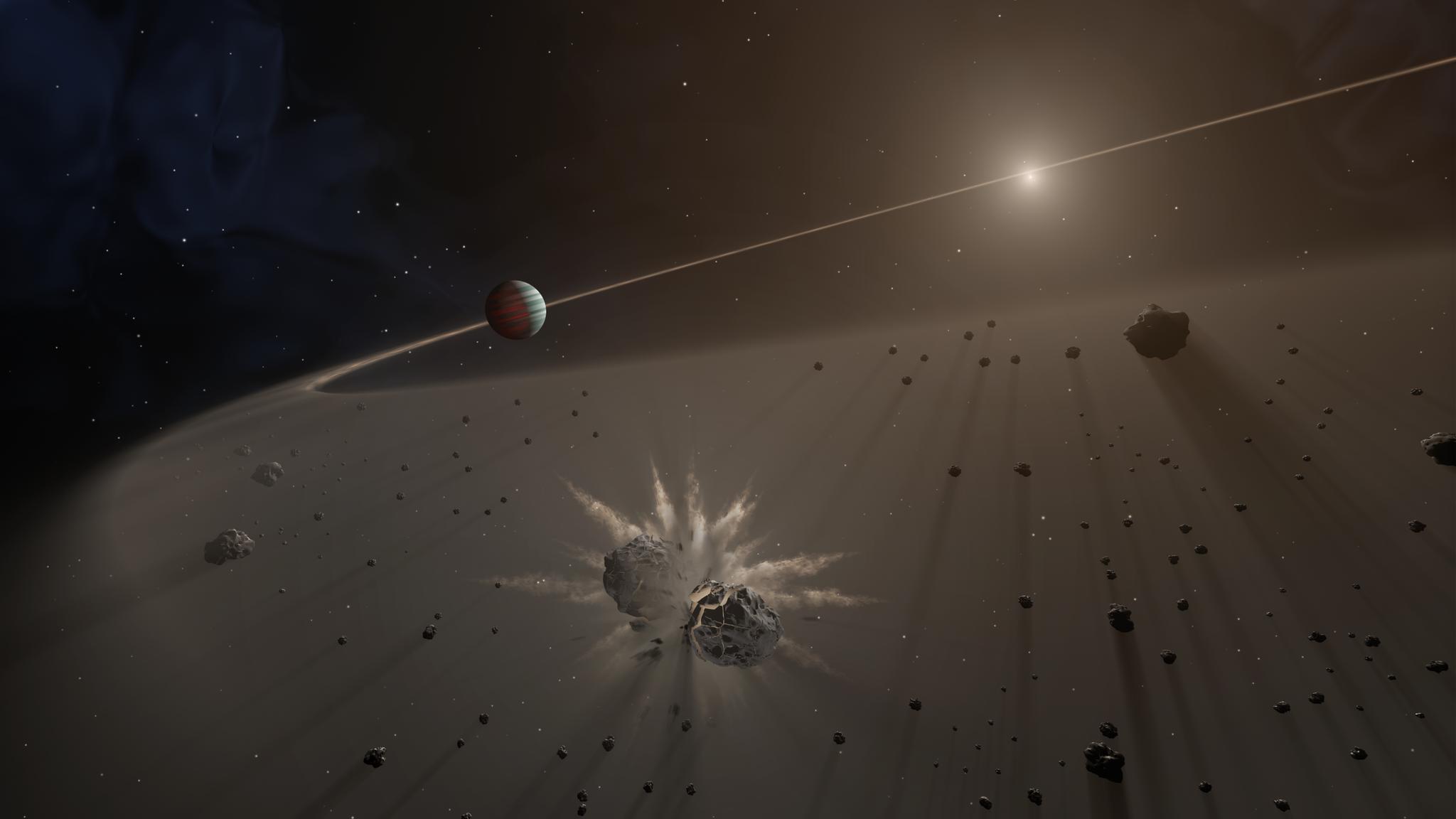
Directly imaging a planet around another star is one of the hardest tricks in observational astronomy. You are trying to spot a faint point of light sitting almost on top of a star that outshines it by factors of thousands to millions, from tens of light-years away. So when a team announced this week that it had wrung a brand-new giant planet out of more than a decade of archival telescope data, and then had it independently confirmed by a second team using a completely different observatory, it is worth paying attention to how the detection was actually made.
The planet is Beta Pictoris d, a third giant world orbiting the young, well-studied star Beta Pictoris, roughly 63 light-years from Earth. The discovery was published on July 15, 2026, in The Astrophysical Journal Letters, with the University of Edinburgh, the European Southern Observatory (ESO), and the University of Oxford among the institutions behind it. The paper's title says the quiet part out loud: "Direct Imaging Discovery of Giant Exoplanet β Pictoris d: A Decade-long Game of Hide-and-seek."
A star system that keeps giving
Beta Pictoris is not a stranger to planet hunters. It is a nearby, youthful star surrounded by a bright debris disk — essentially a construction site of leftover planet-forming material — and it already had two known giant planets, Beta Pic b and Beta Pic c, on the books. Adding a third confirmed planet makes it one of the richest directly imaged planetary systems we know of, and a natural laboratory for watching how giant planets settle into their orbits early in a system's life.
What sets the newcomer apart is not its heft but its faintness. Beta Pictoris d weighs in at about 2.4 times the mass of Jupiter — a substantial gas giant by any measure. Yet it is roughly 100 times fainter than Beta Pic b. Once astronomers correct for distance, ESO describes it as the faintest exoplanet ever imaged directly from Earth. That is the headline result: not a record-breaking size or a strange orbit, but a record in sensitivity, a demonstration of just how deep ground-based direct imaging can now reach.
How do you find a planet that has been hiding for 11 years?
The short answer is patience and archives. The planet turns out to be visible in observations stretching back about 11 years, but it was buried in the glare and the noise the whole time. Nobody spotted it live; it had to be excavated.
The detection came together across multiple instruments. The team, co-led by Ben Sutlieff and Markus Bonse (with affiliations at the University of Edinburgh and ESO), found the planet using ESO's Very Large Telescope (VLT) in Chile — specifically the ERIS instrument. They then went back and confirmed the signal in archival data from VLT's SPHERE instrument, the earlier-generation planet imager that had been staring at this same system for years. In other words, the evidence had been sitting in the data vault; it took new instruments and new analysis to recognize it.
That kind of result invites an obvious skeptical question: if a planet is 100 times fainter than its neighbor and only emerges after careful reprocessing of old data, how confident can anyone be that it is real and not an artifact of the analysis? This is where the second team matters.
An independent confirmation from space
A separate group, led by Aidan Gibbs of the University of California, independently confirmed Beta Pictoris d using JWST's NIRCam instrument. That is about as clean a cross-check as direct imaging offers: a different team, a different telescope, a different observing environment — space rather than the ground — and the same planet shows up. When a ground-based detection wrung out of a decade of archival data is corroborated by an orbiting infrared observatory analyzed by people who were not part of the original discovery, the case for the planet being real gets a lot stronger.
The peer-reviewed paper of record, in The Astrophysical Journal Letters (Vol. 1006, No. 1, Article L10), carries 81 authors and documents the detection across both ground- and space-based observatories over that 11-year baseline. The University of Edinburgh, whose researchers captured the discovery imagery with the VLT, issued its own primary announcement on July 16.
Why It Matters
Most of the thousands of known exoplanets were found indirectly — by the tiny dip in starlight as a planet transits, or the subtle wobble it induces in its host star. Direct imaging is different and far rarer: it captures actual photons from the planet itself, which is what you need to eventually study a planet's atmosphere and composition in detail. Every gain in how faint a planet imagers can reach expands the population of worlds open to that kind of scrutiny.
Beta Pictoris d is a proof of that reach. Pulling a 2.4-Jupiter-mass planet out of the glare when it is 100 times dimmer than an already-known companion shows that current instruments and analysis techniques can find worlds that would have been invisible a decade ago — including, crucially, worlds that were already sitting in existing data archives, waiting to be recognized. It also reinforces Beta Pictoris as a benchmark system: three confirmed giant planets around one young star gives theorists a rare, real-world data set for testing how giant planets form and arrange themselves. And the fact that the discovery survived independent confirmation from a completely separate JWST team is a reminder of how the strongest claims in this field get made — not by a single dramatic image, but by two groups, two telescopes, and years of data agreeing.
Sources
- Elusive planet found after years of hide-and-seek — University of Edinburgh (16 July 2026)
- Faintest planet ever imaged from Earth found after more than 10 years of hide-and-seek — ESO release eso2609 (15 July 2026)
- Direct Imaging Discovery of Giant Exoplanet β Pictoris d: A Decade-long Game of Hide-and-seek — The Astrophysical Journal Letters (15 July 2026)
