
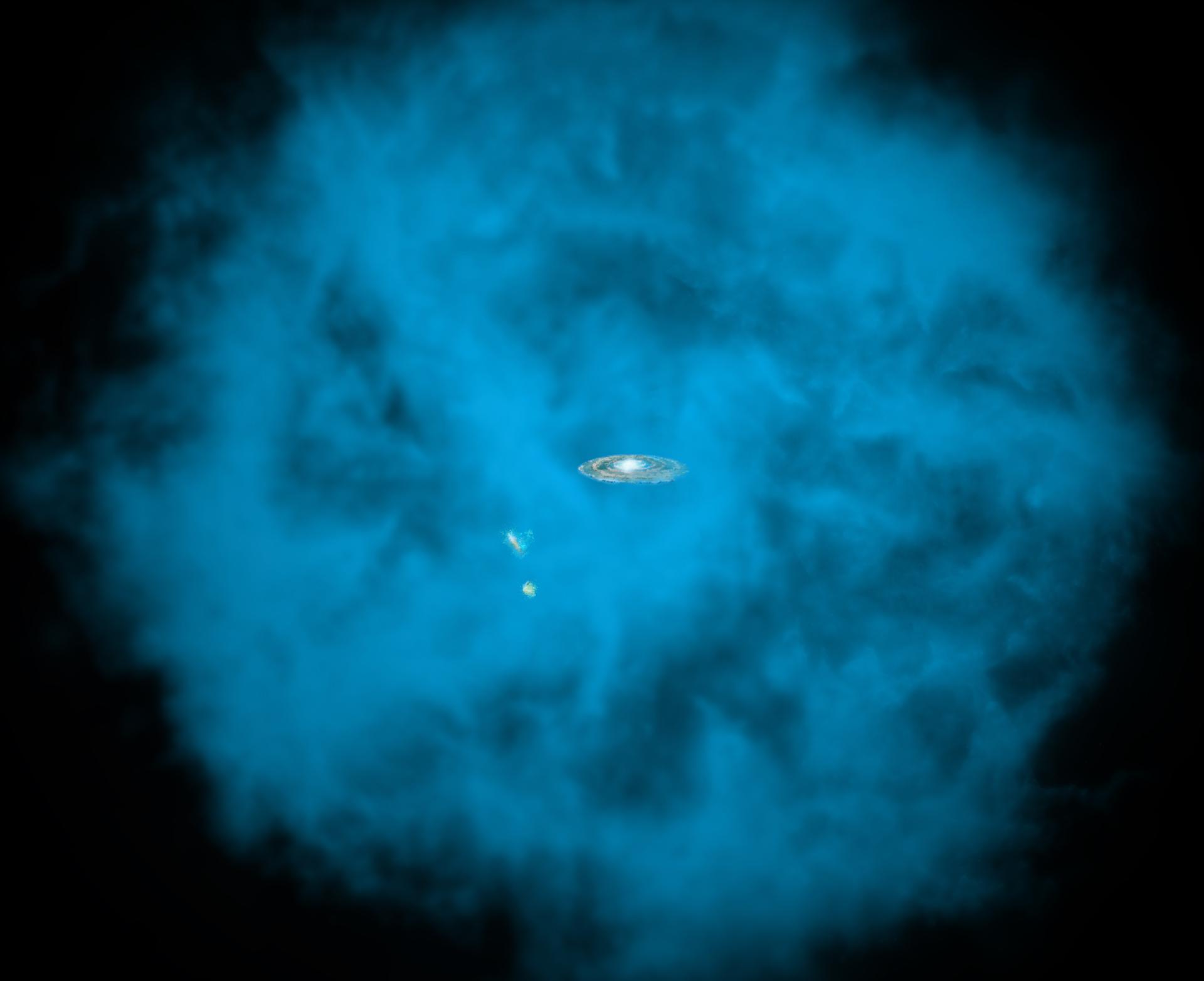
The Milky Way we see tonight — a broad disc of stars we sit inside and look out across — may be oriented nothing like the galaxy that existed when the Sun was young. According to work presented this week at the Royal Astronomical Society's National Astronomy Meeting, our galaxy's disc likely tipped over by more than 90 degrees early in its history, a slow-motion somersault triggered by a violent, head-on collision with another galaxy roughly 10 to 11 billion years ago.
Kirill Batrakov, a researcher at Durham University, laid out the case in Birmingham on Tuesday, 21 July 2026. The argument rests not on a single glimpse of the past — we don't have one — but on a population of simulated galaxies, and on a subtle property of the real Milky Way that turns out to be a fingerprint of exactly this kind of upheaval.
The clue hiding in the halo
Every large galaxy is wrapped in a diffuse cloud of old stars called the stellar halo — a sparse, roughly spherical population that surrounds the bright central disc. Halos are, in a sense, wreckage: much of their contents was donated by smaller galaxies that the host tore apart and absorbed over billions of years. Because of that violent origin, a halo carries a kind of dynamical memory of the mergers that built it.
The Milky Way's stellar halo has a peculiarity. It rotates very slowly. That is the loose thread Batrakov and his colleagues pulled on.
To find out what a sluggish halo implies about a galaxy's past, the team turned to the Auriga suite — a set of 25 cosmological simulations of Milky-Way-like galaxies, each followed across billions of years of evolution. Rather than trying to reconstruct our galaxy's biography from the outside in, they asked a cleaner question: among these 25 simulated galaxies, what do the ones with the slowest-spinning halos have in common?
Two shared scars
The answer came back with unusual consistency. The simulated galaxies whose stellar halos rotated most slowly shared two events in their histories.
The first was a major head-on merger — not a gentle, glancing encounter with a passing dwarf, but a direct, high-impact collision with a substantial galaxy. The second was a "disc flip": a wholesale reorientation in which the galactic disc changed its orientation by more than 90 degrees. The plane the galaxy's stars had been rotating in swung around to face a dramatically different direction.
Those two traits traveled together. A slow halo, a head-on smash, and a disc that flipped past a right angle appeared to be facets of the same underlying story.
That is where the real Milky Way re-enters the picture, because our galaxy is known to check two of the three boxes already.
Gaia-Sausage-Enceladus, the smoking gun
Astronomers have strong evidence that the young Milky Way suffered exactly the kind of collision the simulations flag. Around 10 to 11 billion years ago, a dwarf galaxy now known as Gaia-Sausage-Enceladus plowed into it head-on. The intruder was torn apart and absorbed, its stars scattered into the halo, where their distinctive, elongated orbits were later identified in data from ESA's Gaia mission — the "Sausage" in the name refers to the stretched, elongated shape those orbits trace out.
So the Milky Way has the head-on merger. It has the slowly rotating stellar halo. In the Auriga simulations, those two features come packaged with a third: a disc flip exceeding 90 degrees. Batrakov's conclusion follows the pattern — the Milky Way's disc very likely flipped in the past, reorienting by more than 90 degrees in the aftermath of the Gaia-Sausage-Enceladus collision.
Independent coverage of the announcement frames the physical process in accessible terms: the Gaia Sausage dwarf was absorbed roughly 10 billion years ago, and afterward the disc gradually reoriented into the position we observe today. The slowly rotating halo is described as the tell-tale signature left behind by that greater-than-90-degree flip.
What "flipped" actually means for us
It is worth being precise about the claim, because "the galaxy flipped over" invites cinematic mental images that overstate the violence. This is not a suggestion that stars were flung out of the galaxy or that the Milky Way was destroyed and rebuilt. The disc — the rotating sheet of stars, gas, and dust — changed the direction it faced. Its axis of rotation swung by more than a right angle.
The consequence for our own neighborhood is genuinely striking. The Sun and its ancestral material would have been part of, or embedded in, that disc. If the disc's orientation swung by more than 90 degrees, then the Sun's ancient orbit was oriented very differently than it is today. The plane the Sun traced around the galactic center in that early era pointed a different way in space than the plane it traces now.
None of this is something a single telescope pointing can reveal directly. The flip, if it happened, finished billions of years ago. The evidence is necessarily circumstantial and statistical: a match between a distinctive property of the real Milky Way and the shared histories of simulated galaxies that look like it.
Why It Matters
Reconstructing a galaxy's history is a bit like archaeology carried out on a moving target — the events that shaped the Milky Way happened billions of years before anyone could watch, and the galaxy has been churning ever since. Work like this matters because it turns a present-day, measurable quantity — how fast the stellar halo spins — into a readable clue about an unwitnessed past. If a slowly rotating halo really is the reliable fingerprint of a head-on merger plus a major disc flip, then astronomers gain a tool that can be pointed at other galaxies, not just our own.
It also reframes how we think about our place. The tidy, stable pinwheel we picture when we imagine the Milky Way is a snapshot, not a permanent condition. Our galaxy has been knocked sideways, has absorbed at least one substantial rival whole, and has reoriented the very disc the Solar System rides within. The Gaia-Sausage-Enceladus collision was already one of the defining events in Milky Way history; this analysis argues it may have literally changed which way our galaxy — and the Sun's orbit through it — was pointed.
As with any result drawn from simulations matched against a single real galaxy, the case is strong but circumstantial rather than a direct observation, and it invites follow-up against other galaxies and other simulation suites. But it is a clean, testable idea built on a specific measurable property, and it hands astronomers a fresh way to read the scars that mergers leave behind.
Sources
- NAM 2026: How our Milky Way once underwent a dramatic flip (Royal Astronomical Society)
- Cosmic gymnastics: How our Milky Way once underwent a dramatic flip (EurekAlert!)
- Cosmic gymnastics: How the Milky Way once underwent a dramatic flip (Phys.org)
- Our galaxy flipped after a collision, say astronomers (EarthSky)
