
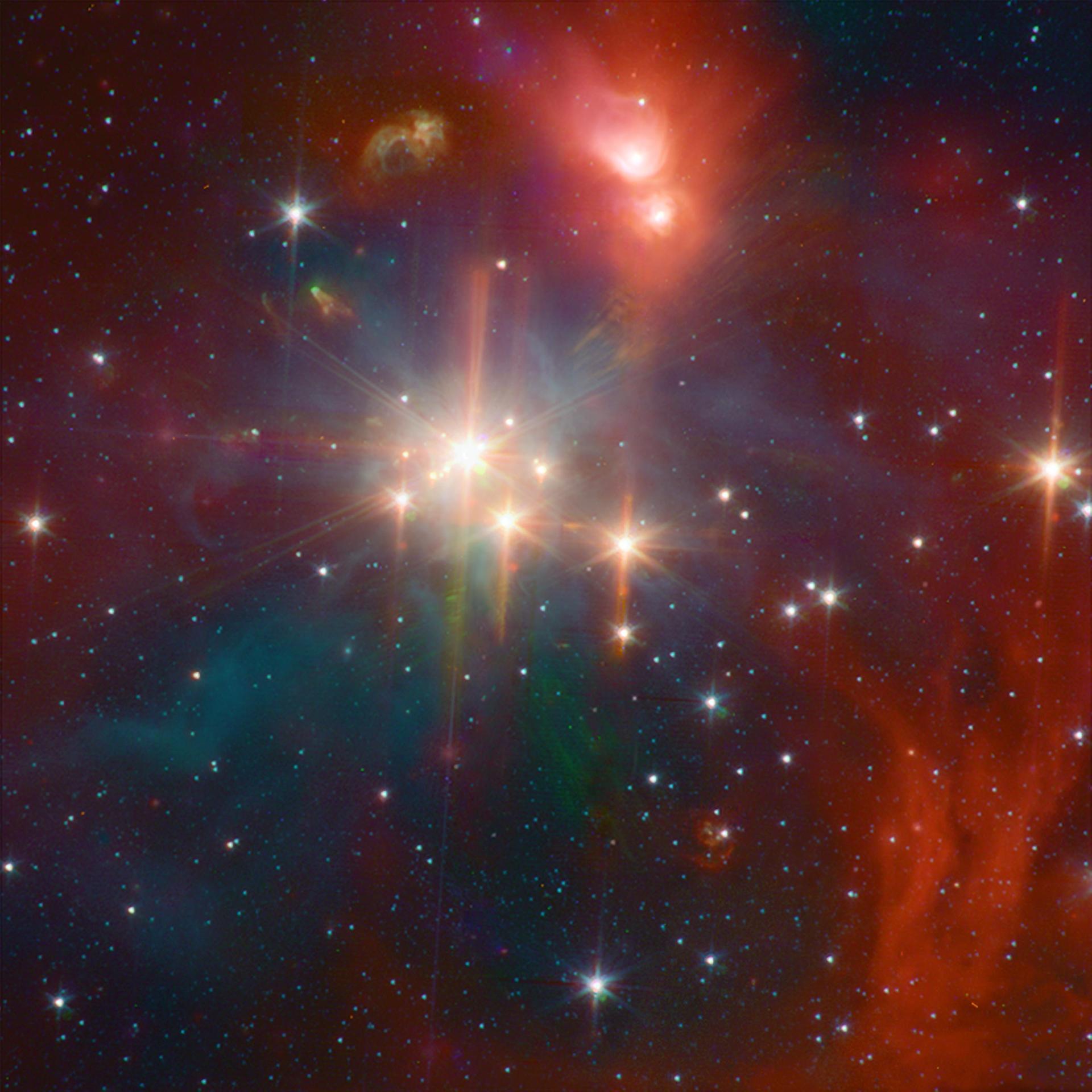
When an observatory reaches for a Van Gogh comparison, it is usually a warning sign — a press office dressing up a routine image with an art-history flourish. This time the comparison earns its keep. In mid-July 2026, NSF NOIRLab released a sweeping mosaic of the Corona Australis Molecular Cloud, and the swirling gas and dust genuinely do echo the churning brushwork of The Starry Night. NOIRLab leaned into it, titling the release "The Starry Night Redux."
The image comes from the Dark Energy Camera, or DECam, a 570-megapixel imager mounted on the Victor M. Blanco 4-meter telescope at Cerro Tololo Inter-American Observatory in Chile. DECam was built to survey vast swaths of sky for the faint fingerprints of dark energy, but its combination of wide field and deep sensitivity makes it equally suited to portraiture of the nearby cosmos. Corona Australis — the Southern Crown — is about as nearby as active star formation gets.
The closest nursery
Corona Australis (CrA) sits roughly 425 light-years from Earth, making it one of the closest star-forming regions to the solar system. That proximity is the whole point. Most stellar nurseries are thousands of light-years away, their internal structure smeared into a haze by distance. At 425 light-years, CrA is close enough that a 4-meter telescope on a good mountain can resolve the individual dark filaments, the dense clumps, and the reflected glow of embedded stars.
The cloud itself is a dark nebula — cold, dense molecular gas and dust that blocks the light of stars behind it. In the mosaic those obscuring lanes read as inky rivers cutting across the star field, and they are the raw material for the next generation of stars. Where the gas piles up densely enough, it collapses under its own gravity and ignites.
What's actually in the frame
The scene is anchored by R Coronae Australis, a variable binary system whose light is scattered by the surrounding dust to produce an orange reflection nebula. Reflection nebulae don't glow on their own; they shine because dust grains bounce starlight toward us, and the color depends on the illuminating star and the scattering. Here the result is a warm, tawny cloud wrapped around R CrA — the visual heart of the image.
Off in the upper right sits NGC 6723, a globular cluster. It looks like a natural companion to the nebula, but that is a trick of line-of-sight. NGC 6723 is far more distant than the molecular cloud, a dense ancient swarm of stars that happens to fall along the same direction as we look toward CrA. The juxtaposition — a young, dusty nursery in the foreground and an old, tightly bound cluster in the background — is one of those accidents of perspective that makes a single frame do double duty.
Scattered through the rest of the mosaic are the ordinary and the newborn: field stars, wisps of nebulosity, and the dense clumps where fresh stars are still condensing out of the dark.
Why a wide-field ground telescope still matters
It would be easy to assume that in the age of space telescopes, a 4-meter instrument on the ground is a supporting player. The Corona Australis mosaic argues otherwise. DECam's particular strength is the marriage of depth — how faint an object it can register — with breadth, the sheer area of sky it can capture in one shot.
A space telescope like JWST can dive far deeper into a small patch, but it sees the sky through a soda straw. To frame an entire molecular cloud and its surroundings — the nebula, the background cluster, the full sprawl of dust lanes — in a single coherent, deep image, you want a large-format camera on a large mirror under a dark Chilean sky. That is exactly what the Blanco telescope and DECam deliver.
Why It Matters
Beyond the obvious visual payoff, images like this one are working scientific data. The Corona Australis Molecular Cloud is a nearby laboratory for the earliest stages of star formation, and resolving its dense clumps and dust structure at this depth lets astronomers trace where and how new stars are taking shape — in the closest such region available to study. Because CrA is so near, what we learn here calibrates our understanding of star-forming regions much farther away, where the details are unresolvable.
There is also a quieter point about instruments. DECam was built to map dark energy across enormous volumes of the universe, yet the same hardware produces a definitive portrait of a nursery in our own galactic backyard. Survey instruments are general-purpose in a way single-target telescopes are not, and their archives are full of science no one has extracted yet. And the Van Gogh resemblance, gimmicky as it sounds, is doing real communicative work: the turbulence that painters intuit and the turbulence that shapes collapsing gas clouds are not entirely unrelated, and an image that draws a general audience into a molecular cloud has earned its comparison.
Sources
- The Starry Night Redux — Dark Energy Camera captures a Van Gogh-esque scene | NSF NOIRLab
- The Dark Energy Camera's New Image is Reminiscent of van Gogh | Universe Today
- 570-Megapixel Dark Energy Camera Photographs Van Gogh-Esque 'Starry Night' | PetaPixel
- The starry night redux: Dark Energy Camera captures a van Gogh-esque scene | Phys.org
