
Ask an astronomer how far away a galaxy is, and the honest answer involves a chain of several different techniques, each one calibrated by the last. No single instrument or formula measures cosmic distance directly past a few hundred light-years; instead, astronomers climb what's known as the cosmic distance ladder, using progressively brighter and rarer objects to reach progressively farther into the universe. It's an elegant piece of scientific bootstrapping — and, as of the last decade, the place where the ladder's two ends stop agreeing with each other is the most interesting problem in cosmology.
Rung one: parallax, the only truly direct method
The ladder's foundation is parallax, a purely geometric technique: as Earth orbits the Sun, nearby stars appear to shift very slightly against the background of more distant stars, the same way a finger held up at arm's length seems to jump when you view it with one eye closed and then the other. Measure that tiny angular shift and simple trigonometry gives a distance, with no assumptions about the star's physics required. ESA's Gaia mission, which mapped over a billion Milky Way stars, measures parallaxes precisely enough to pin down distances to stars near the galactic center some 30,000 light-years away to within about 20% accuracy — and for the nearest stars, to a precision of a few thousandths of a percent, according to ESA. Beyond a few tens of thousands of light-years, though, the parallax angle becomes too small to measure even with Gaia, and the ladder needs a new rung.
Rung two: Cepheid variable stars
That next rung was discovered by Henrietta Swan Leavitt at the Harvard College Observatory, who found in 1908 and confirmed in 1912 that Cepheid variable stars — stars that pulse in brightness because of a cyclic ionization instability in their outer layers — pulse more slowly the more luminous they intrinsically are. That period-luminosity relationship means a Cepheid's pulse rate, timed from a light curve, reveals its true brightness; compare that to how bright it appears from Earth, and the difference gives its distance. Crucially, the relationship itself is calibrated using parallax measurements of nearby Cepheids, which is why this rung depends on the one below it. Per ESA's description of the distance ladder, Cepheids remain useful out to roughly 50 million light-years — beyond that, individual Cepheids become too faint to pick out from the surrounding starlight of their host galaxy, even for space telescopes. We've covered Leavitt's discovery and its consequences in more depth.
Rung three: Type Ia supernovae, standard candles
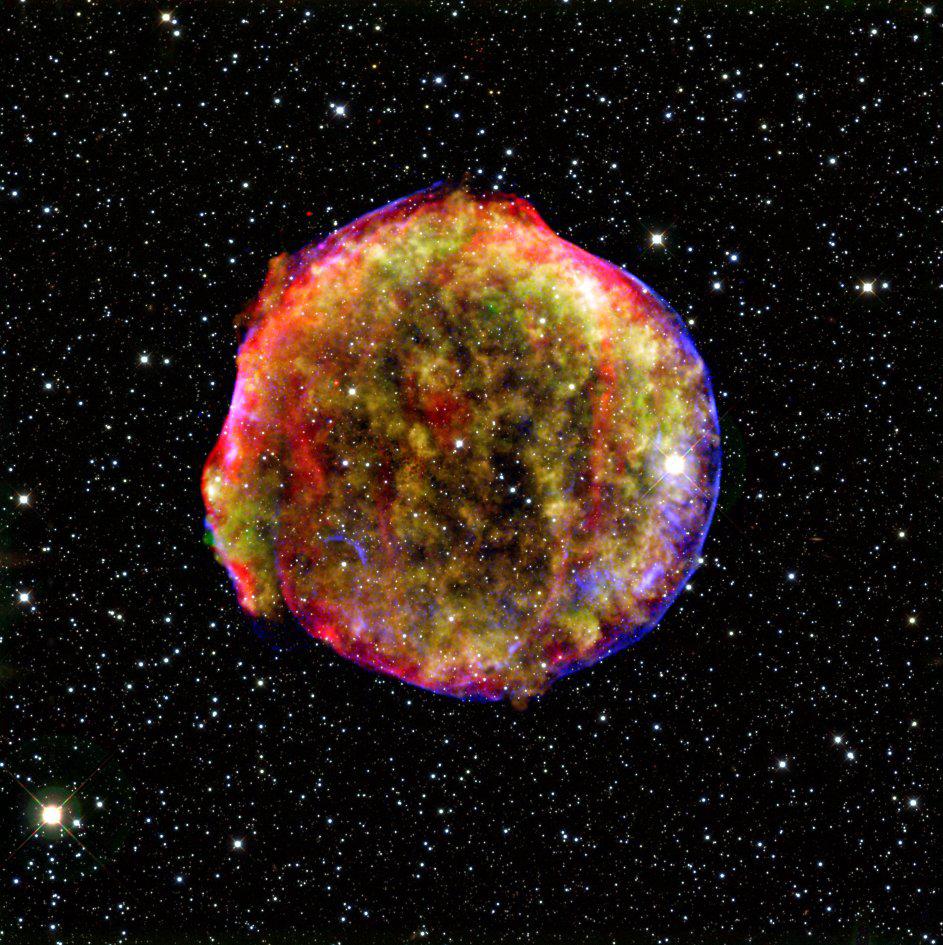
To reach farther, astronomers need something far brighter than any single star, and Type Ia supernovae fit the need almost perfectly. These explosions occur when a white dwarf star — the dense, burned-out core left behind by a Sun-like star — accumulates enough mass, typically by pulling material from a companion star, to approach the Chandrasekhar limit of about 1.4 solar masses, at which point it detonates in a runaway thermonuclear explosion. Because that triggering mass is close to universal, the resulting explosions reach very similar peak brightness — closer to standard after a well-established brightness-versus-fade-rate correction (the Phillips relation) is applied, which can pin down relative distances to about 7% accuracy. The key calibration trick, per ESA, is finding galaxies close enough to contain both measurable Cepheids and a Type Ia supernova; the Cepheid distance calibrates the supernova's true brightness, and that calibration can then be applied to any Type Ia supernova found anywhere, including in galaxies billions of light-years away where no individual star, Cepheid or otherwise, could ever be resolved.
Rung four: redshift and the expanding universe
The final rung doesn't measure distance directly at all — it measures velocity, and converts that to distance using the relationship discovered independently by Georges Lemaître and Edwin Hubble in the late 1920s. As the universe expands, light from a distant galaxy is stretched to longer, redder wavelengths in transit, an effect called redshift that grows larger with distance. By calibrating that relationship against a couple hundred galaxies with both a known Type Ia supernova distance and a measured redshift, astronomers derive the Hubble constant — the universe's current expansion rate — and can then use redshift alone to estimate distances to galaxies so far away that no other rung of the ladder could ever reach them.
Where the ladder cracks: the Hubble tension
This is where the ladder gets genuinely contentious. The Hubble constant can be measured two ways: by climbing the distance ladder from Cepheids and Type Ia supernovae in the local universe (yielding roughly 73 km/s/Mpc), or by working backward from the cosmic microwave background — the relic radiation from 380,000 years after the Big Bang — using the standard cosmological model (yielding roughly 67.4 km/s/Mpc). Those two answers disagree by about 9%, at better than 5-sigma statistical confidence, a discrepancy known as the Hubble tension. For years, the leading suspect was some unrecognized systematic error in the distance-ladder side — perhaps crowded star fields subtly biasing Cepheid brightness measurements. The James Webb Space Telescope was specifically used to re-observe over a thousand Cepheids and rule that explanation out at high confidence, which means the tension isn't a measurement mistake so much as a real crack in either the local calibration chain or the standard model of cosmology itself. We've covered the tension and its implications in more detail in our pieces on why cosmology's numbers don't agree and the distance-ladder methods behind the dispute.
Why It Matters
The distance ladder is a case study in how science handles a problem too big to solve in one step: break it into rungs, calibrate each one against the last, and accept that any error introduced low on the ladder propagates all the way to the top. That's exactly why the Hubble tension is taken so seriously rather than dismissed as noise — if a subtle bias exists anywhere between parallax and redshift, it would quietly distort our estimate of the universe's age, size, and fate. Ruling out Cepheid crowding with Webb didn't close the case; it narrowed the suspects to either new physics beyond the standard cosmological model or a systematic error nobody has found yet, and either answer would be a genuinely significant result. The next rungs of resolution — more Webb Cepheid data, independent distance methods like gravitational lensing time delays, and better CMB constraints — are actively being built now, which makes this a rare case in cosmology where the open question is not abstract but is actively narrowing in real time.
Sources
- Cosmic distance ladder — ESA Science & Technology
- Cosmic distances — ESA Gaia mission
- Measuring stellar distances by parallax — ESA Gaia
- JWST Observations Reject Unrecognized Crowding of Cepheid Photometry as an Explanation for the Hubble Tension at 8σ Confidence — The Astrophysical Journal Letters
- A Harvard 'computer' cracked the mystery of stellar distances — Cosmic Herald
