
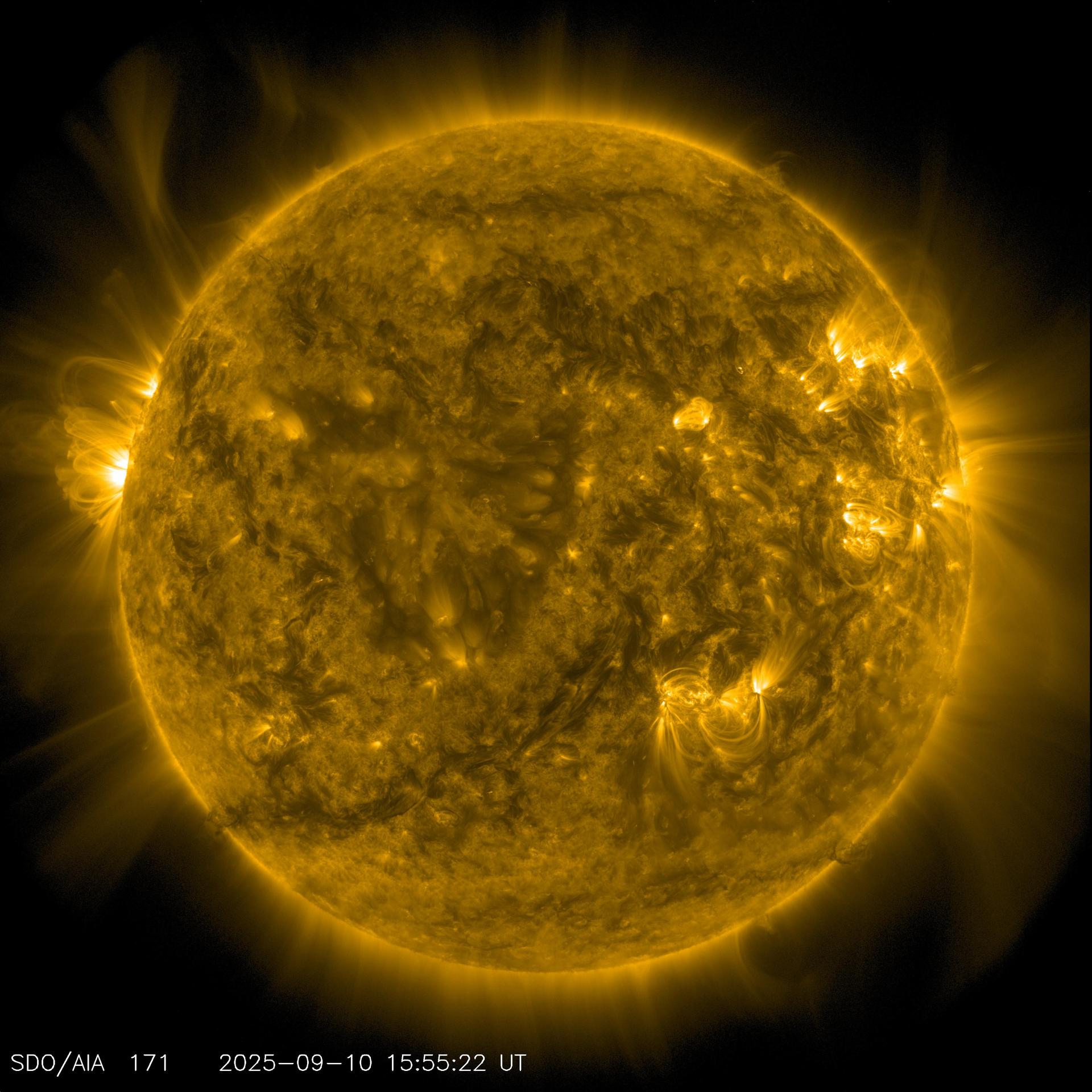
For decades, the Sun has had a silver problem. Weigh the element in a primitive meteorite and you get one number. Read it off the Sun's spectrum and you get another — about 0.25 dex lower, a factor of roughly 1.8. That is a large gap for two objects that condensed out of the same cloud of gas and dust 4.6 billion years ago and should, in principle, carry the same chemical fingerprint.
A paper from Uppsala University, announced July 17, 2026 and accepted for publication in Astronomy & Astrophysics, argues the discrepancy was never really about the Sun. It was about how we were reading it. Lead author Sema Caliskan and colleagues built the first Ag I non-LTE model atom — a comprehensive three-dimensional, non-local-thermodynamic-equilibrium treatment of neutral silver — and applied it to the solar spectrum. The result: a recommended solar silver abundance of 1.15 ± 0.08, an increase of 0.19 dex over the current reference value. In plain terms, the Sun holds about 55% more silver than the accepted number said it did — and the gap with meteorites collapses from 0.25 dex to 0.06 dex.
No new observations were required. The spectral lines were already there. What changed was the physics standing between the light and the number.
What Was Actually Wrong
Measuring an element in a star means measuring the depth of the dark absorption lines it carves into the spectrum. Deeper line, more atoms. The arithmetic is straightforward; the modeling is not, because the depth of a line depends on the state of the gas that produced it — its temperature, its motion, and the way its atoms are being knocked around by radiation and collisions.
Classical abundance work leaned on two convenient simplifications. The first treats the solar photosphere as a smooth, static, one-dimensional layer cake. The real photosphere is nothing of the sort: it is a boiling convective surface, with hot gas rising in granule centers and cooler material sinking in the lanes between them, all of it Doppler-shifting the line profiles. The second simplification, local thermodynamic equilibrium, assumes the atoms populating each energy level are distributed as a single local temperature dictates. In the tenuous upper photosphere, that assumption breaks — the radiation field itself pumps atoms between levels, and the level populations depart from what the local temperature would predict.
As Universe Today's Mark Thompson framed it, earlier calculations overlooked entirely the fact that light itself affects the very atoms producing those absorption lines, while the revised model also accounts for the genuinely turbulent, dynamic nature of the Sun's outer layers. The Uppsala team handled both, applying its model atom to the solar Ag I resonance lines at 328 and 338 nanometers, where coupled 3D and non-LTE effects produce severe positive abundance corrections. That is the entire story of the missing silver: a modeling deficit, not a solar one.
Building an Atom From Scratch
Running non-LTE radiative transfer requires something the LTE shortcut lets you skip: a detailed model atom. You need to know, for every relevant energy level and transition, how readily silver absorbs and emits photons, and how often collisions with the surrounding gas shuffle its electrons between levels. For silver, that data simply did not exist at the quality the calculation demanded, so the team computed it — building the model atom from carefully curated radiative and collisional data.
Oscillator strengths — the quantum-mechanical measure of how strongly a given transition couples to light — were newly computed with an ab initio multi-configurational Hartree-Fock method. Inelastic collision rates with neutral hydrogen were derived using a combined asymptotic and free-electron model approach. The authors describe the resulting construction as an ab initio model: it starts from quantum mechanics rather than from empirical fudge factors, which is what lets them claim the improvement is physical rather than fitted.
To their credit, the team also ran targeted sensitivity tests to find out which input the answer leans on hardest, and reported the uncomfortable answer: the hydrogen collision data. Those rates remain the dominant modeling uncertainty. This is a well-known soft spot in non-LTE stellar spectroscopy generally, and flagging it is more useful than burying it — it tells the next group exactly where to push. The calculations ran on Tetralith, the Swedish supercomputer at the National Supercomputer Centre at Linköping University.
Why It Matters
Start with the obvious: the Sun is astronomy's ruler. Abundances in other stars are routinely quoted relative to solar values, which means a systematic error in a solar number propagates silently into everything measured against it. "The new knowledge about the sun's composition is important for the understanding of other stars, planets and cosmic material, because the sun is one of astronomy's key reference points," Caliskan said. When the ruler is off by 55% for a given element, so is every measurement taken with it.
Then there is the nucleosynthesis question. Silver is an important light neutron-capture element whose stellar abundances help constrain the origin of the weak r-process — a channel whose astrophysical site and yields remain contested. Abundance measurements are the observational constraint on those models, and a 0.19 dex shift is not cosmetic; it moves the target the theorists are aiming at.
The result also feeds a long-running argument about the Sun-CI abundance versus condensation temperature trend — essentially, whether the Sun and the most primitive meteorites differ in ways that depend on how easily each element condenses out of a cooling gas. Silver is a moderately volatile element in CI chondrites, which makes it a useful diagnostic for exactly that debate, and apparent trends in the relationship are only as trustworthy as the abundances underlying them. The authors note that the residual 0.06 dex offset is consistent with recent results for other moderately volatile elements — silver no longer stands out.
There is a broader methodological lesson worth stating plainly. Only about 1.5% of the Sun's mass consists of elements heavier than hydrogen and helium — the carbon, iron and silver that make up planets and people. Pinning down that 1.5% is not a rounding exercise; it is the foundation of stellar and planetary chemistry. And this particular correction arrived through better theory applied to existing data, with the expensive part being supercomputer time rather than telescope time. When a longstanding discrepancy resolves that way, it is a reminder that some of the most stubborn observational puzzles are really unexamined assumptions wearing a disguise.
Next: The Rest of the Galaxy
The obvious follow-up is to point the same machinery at other stars, and the paper says so directly: in subsequent work, the model will be applied to determine 3D non-LTE silver abundances in metal-poor dwarfs and giants, enabling improved constraints on Galactic chemical evolution and weak r-process nucleosynthesis. "By studying the light of stars of different types and ages, we hope to understand where silver is formed in the universe and how it has been distributed throughout the Milky Way over time," Caliskan said.
Whether a correction of similar magnitude shows up in those stars is an open question — the Sun is the benchmark test for this model atom, not the end of its use. Silver abundances measured across galactic history under LTE assumptions may need the same revisit the Sun just got.
The paper was submitted May 6, 2026, and runs 11 pages with 9 figures and a single table. A single table, for a number that had been low by a factor of about 1.5 for decades.
Sources
- Ag I model atom and the 3D non-LTE solar silver abundance — Caliskan et al., arXiv (accepted, Astronomy & Astrophysics)
- Sun Holds More Silver Than Thought — Mirage News (Uppsala University release, July 17, 2026)
- The Case of the Sun's Missing Silver — Mark Thompson, Universe Today
- Sun holds 55% more silver than estimated, new model reveals — Phys.org
- Journal version — Astronomy & Astrophysics, DOI 10.1051/0004-6361/202659578
