
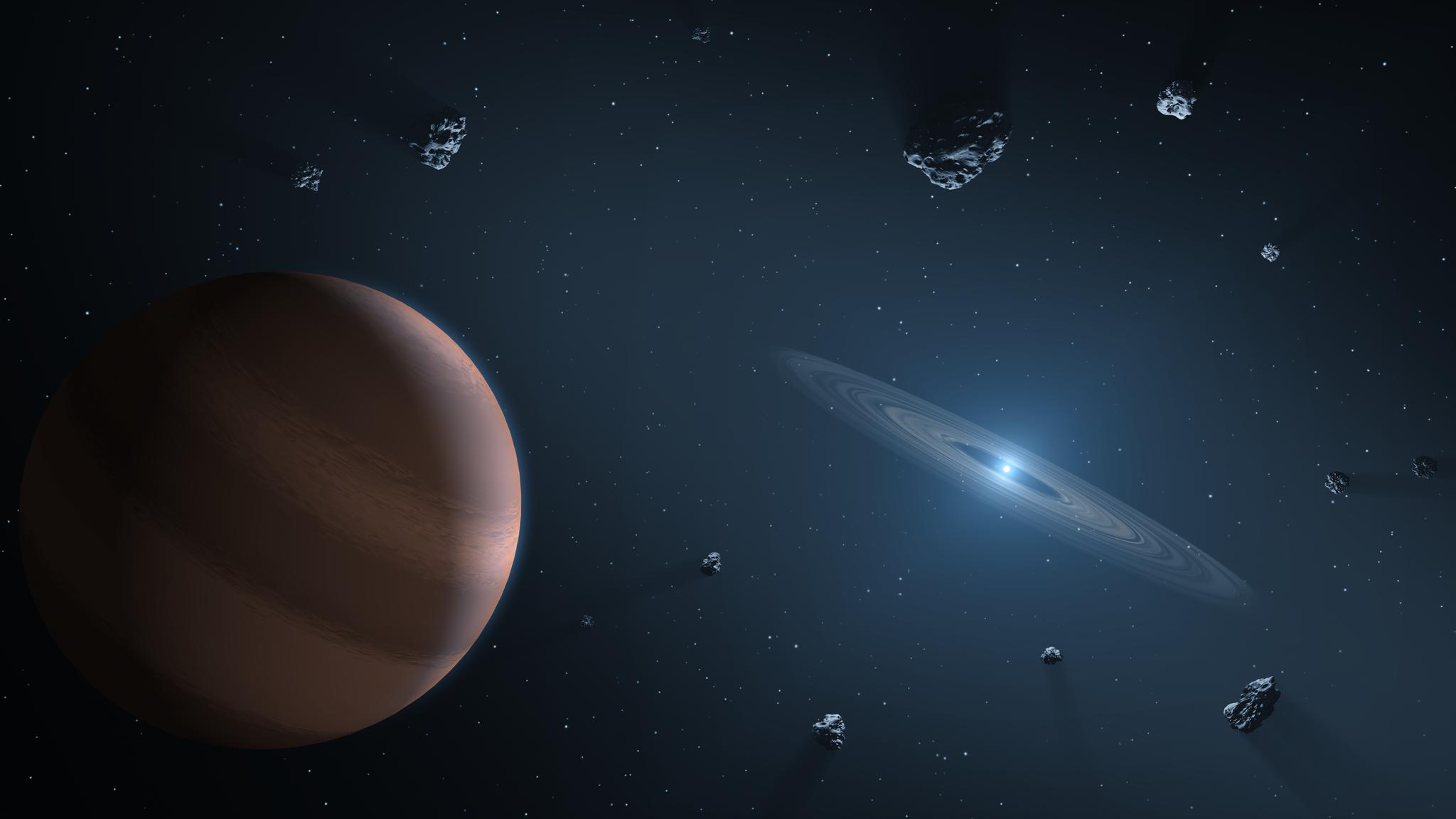
White dwarfs are cosmic garbage disposals. When a star like the Sun exhausts its fuel and collapses into an Earth-sized ember, its surviving asteroids and shattered planetary leftovers occasionally wander too close, get torn apart by tidal forces, and rain down onto the stellar surface. Heavy elements should sink out of sight almost immediately in that crushing gravity — so when astronomers see iron, magnesium, or calcium sitting in a white dwarf's atmosphere, they know something fell in recently. Those "polluted" white dwarfs are the only place in astronomy where you can read the bulk chemistry of an exoplanetary system directly, element by element.
Which raises a question that sounds like science fiction but reduces, in practice, to statistics: if a civilization ever built anything on those planets, would the wreckage look different?
A team led by Bo-Lun Huang of Beijing Normal University, with co-authors Zhen-Zhao Tao and Tong-Jie Zhang, decided to find out. Their paper, A Calibrated Bayesian Search for Potential Chemical Technosignatures in Polluted White Dwarf, was posted to arXiv on May 28, 2026, has since been published in The Astrophysical Journal, and was featured by AAS Nova on July 15 — the moment the work moved from preprint to the field's shared conversation.
The idea: industry leaves a chemical accent
Natural rock has a chemistry set by physics and geology. Refined metal does not. Smelting, alloying, and industrial concentration pull particular elements out of ore and pile them up in proportions that no asteroid produces on its own. If a debris field contained a meaningful mass of processed material — structural steel, say, rather than chondrite — the fingerprint would be an enrichment in siderophile ("iron-loving") elements: iron, nickel, chromium, and manganese, in a template that is metal-rich and silicate-poor.
That is the hypothesis Huang and colleagues tested. Not "is there a Dyson sphere," but something far more tractable: does the accreted material's composition sit better under a natural model or a partly-processed one?
The trick is that "natural" is not a single number. Meteorites vary enormously. So the team's first move was to nail down the null hypothesis with real data, fitting a multi-modal natural-composition reference to 3,493 whole-rock meteorite analyses. That calibration is the quiet backbone of the whole paper — it means the natural model isn't a theorist's guess about what rock should look like, but an empirical map of what rock actually does look like across the Solar System's leftovers.
Against that reference they set a second model: natural material mixed with a fixed siderophile-enriched template, parameterised by a calcium-normalized mixing fraction. Then they let Bayesian model comparison arbitrate. For each observed record, which story explains the numbers better, and by how much?
What 697 records had to say
The team ran that comparison across 697 star-paper abundance sets, spanning at least 397 distinct objects once Gaia-designated repeats are consolidated — effectively the accumulated published record of white dwarf pollution measurements. The answer, stated plainly, is no.
Just 8 of 697 photospheric records produced a Bayes Factor above 10 — the conventional threshold for "strong" evidence favoring one model. Only 4 of 697 cleared a Bayes Factor of 100. In a diffusion-adjusted steady-state subset of 148 records spanning at least 94 objects (correcting for how fast different elements sink out of the visible atmosphere, which distorts the raw abundances), 6 of 148 passed the BF > 10 bar.
The population-level numbers are even more deflating for anyone hoping for a headline. Here it is worth being precise about what was actually measured: the authors inferred the fraction of records that detectably favor the mixture model — not the fraction of processed material sitting in the debris. That quantity came out with a posterior median of 0.011 for the photospheric compilation and 0.041 for the diffusion-adjusted subset. Roughly one to four percent of records, and those are records where the mixture model is merely detectably preferred — not confirmed. Consistent with a universe of ordinary rock.
The AAS Nova write-up puts the conclusion the same way: strong statistical support for technological processes proved uncommon. As it summarizes the result, the work "didn't dredge up firm evidence for technological activity," but "provides a jumping-off point for future searches."
The outliers are not a detection — and the authors don't pretend otherwise
The paper does report its highest-evidence candidate records. It would be easy to name them, gesture at them, and let the press do the rest. The authors decline.
A Bayes Factor above 10 in eight cases out of 697 is roughly what you would expect from a large survey with heterogeneous data quality, measurement systematics, and astrophysical processes nobody has modeled yet. Polluted white dwarfs already have known natural routes to weird iron and nickel numbers — accreting the differentiated core of a shattered planet, for instance, concentrates exactly the siderophile elements an industrial template predicts. Nature has its own smelter: planetary differentiation. The framework flags anomalies. It does not adjudicate their cause.
The paper is also candid about its resolution limit. The team calibrated the analysis with end-to-end injection-recovery experiments matched to each record's element coverage and censoring. That calibration showed discrimination is driven mainly by chemical information, and that decisive support typically requires roughly five or more detected elements. Below that, the data simply cannot tell the hypotheses apart — which quietly disqualifies a large share of existing measurements from carrying any weight at all. AAS Nova makes the same point: records with many definitive element detections outperformed those carrying only upper limits.
Nor is it just the count of elements that matters — it's which ones. For the siderophile template, discrimination is strongest for exact five-element panels containing iron, magnesium, chromium, and titanium, together with one of nickel, silicon, or sodium. That is a useful shopping list. It tells observers exactly which lines are worth fighting for in the next spectrum.
Why It Matters
The result here is a null. The contribution is a method.
Most technosignature searches are hunting for signals someone is broadcasting — radio, laser pulses, waste heat. All of them share a weakness: they require the civilization to be present, and doing something detectable, right now. Chemical technosignatures in white dwarf debris invert that. Refined metal doesn't need a transmitter or a maintainer. It sits in the rubble long after everything else is gone, and when the rubble falls into the star, it announces itself in the spectrum. This is, in principle, an archaeological search rather than an eavesdropping one.
What Huang and colleagues have built is the piece that was missing: a calibrated, quantitative test with a defensible null hypothesis. Anchoring "natural" to 3,493 real meteorite analyses converts a vague intuition — that composition looks funny — into a Bayes Factor that other researchers can reproduce, dispute, and recalibrate. It also produces a falsifiable population-level constraint. In the authors' own framing, the results constrain the detectable incidence of the tested processed-composition class in current data. That is now a number on the board. Future work has to beat it, not just talk past it.
And the five-element requirement is a concrete instruction to observers. It says: the bottleneck isn't the idea, it's the spectra. The paper explicitly sets observational requirements for future multi-element surveys and expanded template families — deeper observations of known polluted white dwarfs, with more elements pinned down per object, are what move this from a curiosity to a real constraint.
There's a broader point about how SETI-adjacent work should be done. This paper's most valuable move was making its own hypothesis hard to confirm — building the natural model carefully enough that it could win, and reporting honestly when it did.
Nobody found alien industry in the ashes of dead stars. But the field now has a tool that could recognize it, and knows what it would need to see. In a search that has produced far more press releases than measurements, that is worth more than another maybe.
