
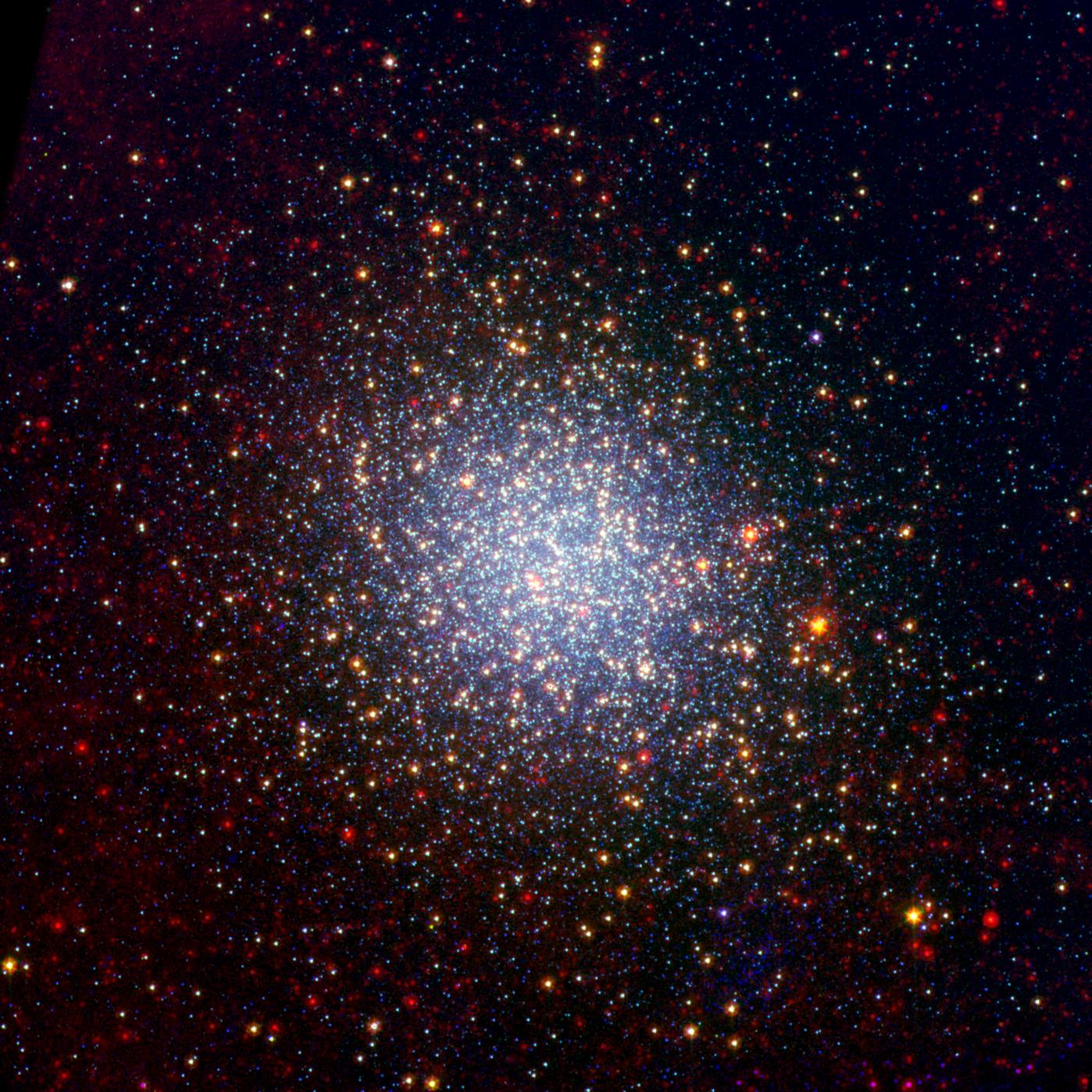
Omega Centauri has a reputation problem. The Milky Way's largest globular cluster packs roughly 10 million stars into a dense, ancient stellar swarm, and for decades theorists have insisted it should be riddled with black holes — the collapsed remnants of the massive stars that lived fast and died young in that crowd. Models put the number at somewhere around 10,000. The observed number, until this week, was zero.
That changed on July 13, 2026, when a team led by Matthew Whitaker of the University of Utah announced the first confirmed stellar-mass black hole inside Omega Centauri, cataloged as oMEGACat BH-2. The discovery, published in The Astrophysical Journal Letters, didn't come from a single dramatic image. It came from patiently watching one star wobble for more than twenty years.
How do you spot a black hole that emits no light?
You don't look for the black hole. You look for what it's doing to something you can see.
oMEGACat BH-2 has a companion star weighing about 0.78 solar masses — smaller than the Sun, ordinary in every way except its choice of neighbor. The two objects orbit a common center of mass, and because the black hole itself is invisible, that companion star traces a tiny, repeating loop against the sky as it swings around its unseen partner. Detecting that loop required stitching together more than two decades of archival Hubble Space Telescope imaging of Omega Centauri with new near-infrared observations from the James Webb Space Telescope, then measuring the star's position with enough precision to catch a wobble smaller than a pixel.
"The precision of these measurements is incredible, down to a fraction of a pixel on Hubble and Webb's detectors," Whitaker said. That precision is what let the team separate a real orbital signal from the noise of a crowded, 12-billion-year-old star field roughly 18,000 light-years away.
A surprisingly light, surprisingly patient black hole
Two numbers make oMEGACat BH-2 stand out even among the small handful of black holes ever measured this way. Its mass — 4.46 times that of the Sun — is heavy enough that it can't be a neutron star, yet researchers note it's actually much lower than they would expect for a black hole formed in a metal-poor environment like Omega Centauri, where more massive stellar remnants are typically predicted. And its orbital period, 94 years, is the longest ever recorded for a black hole binary. Most known black hole binaries complete an orbit in days or weeks; this one takes nearly a human lifetime.
That combination matters. A long period means a wide orbit, which means the companion star is far enough from the black hole that the system isn't losing material or energy quickly — it's essentially undisturbed, a fossil orbit preserved since not long after the pair formed. A lower-than-expected mass gives astronomers a data point that doesn't fit the simplest predictions for how stellar remnants form in a cluster like this one. Together, the two numbers give astronomers a rare, clean data point for testing models of how massive stars die and what they leave behind.
Why It Matters
Omega Centauri is already known to host an intermediate-mass black hole at its center, and understanding the cluster's broader black hole population helps astronomers understand how that central object and the cluster itself came to be. It also feeds directly into one of the biggest open questions in the field: how do intermediate-mass black holes suspected at the centers of some globular clusters actually form? Finding and characterizing the "normal" stellar-mass black holes scattered through the rest of the cluster — like oMEGACat BH-2 — is the first step in testing theories about that process, because you need to know what the raw material looks like before you can judge whether it's assembling into something bigger.
There's also a broader payoff for gravitational-wave astronomy. As the research team has noted, understanding how black holes form and how they end up in binaries is vital to interpreting gravitational-wave events detected elsewhere — but those detections can't tell astronomers much about the quiet, isolated black holes that never merge, the ones just orbiting a star for tens or hundreds of thousands of years. Astrometric detections like this one are one of the only ways to find those objects and measure their masses directly, filling in the population statistics that gravitational-wave data alone can't provide. With models predicting thousands more black holes hiding in Omega Centauri, oMEGACat BH-2 is likely to be the first of many rather than a one-off curiosity.
What comes next
The method that found oMEGACat BH-2 — long-baseline Hubble astrometry cross-checked against Webb's infrared sensitivity — is now a proven recipe, and the same archival Hubble dataset covers the rest of Omega Centauri's crowded core. Researchers already have the raw material to hunt for more wobbling stars; it's a matter of combing through the data. Given that models predict on the order of 10,000 black holes lurking in the cluster, the discovery announced this week reads less like an ending and more like a proof of concept — the first confirmed detection in a search that has, until now, come up empty for decades.
