
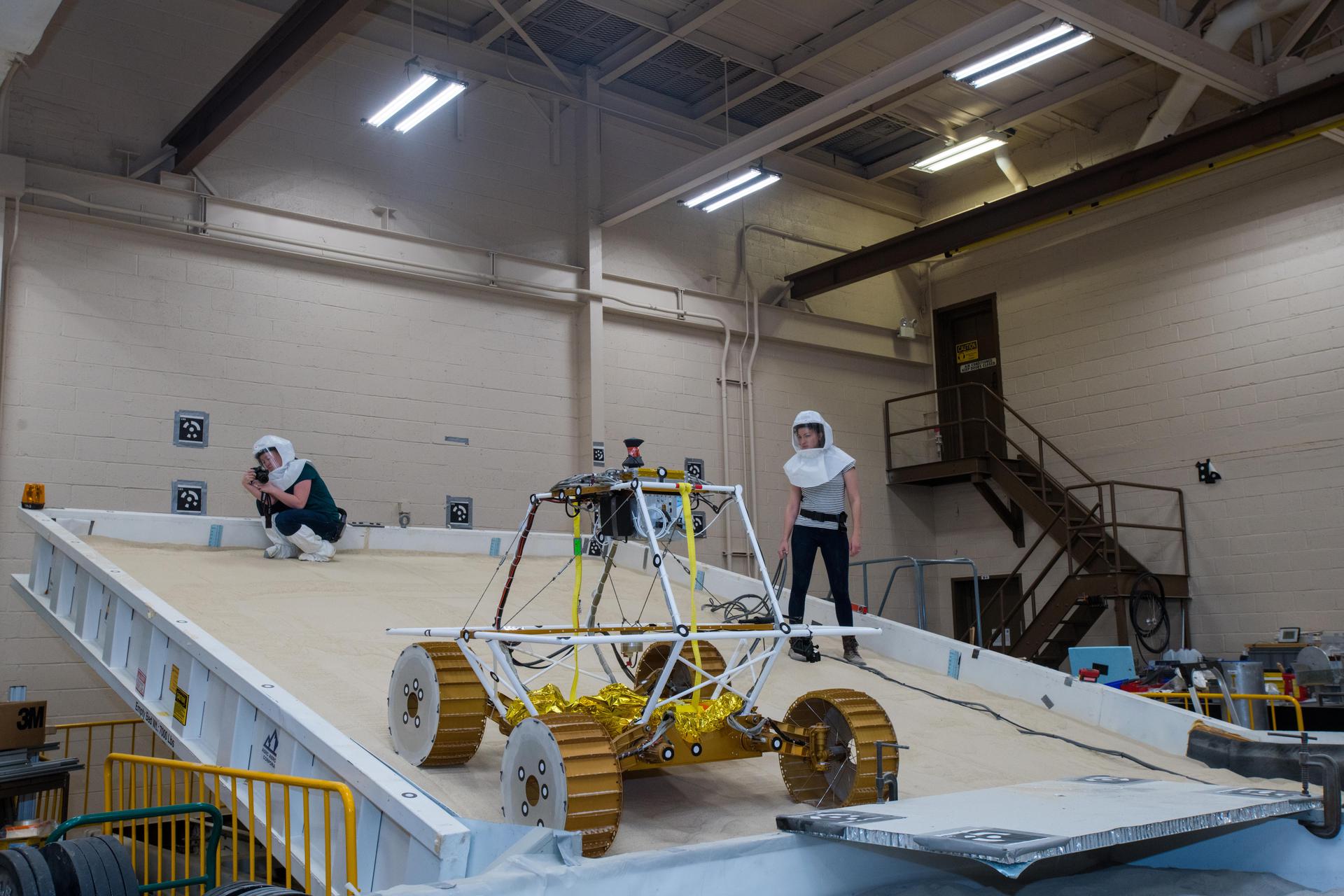
NASA's lunar surface plans include a lot of wheels. In an Oct. 20 progress update from its Moon Base Program, the agency gave status reports on three separate rover efforts: VIPER, a robotic prospector that is finished and in final testing, and two crewed lunar terrain vehicles (LTVs) from Astrolab and Lunar Outpost that are about to move from concept to committed design.
"Lunar rovers are central to our surface mobility strategy," said Robert Pickle, director of the Surface Mobility Office in the Moon Base Program. The update mostly backs that up with dates: design reviews this fall and winter, tire tests in the coming weeks, and flight hardware due by the end of 2027.
VIPER: Built and Waiting for a Ride
The most advanced of the three is VIPER, which NASA says is fully built at Johnson Space Center in Houston and in final testing before it moves to Kennedy Space Center in Florida. The rover is scheduled to launch in 2027 to the lunar South Pole aboard a Blue Moon Mark 1 lander. Once on the surface it is expected to cover more than 18 miles (30 km), with mission operations run from NASA's Ames Research Center in California.
That ride is new. A February 2025 release from Astrobotic noted that its Griffin Mission One was originally set to carry VIPER under NASA's Commercial Lunar Payload Services (CLPS) program. VIPER now goes on Blue Origin hardware, and Griffin's cargo bay holds a different rover (more on that below).
The Crewed Rovers: Two Designs, One Set of Requirements
NASA has awarded LTV task orders to two companies, Astrolab and Lunar Outpost. Blue Origin has separately been awarded delivery of LTVs to the south pole by 2028 through CLPS. The capabilities NASA described give a good picture of what these vehicles are supposed to do:
- Remote driving: up to 3.7 miles (6 km) per day, operated from Earth before crew arrive
- Crew support: up to three moonwalks per Artemis mission
- Cargo: up to 176 pounds (80 kg) of lunar samples and tools
- Range: up to 6 miles (10 km) on a single battery charge
- Cold environment: NASA wants data on how well the vehicles preserve energy and function when driving in and out of permanently shadowed regions, which can reach minus 334 degrees Fahrenheit (minus 203 degrees Celsius)
The remote-driving requirement matters most. A rover that astronauts use for only a few days per mission would sit idle for most of its life. Driving it from Earth between crews makes it a scouting and science platform that works year-round, not a parked car.
The two companies are at different points. Astrolab has already put astronauts on a mockup of its CLV-1 design during evaluations at Axiom Space. Lunar Outpost's preliminary design review (PDR) is scheduled for this month, and Astrolab's PDR is expected by the end of December. In the coming weeks, both companies will test wheels and tires at NASA's Glenn Research Center in Cleveland. NASA says both companies are on schedule to deliver flight-ready hardware at the end of 2027.
A PDR is where a design stops being a set of ideas and becomes a baseline the agency agrees can meet requirements. If both reviews land on schedule, NASA will have two completed preliminary designs for crewed rovers within about two months. Lunar Outpost also has more lunar flying ahead: NASA says the company's second MAPP rover is scheduled to launch in early 2027.
FLIP: A Supercomputer Scout
Astrolab's nearer-term mission is FLIP, short for FLEX Lunar Innovation Platform. It is an uncrewed rover that the NASA update says will fly on Griffin Mission One in late 2026. According to Astrobotic's 2025 announcement, the Griffin lander will deliver FLIP to the Nobile Region near the lunar south pole. That announcement targeted the end of 2025, and the date has since slipped about a year.
FLIP's payload is unusual. Space.com reports that the rover will carry Hewlett Packard Enterprise's Spaceborne Computer-4, a fanless system with a low-power 64-bit CPU, a GPU, and KIOXIA solid-state drives. Space.com describes it as the first time high-performance computing and AI will be tested on the lunar surface. At an Oct. 14 media event in Hawthorne, California, Astrolab CEO Jaret Matthews described the mission as delivering the first GPU and the first AI experiments to the Moon. HPE says an AI services container aboard will demonstrate deploying scalable AI services on the lunar surface.
Space.com reports that Matthews said the design must last a full year on the surface. That means surviving multiple lunar nights, each upwards of 150 hours of complete darkness without energy or warmth from the sun.
Why It Matters
For years, lunar surface mobility has been a story of individual vehicles. The program NASA described this week is built around a dedicated Surface Mobility Office within the Moon Base Program, a robotic prospector, two commercial crewed-vehicle designs, and a commercial delivery contract, all aimed at the same region near the south pole.
The pieces connect. VIPER is meant to gather information on the thermal, lighting and terrain environment of the South Pole region, and the LTVs are meant to collect data on driving in and out of permanently shadowed regions that can reach minus 334 degrees Fahrenheit. Precursor missions such as FLIP test whether hardware, including modern processors, can survive lunar nights over months instead of days. If that works, a rover could in principle process more of its own data on site, which would bear on how much autonomy future surface vehicles can have.
The schedule is the part to watch. Two PDRs, a tire campaign, a VIPER shipment to Kennedy, FLIP's launch, and flight hardware by end-2027 all need to happen roughly on time to support LTV delivery by 2028. Each of these milestones is close enough that readers will know within months whether the plan is holding.
