
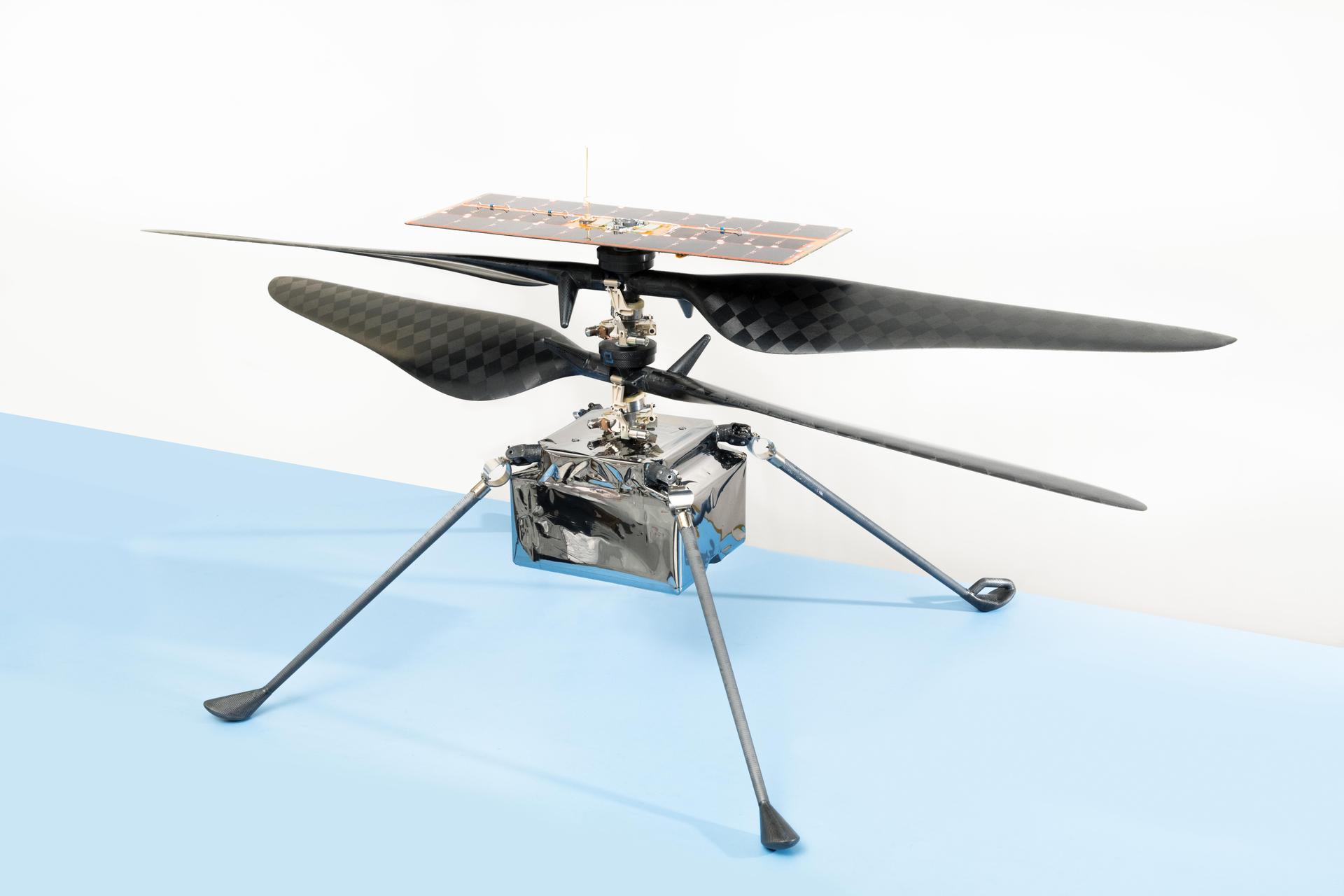
Flying on Mars means flying in an atmosphere so thin that a rotor blade spends its whole life near the edge of what aerodynamics allows. Ingenuity proved it could be done. A NASA-led team now says a rotor that flies much better is possible, and the gain is large. In simulations, a new airfoil called roamx-0201 could push the range of a single uninterrupted flight from Ingenuity's 0.7 kilometers to as much as 18.7 kilometers, with science instruments on board.
The work comes from researchers at NASA's Ames Research Center, working with Imperial College London and Nagoya University, with wind tunnel testing done at Tohoku University in Japan. The findings were published Sept. 22 in an AIAA journal. NASA is careful to say the design is not yet ready for Mars, but it sets a direction for the rotorcraft that come after Ingenuity.
A blade cut down to almost nothing
The airfoil is the cross-section of the blade, the shape that turns rotation into lift. Ingenuity used one called CLF5605. According to Imperial College London, that profile is a 5 percent thick, cambered, tear-drop shape used on the outer half of Ingenuity's blades. NASA describes the traditional Ingenuity blade as having a more rounded shape.
roamx-0201 looks different. Imperial describes it as a 1 percent thick unconventional design optimized for Mach 0.60 and a Reynolds number of 20,000, conditions representative of Mars rotor operation. That makes it a fifth of the thickness of Ingenuity's section, and NASA describes it as thinner and asymmetrical. NASA says researchers designed it using advanced simulations and algorithms tuned to Mars conditions, and that its blade tips can operate longer at higher speeds before running into trouble.
NASA says the new profile does better on two failure modes that limit rotor performance: drag divergence, where performance drops suddenly as the rotor approaches the speed of sound (which is lower on Mars than on Earth), and stall, the aerodynamic condition in which performance drops sharply and flight becomes unstable. NASA says Ingenuity's blades degraded steeply at stall, while under the conditions studied roamx-0201 showed significantly improved stall behavior. That means future helicopters could operate safely at a wider range of flight angles.
The team also built in something that sounds counterintuitive. The airfoil deliberately disrupts the boundary layer, the thin region of air flowing next to the surface, at the leading edge. NASA says that disturbance pulls the blade upward and helps lift the rotorcraft more effectively than earlier designs. Disturbing the flow there adds lift rather than costing it.
What the numbers say
A companion study, posted to arXiv as a computational and experimental comparison of the two airfoils, lays out the head-to-head. The authors, including Lidia Caros, Witold Koning, Peter Vincent and Oliver Buxton, compared CLF5605 and roamx-0201 at a Reynolds number of 20,000 and Mach 0.60, across a range of angles of attack. They used three independent methods: NASA's OVERFLOW code running implicit large-eddy simulations, the PyFR code running direct numerical simulations, and physical tests in Tohoku University's Mars Wind Tunnel.
The results agree in direction. Across all three methods, roamx-0201 achieves a given amount of lift with less drag than Ingenuity's airfoil. The OVERFLOW and PyFR results also show superior stall characteristics and a maximum lift about 20 percent higher. The paper's abstract says the work provides a strong body of evidence to support further studies of rotors based on the new airfoil for future Mars helicopter missions.
Producing the same lift with less drag is the kind of efficiency gain that could matter for range, and NASA's mission-level simulations put the single-flight distance at as much as 18.7 kilometers, against Ingenuity's 0.7. That figure is a best-case projection from modeling, though, not a flight-tested result.
Testing Mars air on Earth
The wind tunnel campaign matters because NASA says tests like these help engineers understand and resolve discrepancies between computational predictions and real-world performance. Per Imperial's account, the Tohoku facility is housed within a vacuum chamber and can replicate the low-pressure, low-density conditions of Mars at high subsonic Mach numbers. The tests swept both airfoils through angles of attack from -2 to +6 degrees, representative of hovering conditions for Martian rotorcraft. The team measured forces with a lift/drag balance, mapped surface pressures with pressure-sensitive paint, and imaged the flow with Schlieren photography, which makes density gradients such as shock structures visible.
The collaboration has been recognized for it: the joint NASA Ames, Tohoku University and Imperial team received a second NASA Group Achievement Award for its Martian rotorcraft airfoil research. Imperial says the dataset is one of the most comprehensive of its kind and will guide the design of future Mars rotorcraft capable of greater range, endurance and payload capacity.
Why It Matters
Ingenuity showed that powered flight on Mars works. Its short hops also showed the limits of the first-generation design. A helicopter that can cover nearly 19 kilometers in one flight while carrying instruments would be a different kind of tool. It could scout far ahead of a rover, survey terrain no wheeled vehicle can reach, or do science on its own instead of serving mainly as a technology demonstration. Those uses are our own extrapolation from the range figure, not claims made by the researchers.
The timing matters too. NASA notes that SkyFall, a mission that will deliver three helicopters to Mars, is scheduled to launch in 2028. NASA frames the thinner, sharper blade work as aimed at missions after SkyFall, and says roamx-0201 is not ready for the Red Planet yet, so it is not a component already headed for SkyFall. It is the kind of groundwork that could decide how capable those later rotorcraft become.
The bigger lesson is that there may be a lot of room to improve Martian flight. A section designed from the start with algorithms tuned to Mars conditions, then checked against two kinds of high-fidelity simulation and a purpose-built wind tunnel, reaches about 20 percent higher maximum lift than Ingenuity's airfoil in the simulations. Big gains in range may come from rethinking the basic blade shapes, not only from bigger batteries or lighter frames.
Sources
- NASA Experimental Mars Helicopter Blade Designs Target Longer Flights (NASA, Oct. 20, 2026)
- Computational and Experimental Comparison of CLF5605 and roamx-0201 Martian Helicopter Rotor Airfoils (arXiv:2511.14934)
- Imperial Aeronautics staff honoured with NASA award for Mars helicopter research (Imperial College London)
