
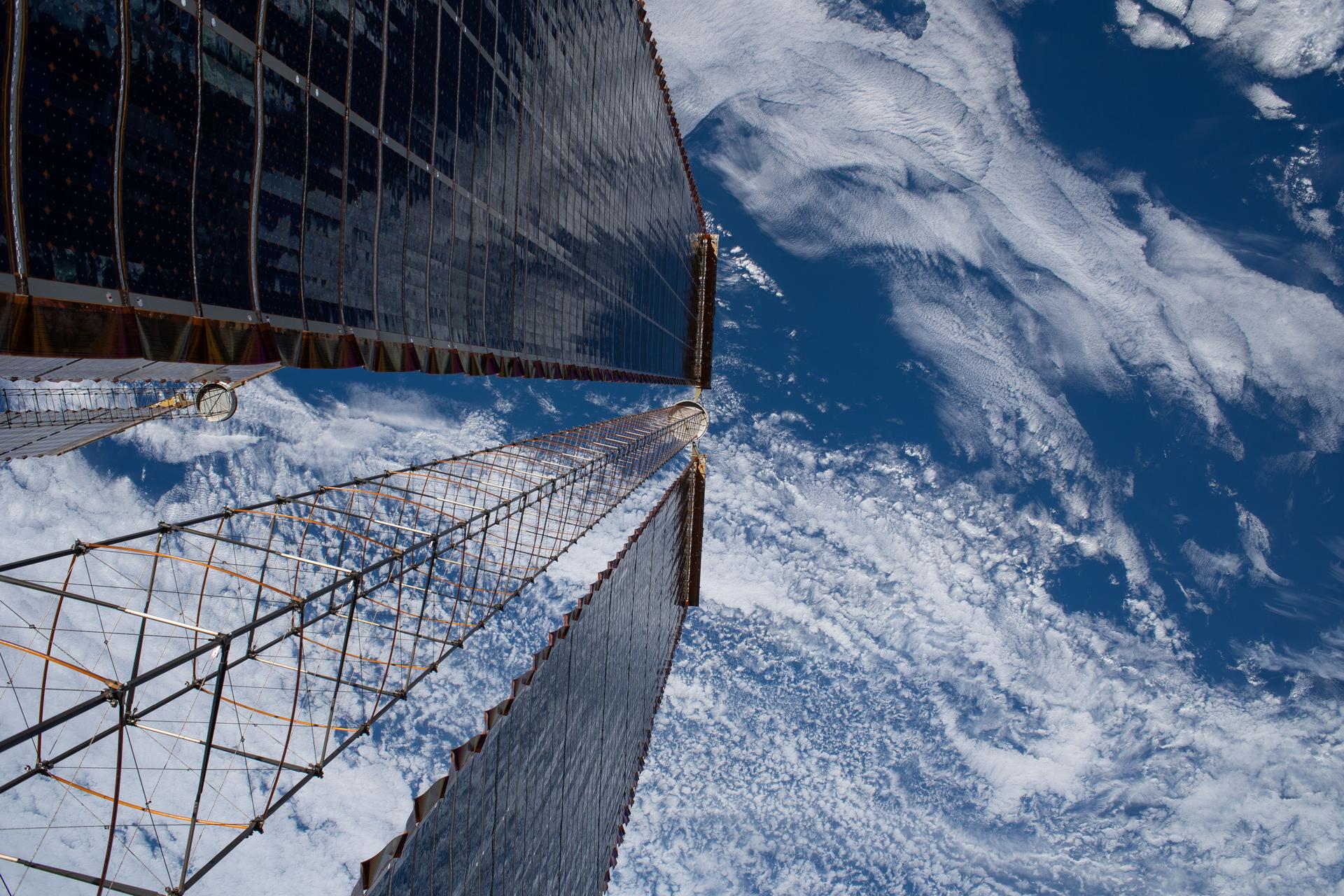
Most of the attention on SpaceX's 35th cargo run to the International Space Station went to the launch. The more important part of the mission is folded up in Dragon's unpressurized trunk: two Roll-Out Solar Array wings, the last pieces of a power upgrade that NASA has been installing on the station in stages. Installing them means two spacewalks, and NASA has scheduled a news conference to preview them.
The agency will hold a preview briefing at 2 p.m. EDT on Tuesday, Oct. 20, at Johnson Space Center in Houston. The briefers are Gaurang Patel and Garrett Hehn. The excursions are designated U.S. spacewalks 100 and 101. NASA counts them as the 285th and 286th spacewalks for station assembly and maintenance.
The delivery
The hardware left Earth at 6:33 a.m. EDT on Tuesday, Oct. 13, from Space Launch Complex 40 at Cape Canaveral, according to NASA. Space.com reported the liftoff as 6:35 a.m.; this article uses NASA's time. Dragon carried more than 6,300 pounds of supplies and science.
Spaceflight Now reported that the spacecraft, Dragon C211, separated from the Falcon 9 upper stage roughly 10 minutes after liftoff and began a two-day trip to the station. NASA scheduled an autonomous docking for 11 a.m. EDT on Thursday, Oct. 15, at the space-facing port of the Harmony module. Space.com calls the same spot Harmony's zenith port and puts the chase at about 51 hours. Menon and Kutryk, the two crew members who will later go outside, were assigned to monitor Dragon's arrival.
Dragon should stay docked for about a month. Space.com notes that most of its pressurized cargo supports Crew-13, which arrived at the station on Oct. 1. Crew-12 returned to Earth about a week after that.
What's in the trunk
The two wings were built by Redwire Space and make up the fourth and final pair of station Roll-Out Solar Arrays (which Spaceflight Now calls ROSAs and NASA calls IROSAs) bound for the station, Spaceflight Now reports. Each wing can produce more than 20 kilowatts and is designed to last more than 10 years.
The technology was first flown on the station as a demonstration in 2017, on the CRS-11 cargo mission. Patel brought up that test flight during launch coverage. Patel said that once the technology was proven, teams worked out how to attach the arrays to legacy station arrays that were not built for standard upgrades, using modification kits at non-standard interfaces.
Spacewalk 100: the 2A channel
On the first spacewalk, NASA astronaut Anil Menon and Canadian Space Agency astronaut Joshua Kutryk will leave the station through the Quest airlock and install the seventh IROSA on the 2A power channel. NASA singles out this channel as one that supports critical operations, including the station's safe controlled deorbit at the end of its life.
NASA's launch release likewise says the final pair of arrays will boost available electricity for research, operations and the station's safe, controlled deorbit. The 2A array, then, is meant to serve the station's working years and its eventual controlled descent.
Spacewalk 101: the 3B channel and the last array
On the second excursion, the same pair will install the eighth and final IROSA, this time on the 3B power channel. NASA's media advisory lists spacewalk 100 for Thursday, Oct. 29, and spacewalk 101 for Thursday, Nov. 5, a week apart. NASA says it will share additional coverage details closer to each operation.
The numbers
NASA says that with all eight roll-out arrays in place, the station's available power will rise by up to 30 percent, from 160 kilowatts to about 215 kilowatts. NASA describes the work as a power system augmentation.
The arithmetic is straightforward. The gap between 160 and 215 kilowatts is about 55 kilowatts, and NASA attributes that increase to the full set of eight arrays, not to the last two alone. Each wing is rated above 20 kilowatts, so the final two account for more than 40 kilowatts of rated capacity between them. The final stage depends on two crew members working by hand outside the station, so the briefing should be worth watching for the timeline and the contingency plans.
Why It Matters
NASA says the final pair of arrays will boost the electricity available for research and operations. Finishing the IROSA set brings the station to the roughly 215 kilowatts NASA describes, and puts the seventh array on a channel NASA ties to the station's safe, controlled deorbit.
The roll-out arrays have also had a long road to this point. They began as a 2017 demonstration on a Dragon cargo flight and are ending as the station's main power upgrade. That kind of path from test hardware to operational equipment is one of the better arguments for the station as a test bed. Spacewalks 100 and 101 should finish the job, if the hardware unrolls and connects as planned.
Sources
- NASA to Host News Conference Previewing US Spacewalks 100, 101 (NASA)
- NASA Science, Cargo Launch on 35th SpaceX Resupply Mission to Station (NASA)
- SpaceX launches NASA science and cargo to the International Space Station (Spaceflight Now)
- Watch SpaceX deliver more than 6,000 pounds of cargo to the ISS today (Space.com)
