
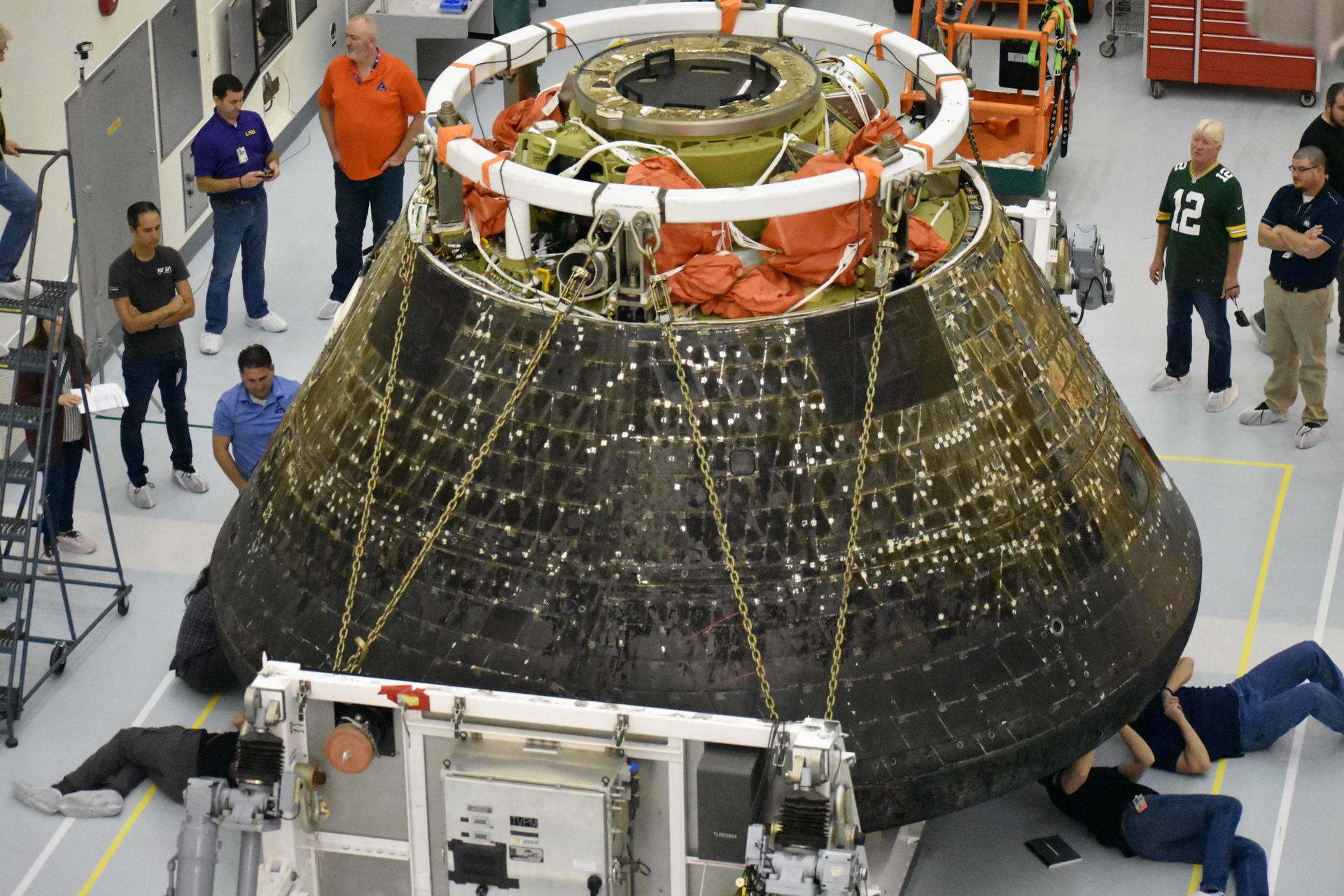
When Orion came home from Artemis II, the heat shield was the part engineers most wanted to see. The flight's trajectory had been changed because of the Artemis I findings, and what the material looked like after reentry would show whether the change worked. NASA has now published its post-flight engineering analysis, dated Oct. 15, 2026. The numbers are plain: the shield came back with nine spots of char loss. After Artemis I it had 103.
NASA says that, measured by both cracking and char loss, damage fell by a factor of ten. The agency concludes the shield performed as expected. Most of the explanation sits in a NASA technical abstract that describes what went wrong the first time.
What the Shield Went Through
Orion hit the atmosphere at 39 times the speed of sound. NASA reports external temperatures above 4,000 degrees Fahrenheit, while the cabin stayed in the mid-70s. The capsule reached its entry interface within 192 feet of the target point and splashed down 0.59 miles from the predicted site off San Diego on April 10, 2026.
That accuracy matters because the entry was deliberately different from the one Artemis I flew. According to Starlust's April coverage of NASA's first assessment, the downrange target was shortened from 2,300 nautical miles to around 1,700. The NASA technical abstract says Artemis II flew a modified trajectory with no skip entry.
The shield is built from 186 blocks of Avcoat, an ablative material designed to char and erode in a controlled way as it carries heat away from the capsule. Some charring is the point. The issue on Artemis I was char that came off in chunks rather than wearing away as designed.
The Root Cause: Gas With Nowhere to Go
NASA's technical paper, "Under Pressure: The Artemis I Heatshield Char Loss Investigation and Artemis II's Successful Entry," lays out the mechanism. The Avcoat on the Artemis I shield had low permeability. During the skip entry, gases produced inside the material built up to extreme internal pressures. With too little permeability to vent them, the pressure cracked the material and liberated pieces of char.
Investigators reproduced the effect in ground testing, according to the abstract. That is what separates a working hypothesis from a root cause, and it gave NASA two levers: change how the shield is heated, or change the material.
For Artemis II, NASA used the first lever. Removing the skip entry and shortening the downrange distance changed the heating profile the shield experienced. For Artemis III and later missions, it is using the second.
Reading the Post-Flight Evidence
The inspection started at sea. Starlust reported in April that Navy divers photographed the heat shield after splashdown, and that Wiseman of the Artemis II crew described some char loss on the shield's shoulder. Those early observations were background. The October analysis is the formal result.
According to NASA, extracting samples and running x-ray scans began in August at Marshall. NASA says the shorter allowable downrange distance limited how long the shield spent in the temperature range where the Artemis I phenomenon occurred, and credits that for the reduction. The final count of nine char-loss spots across the dish, compared with 103 on Artemis I, fits the pressure explanation: less time in that range means less gas buildup and less char liberation.
It did not go away completely, and NASA's report doesn't claim it did. Nine spots is not zero, and Starlust's April report of shoulder char loss shows some char was still shed. Still, the agency calls the result performance as expected, which fits a mitigation designed to reduce the problem rather than remove it.
The backshell, covered in 1,300 ceramic tiles, showed no signs of overheating, NASA reports.
Why It Matters
Artemis II carried a crew on a heat shield whose flaw was already known. NASA's argument was that a known failure mechanism, reproduced on the ground, could be managed by changing the trajectory. The post-flight data supports that argument: NASA says the factor-of-ten reduction in cracking and char loss proves the effectiveness of the trajectory modification.
The result also points toward the longer-term fix. The trajectory change worked by limiting the allowable downrange distance of the entry. The lasting fix is in the material. According to NASA, the Artemis III heat shield has been upgraded for uniformity and consistent permeability of the Avcoat blocks, and was attached to the spacecraft at Kennedy in early July. The NTRS abstract says Artemis III and later missions will use a more permeable version of Avcoat, which should substantially reduce internal pressure buildup during entry.
Artemis II flew with the same heat shield design as Artemis I, per Starlust, so it could not fully test the new material. What it did show is that the failure behaves the way investigators said it does. That makes the material change easier to trust, since it addresses a mechanism with both flight and ground evidence behind it.
The next test will come with a crew aboard. NASA says Artemis III, crewed by Bresnik, Rubio, Douglas and Parmitano, will fly a low Earth orbit mission next year, with the heat shield upgraded as described above.
The Short Version
- Artemis I: 103 char-loss spots, caused by gas pressure building up inside low-permeability Avcoat during a skip entry.
- Artemis II: nine char-loss spots after a modified entry with no skip and a downrange distance cut from 2,300 to about 1,700 nautical miles.
- Artemis III and beyond: a more permeable Avcoat meant to reduce internal gas pressure buildup.
Sources
- Rigorous Analysis Confirms NASA's Artemis II Heat Shield Performance (NASA, Oct. 15, 2026)
- Under Pressure: The Artemis I Heatshield Char Loss Investigation and Artemis II's Successful Entry (NASA Technical Reports Server)
- Artemis II heat shield vs Artemis I: NASA's initial assessment shows marked improvement (Starlust, April 2026)
