
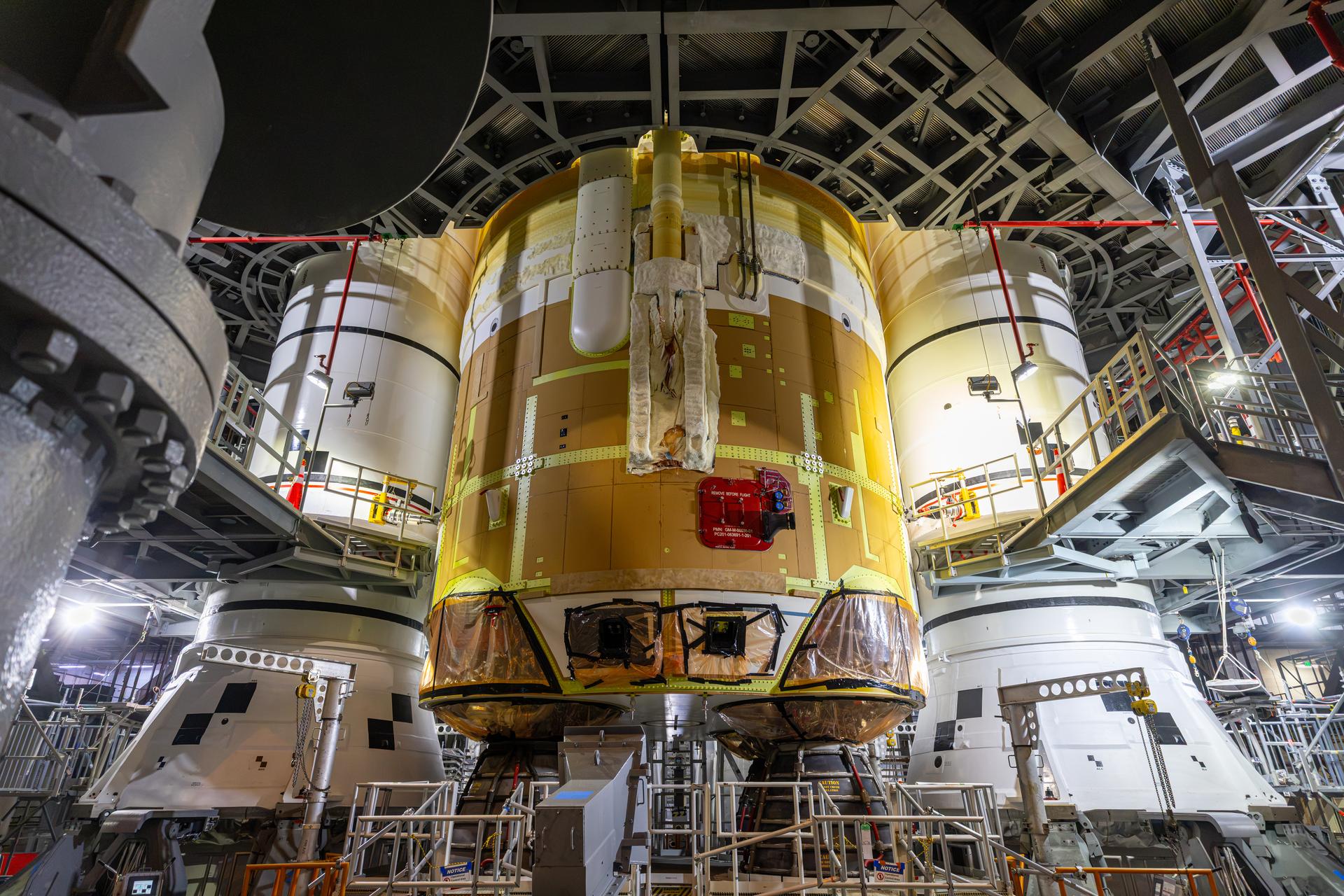
The Artemis III rocket now stands as a rocket. In late October, technicians at NASA's Kennedy Space Center lifted the Space Launch System core stage and integrated it alongside the twin solid rocket boosters. That completes what NASA calls the "short stack" configuration in High Bay 3 of the Vehicle Assembly Building.
It's a milestone NASA likes to photograph, and it photographs well. It also opens a launch campaign that the program's own manager calls "likely the most complicated launch campaign ever undertaken." SLS is only one of three heavy rockets this mission needs.
One 212-foot stage, several steps
NASA gave the timeline in an image release dated October 28. On Thursday, October 22, the core stage was lifted in the Vehicle Assembly Building's transfer aisle. By Friday, October 23, it lay horizontal in the transfer aisle. On Sunday, October 25, it was integrated alongside the twin solid rocket booster motor segments, completing the short stack configuration.
The stage is 212 feet long. Technicians lifted it from the facility's High Bay 2 using a one-of-a-kind lifting beam designed to place the stage onto the mobile launcher. Handling a stage that size inside the building takes several separate steps, and NASA's photos document three of them across four days.
Stacking isn't the end of the rocket's preparation. Once testing and checkouts are complete, NASA plans to roll the core stage and booster stack to Launch Pad 39B for a tanking test. Liquid hydrogen and liquid oxygen will be loaded only into the core stage, and the launch team will practice countdown procedures and timelines. The aim is to exercise the stage, the ground systems and the launch team together before the full mission campaign begins.
A Moon mission that stays in Earth orbit
Artemis III is not the landing many people associated with that name. It is now a test flight in low Earth orbit. The crew will practice rendezvous and docking between Orion and commercial spacecraft from Blue Origin and SpaceX, ahead of future missions to land astronauts on the Moon.
The crew is NASA astronauts Randy Bresnik, Frank Rubio and Andre Douglas, plus the European Space Agency's Luca Parmitano.
NASA presented its concept of operations for the mission at Kennedy on October 23, as Space.com reported. In this plan, SLS doesn't launch first. Blue Origin's New Glenn goes up first, carrying the Blue Moon lander to low Earth orbit. SLS and Orion follow. SpaceX's Starship is the third rocket in the plan, launching after the Blue Moon operations are complete.
"We're launching three of the most powerful rockets in the world, and undertaking what is likely the most complicated launch campaign ever undertaken," Artemis program manager Jeremy Parsons said.
After launch, SLS deploys Orion into a highly elliptical orbit ranging from about 18 miles to 1,122 miles above Earth, according to Parsons. The capsule then maneuvers into an orbit about 345 miles up. The crew spends two days checking out Orion before meeting Blue Moon on Flight Day 3, and the Starship docking comes around Flight Day 8.
Why It Matters
Bringing the core stage and boosters together means the most visible piece of Artemis III hardware is now assembled. It does not tell you when the mission will fly. SLS is the part of this mission NASA controls most directly, and the mission also depends on two commercial launch systems and the landers they carry. Getting the short stack to the pad for a tanking test will show how ready NASA's own rocket is. Whether the whole mission is ready depends on everything else.
The mission design also says something about the program. A docking rehearsal in Earth orbit puts the new meeting between Orion and commercial landers somewhere a crew can still get home quickly. Parsons made the point himself: Artemis III is a low Earth orbit environment "where if something goes wrong, we can come home much more quickly." It is also a sign of how much of the program's future depends on hardware NASA doesn't build itself.
Timing remains open. Space.com reports NASA is targeting the summer of next year, but that an internal memo last month from NASA Administrator Jared Isaacman put Artemis III about 90 days behind schedule, with lander supply chains among the biggest challenges.
Meanwhile, a new upper stage takes shape
SLS hardware news on the same day concerned a later version of the rocket. On October 23, United Launch Alliance announced it is collaborating with NASA on a Centaur upper stage for SLS. NASA has prioritized the 180K Centaur V, which would include a qualification test unit and a flight unit required to support a 2028 Artemis launch.
The changes from the current Centaur are real engineering changes, not cosmetic ones. The tank gets longer, increasing propellant capacity by approximately 50 percent, and the tank material changes from stainless steel to alloy 718. ULA will build the stage in Decatur, Alabama. CEO Mark Peller was quoted in the announcement.
ULA also supplied the Interim Cryogenic Propulsion Stage (ICPS) for the Artemis I and Artemis II launches. The company says the third and final ICPS is ready at the Cape in preparation for delivery to NASA. The Centaur work points to what ULA is developing for future Artemis missions beyond that last ICPS.
What comes next
The near-term schedule is simple to describe and hard to carry out: finish checkouts in the VAB, roll to Pad 39B, load propellant into the core stage and run the countdown practice. After that, Artemis III depends on New Glenn, Blue Moon and Starship reaching their own milestones, and on a launch date NASA has not firmly set.
