
For years, the plan for returning astronauts to the Moon has included a meeting point most people never heard of: a near-rectilinear halo orbit, or NRHO. Orion would go there, a commercial lander would be waiting, and the crew would transfer before heading to the surface. On Oct. 23, NASA said that meeting point is gone.
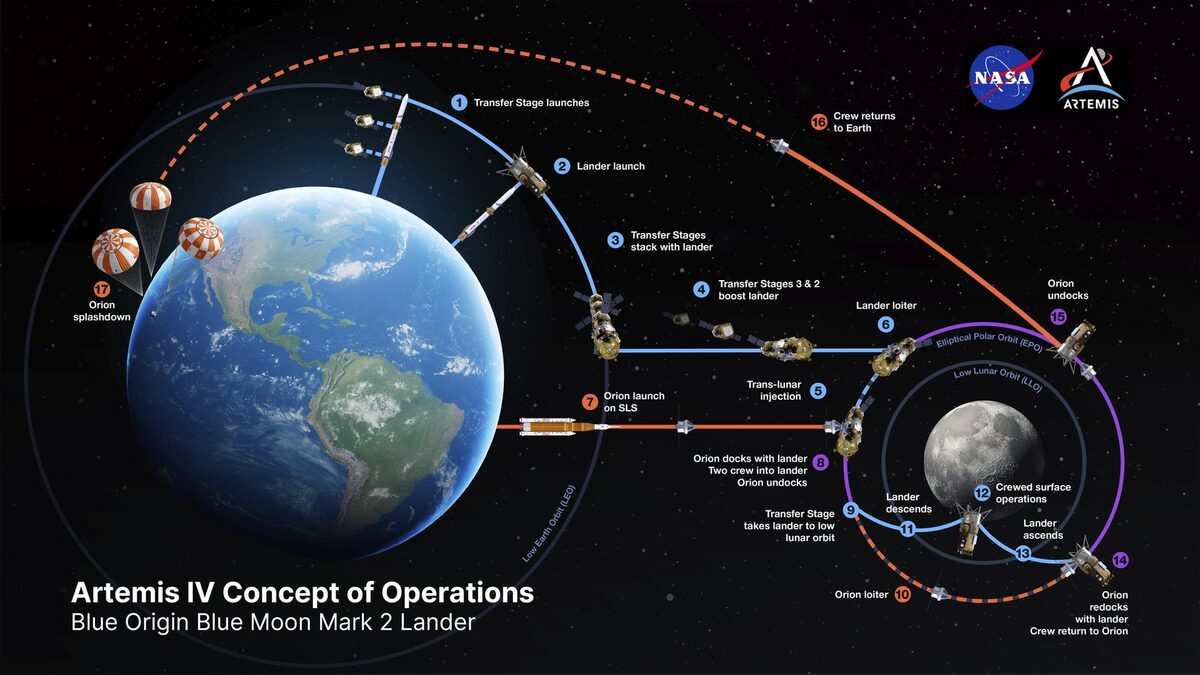
Under revised concepts of operations for the two crewed landers, SpaceX's Starship and Blue Origin's Blue Moon Mark 2, Orion and the landers "no longer rendezvous" in NRHO. Each lander will instead meet Orion in a different orbit, chosen to suit that company's architecture. NASA is still aiming to put astronauts on the surface in 2028.
The change came out in a briefing that, according to Space.com, ran for more than two hours. NASA openly acknowledged what Ars Technica called substantial changes to the architecture.
Two landers, two very different paths
The most striking change is SpaceX's. In the new plan, tanker Starships transfer cryogenic propellant to a depot Starship in low Earth orbit. The Starship Human Landing System then fills up and waits in Earth orbit. Orion docks with it there. Starship then fires a trans-lunar injection burn and carries the whole stack, with Orion attached, to low lunar orbit.
In other words, Starship is no longer just a lander waiting at the Moon. It becomes the stage that carries Orion there. That only works if Orion can take the loads of being pushed by another vehicle, and NASA says it is working to modify Orion so that Starship can push it. Ars reports that NASA canceled the Lunar Gateway earlier this year, which solved the NRHO docking problem SpaceX had asked NASA to remove.
Blue Origin's route looks more like a relay. The company is deferring propellant transfer, so it does not need to refuel its lander in orbit, at least for now. Instead, three transfer stages launch to low Earth orbit, followed by the Blue Moon Mark 2 lander. The lander docks with the stages, and the stack departs for an elliptical polar lunar orbit. Ars reports that the architecture includes four New Glenn launches and no spacecraft-to-spacecraft refuelings. It also says a NASA chart showed Orion docking with Blue Moon in an elliptical orbit about 8,500 km above the Moon, and that NASA is also working on an option to dock in low lunar orbit.
Both companies still have to fly an uncrewed demonstration mission before any crewed landing.
The tanker question NASA won't answer
SpaceX's plan depends heavily on refueling in orbit, and the number of tanker flights it needs is still disputed. Ars reports that a NASA safety panel said on Thursday the current figure is "about 22" tanker launches. Elon Musk said that estimate was wrong and that the actual number will be six to eight. NASA Administrator Jared Isaacman called six to eight possible but the "ultimate potential end state" of Starship, and NASA officials declined to give a precise number.
That spread matters. The gap between 22 and 8 means a very different launch cadence, a different number of pad turnarounds, and a different count of chances for something to go wrong before a crew ever leaves Earth. Ars says much remains uncertain, including Starship's lift capacity, how much cryogenic propellant will boil off in orbit, and how efficient ship-to-ship transfer will be.
Contracts realigned, and the first landing is up for grabs
The revised plan also changes how the contracts are structured. According to NASA, under the realigned contracts both providers take part in Artemis III in low Earth orbit, and neither is assigned a specific landing mission. NASA will choose which company lands first based on readiness, and a second crewed landing opportunity will follow.
Both contracts also add milestones. SpaceX adds two demonstrations of a crew cabin NASA calls "Cabin 1." Blue Origin adds human-in-the-loop milestones. NASA is targeting two moonwalks of about two hours each during initial surface missions, testing a spacesuit provided by Axiom Space.
"This is an achievable path we are on right now," Isaacman said, according to Ars. In NASA's release, he framed the goal as completing the return of astronauts to the lunar surface in 2028 and establishing a Moon base.
Artemis III: a rehearsal in Earth orbit
Before any of that, Artemis III will test how these vehicles work together without going to the Moon. NASA says the mission launches in 2027, and Ars reports it is still expected by "summer" 2027. The crew is Randy Bresnik, Frank Rubio, Andre Douglas and ESA's Luca Parmitano, flying in Orion in low Earth orbit on a planned 14-day mission.
The sequence, as NASA and Space.com describe it:
- Blue Moon goes first. Blue Origin launches a Blue Moon Mk 2 test article to a circular orbit about 273 miles up, where it can wait up to 30 days.
- Orion follows on SLS only days later and meets Blue Moon on Flight Day 3. The crew spends about two days docked, inside the test article, testing life support and emergency scenarios.
- Starship comes last. SpaceX launches a Starship Version 3 test article with an added docking system, likely around Flight Day 6. It meets Orion on Flight Day 8 at about 237 miles, which NASA gives as 206 nautical miles. The docking test lasts about two hours, and the crew does not enter Starship.
Artemis program manager Jeremy Parsons said the mission flies three spacecraft on three rockets, something NASA has never attempted. Space.com quotes him saying "We're launching three of the most powerful rockets in the world, and undertaking what is likely the most complicated launch campaign ever undertaken." The rockets are SLS, Starship and New Glenn, all flying from Florida. Ars reports that Artemis IV, the landing mission, is tracking toward 2028.
Why It Matters
NRHO was the orbit Gateway needed, and every lander design had to work around it. Without it, each company can plan for an orbit that fits its vehicle. For SpaceX, NASA says low lunar orbit will significantly lower the propellant Starship needs to aggregate in space. For Blue Origin, NASA says the elliptical polar orbit offers faster returns from the surface to Orion and reduces lander propellant requirements. Those are real engineering simplifications.
The changes also add new dependencies. The SpaceX plan now needs a modified Orion that can be pushed by another vehicle, plus a tanker campaign whose size even NASA won't estimate. The Blue Origin plan needs four launches and a docking sequence before the lander leaves Earth orbit. And because neither company is assigned a landing, NASA will pick the first lander based on readiness, which makes the 2028 date something of a race. Artemis III in 2027 will be the first real test of whether the three-vehicle choreography works.
Sources
- NASA, Partners Accelerate Lander Development for 2028 Moon Missions (NASA)
- NASA's Artemis III Mission to Test Future Moon Lander Operations (NASA)
- NASA updates lander plans for Moon landings, finally solves long-festering Orion issue (Ars Technica)
- NASA lays out plan for Artemis 3 moon-lander test flight, but when will it launch? (Space.com)
