
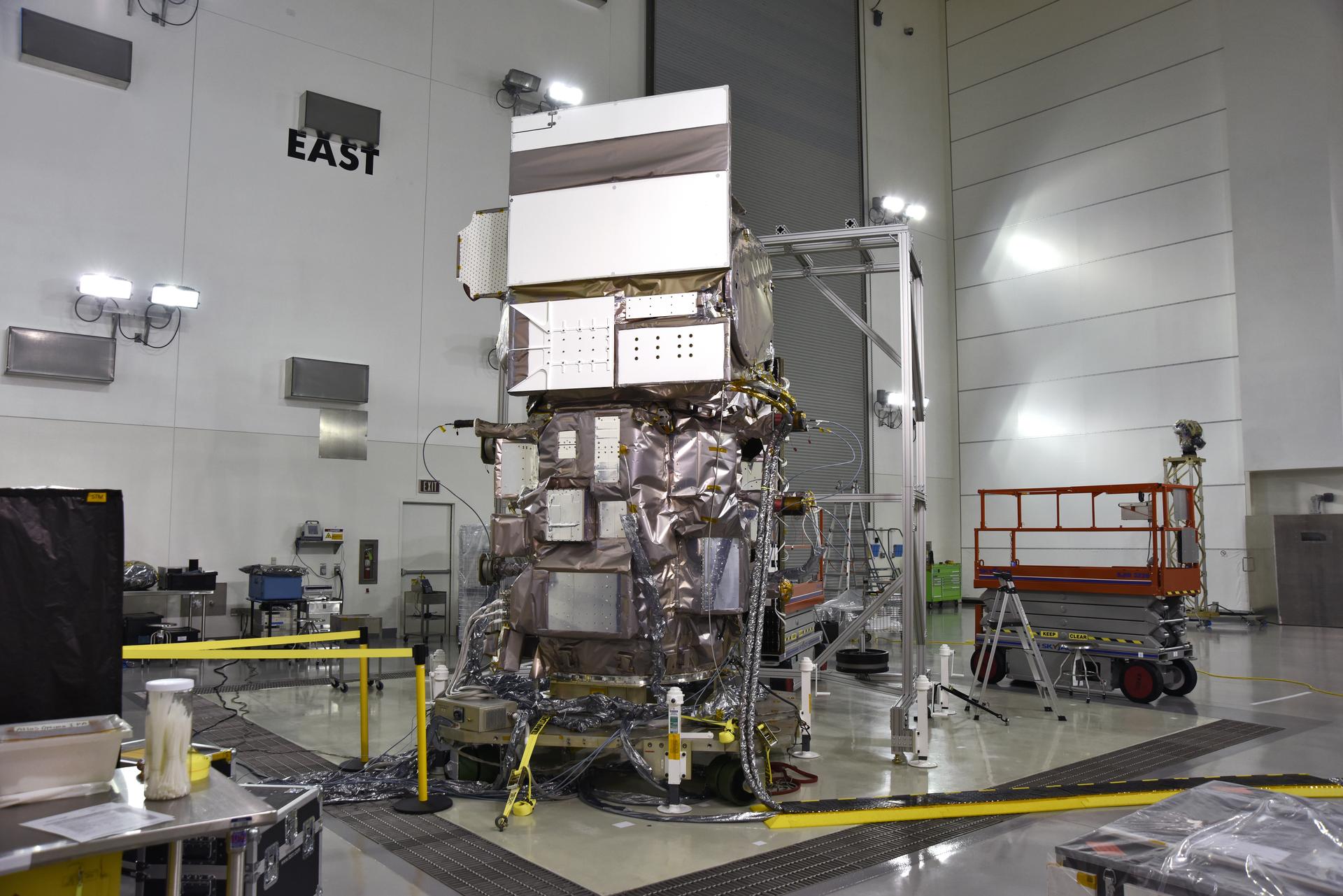
A satellite built to measure the thickness of polar sea ice and the snow piled on top of it has passed its first major tests. On Oct. 26, ESA reported that CRISTAL, the Copernicus Polar Ice and Snow Topography Altimeter, finished assembly in September at Airbus in Friedrichshafen, Germany. Engineers have since unfolded its solar panels for the first time and checked that it fits, and separates properly from, the adapter that will connect it to its launcher.
Next, the spacecraft goes to ESA's establishment in the Netherlands, where it will spend most of next year in environmental testing. ESA is targeting launch for late 2027 to early 2028.
What was tested
ESA lists three milestones in this round of work.
- Solar array deployment. The satellite passed its first solar panel deployment test. A spacecraft's solar wings stay folded for launch and must open reliably once in orbit. ESA says the test verifies that the mechanisms and software sequences work together as planned.
- Launch adapter fit and release. Engineers worked with launch provider AVIO to confirm that CRISTAL mates with its launch adapter and releases from it as intended.
- Intermediate Qualification Status Review. ESA held this review of the qualification and verification status of the satellite's equipment, instruments and subsystems, ahead of the satellite-level qualification tests.
CRISTAL project manager Kristof Gantois said the satellite "passed these tests with flying colours." Early assembly-stage tests are supposed to find problems before the harder environmental campaign, so a clean result here is a good sign for the schedule, though it does not guarantee it.
That campaign is still ahead. ESA says the satellite will spend most of 2027 at its Netherlands site, with launch targeted for late 2027 to early 2028.
A first for the Sentinel Expansion
CRISTAL is set to become the first Copernicus Sentinel Expansion mission to reach orbit. The Expansion missions are a new group of high-priority satellites added to the existing Sentinel fleet that supplies the European Union's Copernicus Earth-observation programme. The eoPortal mission profile also gives CRISTAL the name Sentinel-9.
The mission was early to contract. According to ESA, CRISTAL was the second of six new high-priority candidate missions to be contracted, after the CO2M carbon dioxide monitoring mission. ESA signed the main contract, worth about 300 million euros, with Airbus Defence and Space. Thales Alenia Space was named prime contractor for the IRIS altimeter, the mission's main instrument.
Airbus began manufacturing after the mission passed its Critical Design Review in July 2024. The mission is part of ESA's Copernicus expansion, developed in partnership with the European Commission. That puts roughly two years between the start of manufacturing and a fully assembled spacecraft.
The instrument: two frequencies instead of one
CRISTAL is a radar altimetry mission. It sends radar pulses down to the surface and times their return to work out the height of ice and snow. ESA says the satellite carries the first dual-frequency radar altimeter, along with a microwave radiometer. eoPortal describes the altimeter, IRIS, as an interferometric radar altimeter.
The second frequency is what makes the instrument new. Airbus says IRIS will measure snow cover on ice sheets for the first time, an improvement on the capabilities of CryoSat-2, ESA's current ice-monitoring altimeter. eoPortal calls CRISTAL CryoSat-2's successor and lists three main measurements: sea-ice thickness, the depth of snow on top of it, and the elevation of the ice sheets.
Snow matters for these measurements because altimetry calculates sea-ice thickness indirectly, from how far the ice and its snow cover stand above the water. Not knowing how much snow sits on the ice has long been a source of uncertainty in that calculation. An instrument that measures snow depth directly should help narrow that uncertainty.
Two satellites, one long record
CRISTAL is planned as a pair. eoPortal says Airbus is building two identical altimetry satellites, and ESA says the second, CRISTAL-B, is planned to launch towards the end of CRISTAL-A's operational lifetime. The plan is to hand the job from one spacecraft to the next so the record keeps going, rather than to fly both at the same time.
Why It Matters
Polar ice changes slowly, and the only way to separate long-term trends from year-to-year noise is to measure it the same way for a long time. CRISTAL is designed to carry on CryoSat-2's polar altimetry record and to add snow-depth measurement on the ice. Because the mission is an operational Copernicus mission, ESA says it will deliver data to support maritime activities in the polar oceans, coastal and inland waters applications, and ocean topography monitoring, not just a single science campaign.
The solar-array and adapter tests are a small step, but each problem found and fixed on the ground is one less risk in orbit. The year of environmental testing will be the bigger test. If it goes as well as these first checks, Europe's first Sentinel Expansion satellite should be on track for its late-2027 to early-2028 launch window.
