
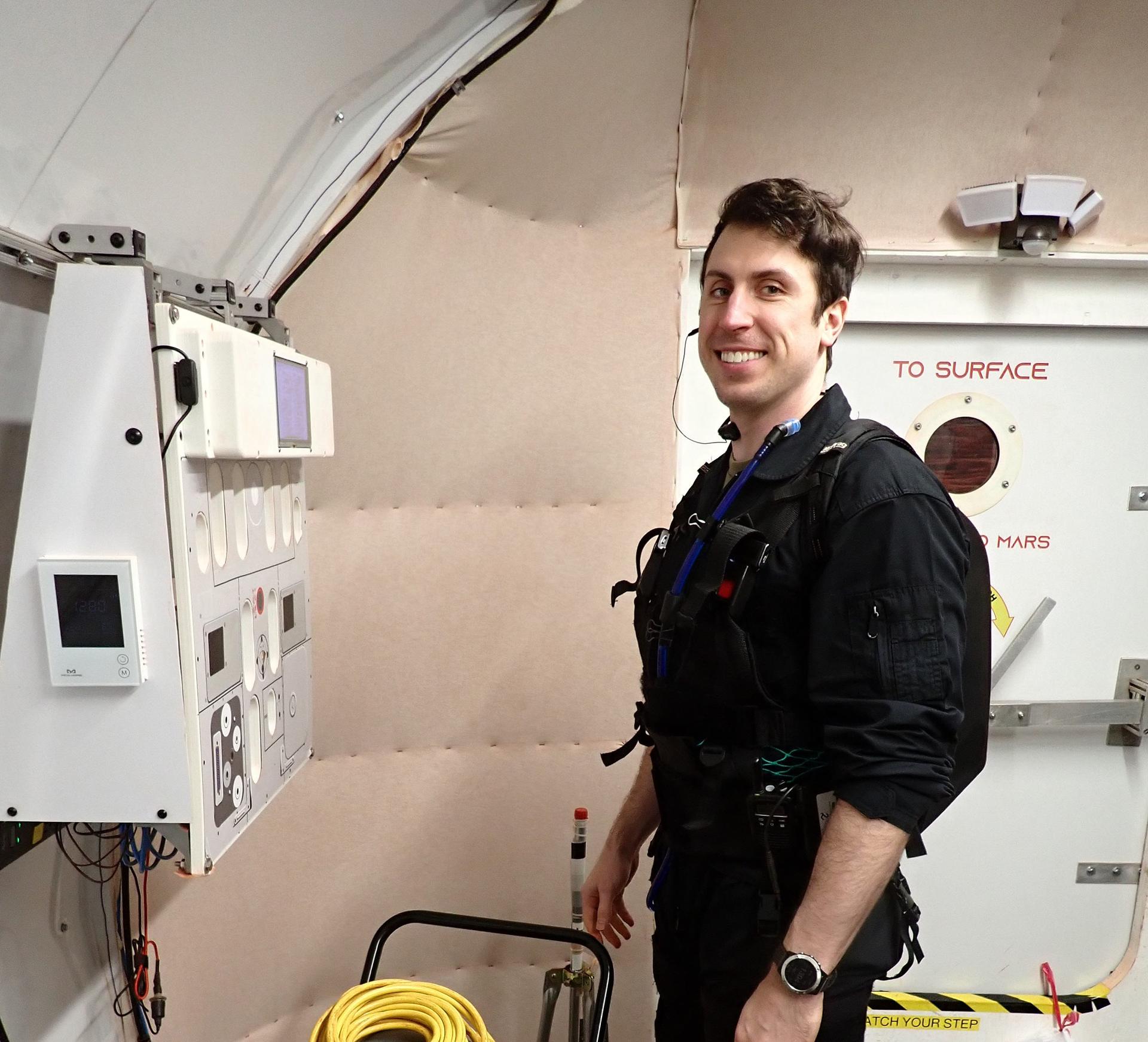
On Saturday, Oct. 31, four people will exit a habitat at NASA's Johnson Space Center in Houston and step outside for the first time after 378 days. Ross Elder, Ellen Ellis, James Spicer and Matthew Montgomery make up the crew of CHAPEA Mission 2, the second yearlong analog mission NASA has run inside Mars Dune Alpha. That is a 1,700-square-foot, 3D-printed habitat built to stand in for a home on the Red Planet.
NASA announced the exit in a media advisory issued Oct. 27. Live coverage starts at 3 p.m. EDT, streamed on NASA Johnson's YouTube and social accounts. Johnson Director Vanessa Wyche and NASA astronaut Jack Hathaway are scheduled to give remarks, as are the four crew members.
No one is going to Mars on Saturday. The point of the event is the data: more than a year of observations on how a small crew holds up when it is cut off, short on supplies and working through communication delays.
What the crew actually went through
CHAPEA, short for Crew Health and Performance Exploration Analog, does not try to imitate the trip to Mars. It imitates the living. The Mission 2 crew went into the habitat on Oct. 19, 2025. Since then, according to NASA, the four have lived and worked in the facility, simulating Mars mission operations, conducting simulated spacewalks, exercising, performing habitat maintenance and growing plants, all while under stressors that future deep space crews will likely experience: communication delays, resource limitations and isolation.
Of the three, the communication delay is the one most likely to change daily life. A crew on Mars could not hold a live conversation with mission control, because every message would take time to cross the distance and the reply would take just as long to come back. An analog that builds in that lag forces the crew to fix problems, make decisions and handle the routine of a mission with far less real-time help from the ground than astronauts in low Earth orbit are used to.
Resource limits work in a similar way. A crew on another planet works with what it brought along, what it can grow and what it can repair. Researchers can then look at how constraints like these affect performance, health and how well a crew gets along.
A second run of the same experiment
Mission 2 follows a precedent. The first CHAPEA crew entered Mars Dune Alpha on June 25, 2023 and came out on July 6, 2024, also after 378 days. That crew of Kelly Haston, Anca Selariu, Ross Brockwell and Nathan Jones ran simulated "Marswalks," grew and harvested several vegetables to supplement their shelf-stable food, and operated under communication delays, resource limitations and isolation, as Space.com and Live Science reported when that mission ended.
A second mission matters because one crew of four is a very small sample. Any finding from CHAPEA-1, such as how fast morale drops in a given month, how a food system holds up over a year, or how crew time actually gets used compared with the plan, could come down to those four personalities. Running a second crew through the same habitat, for the same length of time, gives researchers a basis for comparison. Patterns that show up in both missions are much easier to trust than patterns that show up in one.
CHAPEA-2 ran in a 1,700-square-foot structure and for the same 378 days as the first mission, so the two crews can be compared fairly directly. The open question is how much the second group's experience matched the first.
Why It Matters
NASA's advisory says health and performance data from the mission can help the agency develop methods to counter human spaceflight risks for future Artemis and Moon Base missions. It names several practical areas: food system design, efficient use of crew time, bandwidth on NASA's Deep Space Network, and medical care and behavioral support.
Each of those is a real engineering or operations problem, not a soft science extra:
- Food system design. Over a year, food is mass, storage volume, nutrition and morale all at the same time. A menu that works for a two-week stay can fail over twelve months. The agency needs to know which choices hold up.
- Crew time. Every hour spent on maintenance, cooking or paperwork is an hour lost to science. A full year of logged activity shows how much of the workday gets used up just keeping the crew alive and the habitat running.
- Deep Space Network bandwidth. The Deep Space Network is NASA's link to spacecraft far from Earth, and its capacity is shared and finite. Knowing how much data a crew actually needs to send and receive, and what happens when it gets less, feeds directly into communications planning for distant crewed missions.
- Medical and behavioral support. NASA says the data can help flight doctors and psychologists strengthen spaceflight medical care and behavioral support practices to ensure crew readiness and performance. Isolation and delayed contact change how a crew can get help, so analog data helps work out what support has to be on board and what can stay on the ground.
The advisory's mention of Artemis and Moon Base missions is worth noting. Mars Dune Alpha was built around a Mars scenario, but NASA is presenting the results as useful for lunar operations too. Crewed Mars missions themselves are still targeted for the late 2030s or early 2040s, according to Space.com's coverage of the first mission. That leaves time to put findings like these into hardware, procedures and crew selection.
What to watch on Saturday
The broadcast itself will be ceremonial: the crew's exit from the habitat, remarks from Wyche, Hathaway and the crew members, and the first steps outside after more than a year. The more useful information will come later, when researchers start publishing what two yearlong crews in the same habitat showed about food, time, bandwidth and behavior over long stretches of isolation.
Coverage begins at 3 p.m. EDT on Oct. 31 on NASA Johnson's YouTube and social accounts.
