
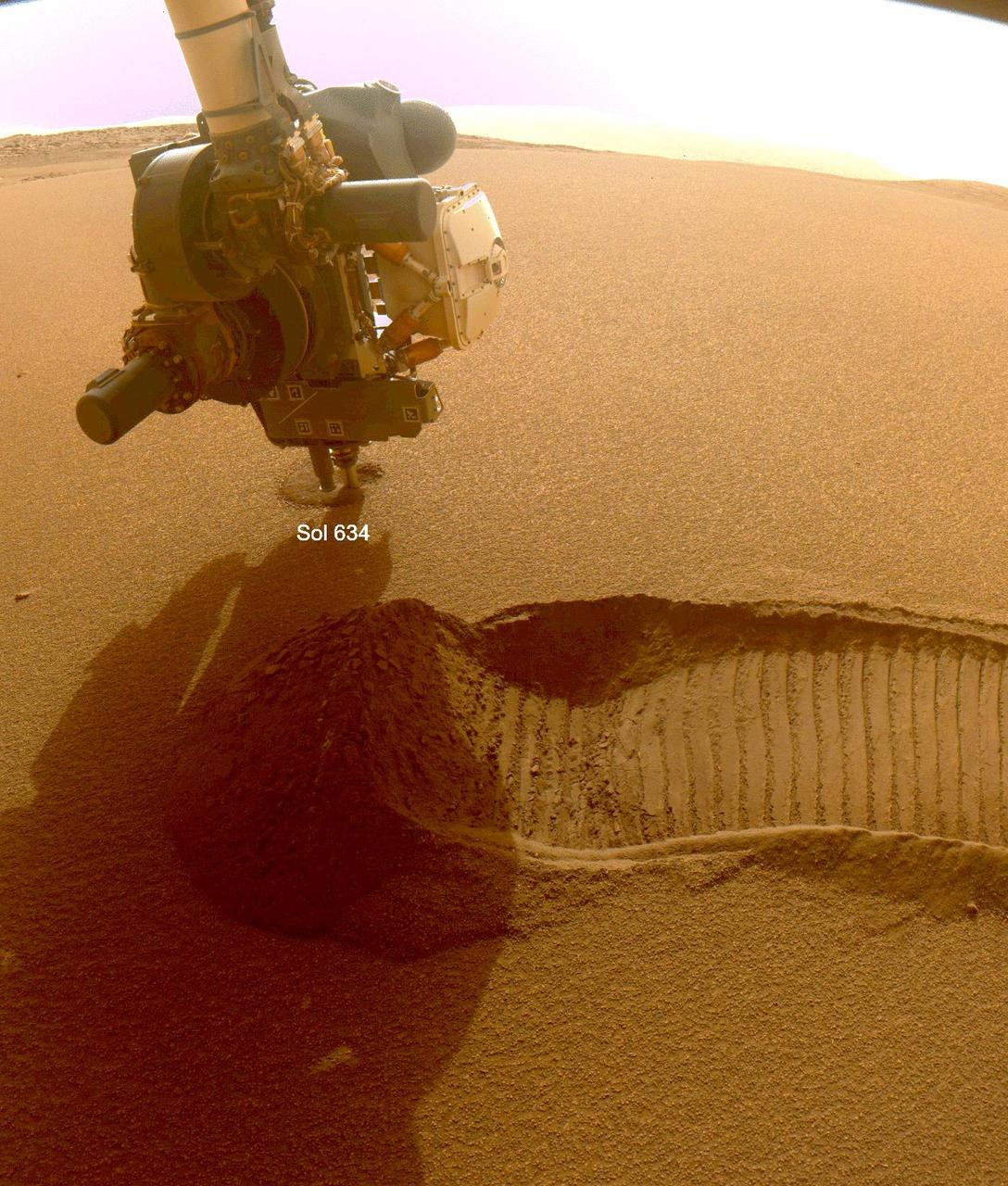
Every surface on Mars ends up with a coat of dust. The question for anyone planning to send people there is what that dust is actually made of at the smallest scales, and how much of it will still be stuck to a glove, a boot or a visor when an astronaut climbs back inside. A paper due Tuesday, October 27, in the Proceedings of the National Academy of Sciences gives the first on-site measurements of the finest of those particles, and it comes from hardware that was never built for this job: the calibration targets on NASA's Perseverance rover.
Over 1,645 Martian days, Perseverance measured fine and ultrafine dust clinging to samples of spacesuit materials and other reference surfaces carried aboard the rover. NASA announced the results on October 26, ahead of the journal release.
Calibration targets turned into a dust lab
The rover's PIXL and SHERLOC instruments both carry calibration targets, surfaces with known properties that let the science teams confirm their readings are accurate. The swatches on SHERLOC's target are each 20 millimeters square, according to NASA. Universe Today has described that experiment as a long-running test of five materials: polycarbonate used in helmet visors, coated and uncoated Teflon, the Ortho-fabric outer suit layer and Vectran. The samples are mounted near the SHERLOC calibration targets so they can be monitored with SHERLOC and the WATSON camera on the rover's arm, while they sit in the Martian environment, which means strong ultraviolet light, big temperature swings, constant dust and corrosive perchlorates.
The swatch experiment was set up to see how suit materials hold up. The new study turns the same surfaces into dust collectors. Because the targets sit on the rover for years, they record what lands on them and, more importantly, what stays.
Smaller than anything measured on Mars before
The main result is a resolution step. According to NASA, earlier dust measurements on Mars resolved particles down to about 3 micrometers. PIXL detected fine particles under 2.5 micrometers and ultrafine particles of roughly 100 nanometers, more than an order of magnitude smaller.
The grain sizes depended on the surface:
- PIXL Teflon target: particles averaged about 2 micrometers.
- SHERLOC Vectran swatch: particles averaged about 2 micrometers.
- PIXL basaltic glass target: sizes ranged down to about 100–300 nanometers.
- SHERLOC Teflon swatch: sizes also ranged down to about 100–300 nanometers.
There is a statistical caveat worth noting. As TS2 points out in its summary, the list mixes two different measures: an average size for some surfaces and the low end of a range for others. Those are different statistics, so the numbers alone cannot rank which material is "dirtiest." What the data do show is that different surfaces hold different populations of grains.
NASA and TS2 also explain why PIXL's Teflon target is useful here. Teflon contains no elements PIXL can directly detect, so any elemental signal the instrument picks up from that sample comes from dust resting on it. That makes it a clean blank for reading the dust's composition.
Static decides what sticks
Why would dust settle differently on Teflon than on basaltic glass, or differently on two Teflon surfaces mounted on two instruments? NASA says static electricity appears to determine which size dust particles stick to which surface. Dust grains become charged as they collide in the air, and different materials on the calibration target attract grains of different sizes.
The other finding is about persistence. The finest particles stayed attached through years of driving and drilling.
"The larger clumps, the Martian dust bunnies, get shaken off over time. But the smallest particles stay behind," said lead author Scott VanBommel of Washington University in St. Louis. NASA's release quotes him adding that those are the ones that pose the greatest challenge for human support systems.
For suit design, this is the uncomfortable part. The grime that comes off with time or handling is not the part that matters most, and the ultrafine fraction is what remains. NASA also says the study found that some materials hold less dust than others, which could guide future choices of materials and protective coatings for spacesuits and habitats.
Material choice matters here in a direct way. TS2 notes that Vectran is a cut-resistant fabric used on glove palms, while Teflon has been used on glove backs and gauntlets. NASA adds that organic polymers like SHERLOC's Teflon sample are common in the outer layers of spacesuits, and the results show they readily collect fine dust.
What the dust is made of
The measurements also gave composition data. NASA reports that the dust matches the iron- and sulfur-rich composition earlier missions measured, and that PIXL also found it enriched in phosphorus and detected signs of calcium sulfate. The agency also points to two components already known to be a concern in Martian material: perchlorates, which can disrupt thyroid function, and reactive iron, which induces cellular damage.
The particle sizes are what link this to human health. On Earth, particulate matter smaller than 2.5 micrometers, the PM2.5 category used in air-quality monitoring, is tied to negative health effects because it can penetrate deep into the lungs and enter the bloodstream. The fine particles PIXL detected fall below that 2.5-micrometer line, and the ultrafine ones are far smaller. NASA says scientists believe the health risks of Mars dust depend on the quantity of dust and the length of exposure.
Why It Matters
Mission planners have long treated Mars dust as an engineering problem, something that coats solar panels, wears down mechanisms and obscures optics. This study puts numbers on a crew-health and habitat-design problem. NASA says the results can inform efforts to refine indoor dust-exposure limits for astronauts, develop safe habits, and establish ways to remove dust while exploring Mars. If the most persistent particles are also the smallest, then judging a cleaning method by the visible dust it removes may not be enough.
NASA's release points to two architectures. One is suitports, where an astronaut enters a suit attached to the outside of a habitat, so the dusty exterior stays outside. The other is dual-chamber airlocks. NASA says such designs could reduce how much dust gets inside astronauts' living quarters. Separately, NASA notes it is already working on dust hazards using ground test facilities and lunar missions as proving grounds. In March 2025 the agency tested an Electrodynamic Dust Shield, which used electric fields to clear lunar regolith from glass and thermal radiator surfaces on the Moon after landing aboard Firefly Aerospace's Blue Ghost Mission 1.
The agency framed the work as part of preparing for human exploration. Lindsay Hays, acting director of NASA's Planetary Science Division, said Perseverance is giving engineers and flight surgeons measurements they can use to improve existing designs well before the first American astronauts arrive on Mars, and Katie Stack Morgan, Perseverance project scientist at JPL, noted that the mission was also designed to help prepare for human explorers. The result is a case of a rover getting extra use out of its own hardware. Calibration targets built to keep instruments honest have yielded the first on-site measurements of the fine and ultrafine material that future crews will have to manage.
