
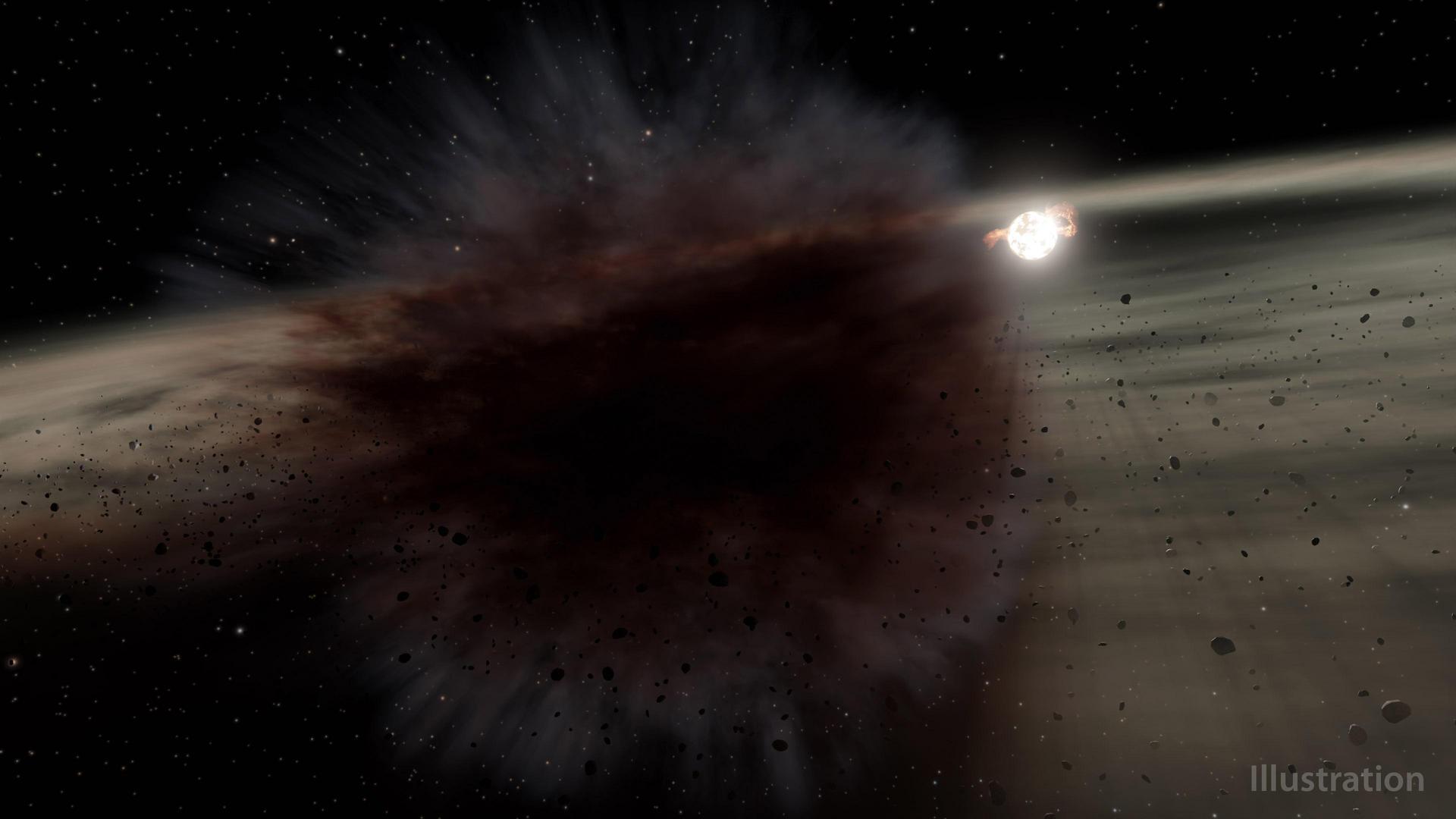
Planet formation is not a tidy process. Somewhere in the first few hundred million years of a star's life, rocky protoplanets can slam into one another hard enough to fill the surrounding space with dust. Astronomers have a name for the systems caught in the act: extreme debris disks, or EDDs. Now a team has put 21 of them side by side, and the wreckage turns out to come in two distinct flavors.
The work is led by Kate Su of the Space Science Institute in Boulder, and NASA announced it on 1 October 2026, saying the results were published in The Astrophysical Journal. The team combined mid-infrared spectra from the James Webb Space Telescope and the retired Spitzer Space Telescope. According to NASA, the sample includes 5 disks from the Spitzer archive and 16 observed with Webb. Twelve of those were newly observed, and four Spitzer disks received follow-up.
What makes a disk "extreme"
The phase is rare. NASA says roughly 1% of young stars show observable signs of it, based on the data collected so far. The EDDs in the sample share three key properties: smaller dust grains than those in protoplanetary or classic debris disks, a high concentration of warm dust, and irregular brightness variations. Those traits are consistent with fresh debris being generated by recent, violent impacts rather than slowly ground out of an old belt.
The technical companion paper, posted to arXiv by Su and nine coauthors on 7 July 2026, describes the grains in these disks as predominantly submicron in size and thermally altered, with high silica and crystalline silicate content. Its conclusion is that the dust is generated by collisions between Moon- and Mars-sized bodies. (The arXiv posting predates the journal publication that NASA cites.)
Two kinds of crash
The new result is that the spectra do not all look alike. Roughly one-third of the disks are silica-rich. NASA ties these to high-energy impacts between bodies on the scale of Mars, in which a significant portion of the material is vaporized. The other two-thirds are silica-poor and are attributed to smaller-scale, grazing collisions between Moon-sized bodies, with the silica-poor mineral forsterite among the materials that mark this type. NASA's own analogy: obsidian is a silica-rich volcanic glass found on Earth, while forsterite appears as green sand grains on some Hawaiian beaches.
The two groups also differ in age. The silica-rich disks are found only around stars younger than 300 million years. The silica-poor type persists across a broad range of ages and often shows greater brightness variability. That age cut is a useful clue: the biggest, most destructive impacts seem to belong to the early period when planets are still assembling, while the smaller grazing collisions can happen later.
For scale, NASA notes that simulations suggest terrestrial planets such as Earth should form within the first few hundred million years of a solar system's formation, a period that fits the ages of the silica-rich disks observed so far. NASA also cites the estimate that Earth and the Moon formed around 100 million years after the Sun, with the Moon likely the result of a collision between Earth and a Mars-sized object. The silica-rich disks may therefore resemble the kind of event that shaped our own planet and its satellite.
A caveat on the older systems
Coauthor Attila Moor of Konkoly Observatory said the team expects no silica-rich systems among older extreme debris disks, but that only three disks in the sample fit that age criterion. That is a small number, and it limits how firmly the age split can be stated. In Moor's words, it would be nice to observe more of these systems to confirm the hypothesis, and a larger census of older systems would tighten the pattern.
One note on coverage: a Tech Times write-up of the same study describes it as the first large-sample compositional census of extreme debris disks with Webb's MIRI instrument, and covers the two chemically distinct collision types. Its headline, however, attributes the young-only pattern to Moon-scale impacts, which conflicts with NASA's description of silica-rich, Mars-scale impacts as the young-only type. This article follows NASA's account.
Why It Matters
Rocky planets like Earth are built by collisions, and until now there were few ways to see the process happening elsewhere. A compositional census of 21 systems turns a handful of curiosities into a population, and suggests that planet-scale collisions leave distinguishable chemical fingerprints. Silica-rich versus silica-poor dust is a way to read off what hit what, and how hard. Coauthor Agnes Kospal of Konkoly Observatory put the difficulty plainly: there is no other way to study these planetary embryos directly, because they are too small.
The sample also bears on our own history. NASA says that if older silica-poor disks and their random intervals of infrared brightness do reflect orbital instability, that would be broadly consistent with the Late Heavy Bombardment hypothesis, the idea that migrating giant planets disrupted the orbits of smaller bodies and triggered catastrophic collisions in the early solar system. That is a conditional possibility rather than a finding, but a catalog of what other young systems look like during their own violent phases gives the debate something to be compared against.
