
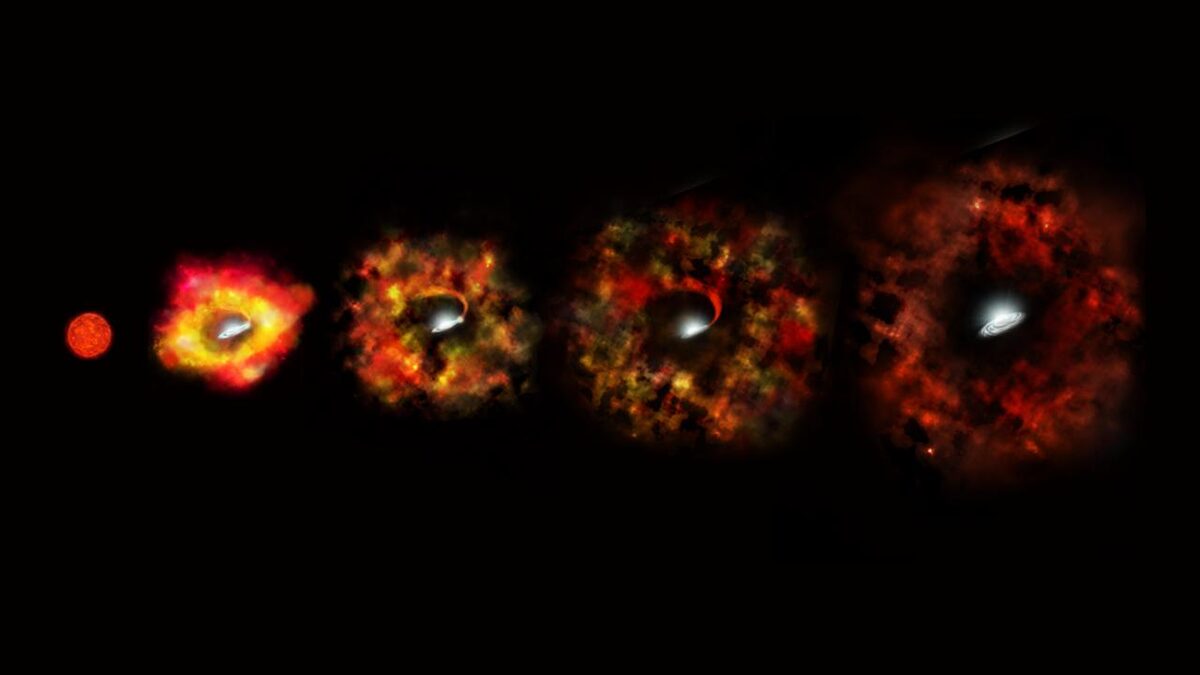
Gravitational-wave detectors have now recorded enough black hole collisions that astronomers can ask a census-style question: which masses are common, and which are missing? The answer turns out to be lopsided. A new analysis of LIGO-Virgo-KAGRA data finds a sharp pile-up of merging black holes near 10 times the mass of the Sun. Just above that, there is a stretch where they almost disappear.
The study's authors are Isaac Legred, Jacob Golomb and Katerina Chatziioannou, in a Caltech-led collaboration. They argue that the pattern could be the signature of a separate class of black holes. These would form when massive stars collapse straight into black holes without the explosion that normally marks a star's death. Such events are called failed supernovae. The results were published in Physical Review D on November 10, and Space.com and Italy's MEDIA INAF have covered them.
A peak, then a cliff
The underlying paper, posted to arXiv as "Low-mass failed supernovae and the 10 M_sun peak in the merging black hole mass distribution" and revised on November 9, works from 153 observations in the GWTC-4.0 catalog. In that sample, the team confirms a strong peak at a primary mass of 10 solar masses. (The primary is the heavier black hole in each merging pair.) They put the peak rate density at 7.36 (+6.35/−3.11) mergers per solar mass per year per cubic gigaparsec. The error bars are wide, but the peak itself is clear.
The more striking result is what comes after the peak. Between roughly 10 and 15 solar masses, the inferred merger rate falls by about two orders of magnitude. For primary masses from 12.0 to 16.1 solar masses, the rate becomes consistent with zero at the 90 percent level. In other words, the data can't rule out that the universe simply makes no merging black holes in that range. Above about 16 solar masses, the population returns and the rate rises again.
"We see 10 solar-mass black holes merging all the time," team member Isaac Legred of the University of Illinois Urbana-Champaign said in Space.com's coverage. "But why are, say, 14 solar-mass black holes so rare?"
The press coverage describes a somewhat different sample from the one in the arXiv paper. Both Space.com and MEDIA INAF, the news outlet of Italy's National Institute for Astrophysics, say the team examined 257 mergers recorded by LIGO, Virgo and KAGRA over ten years. They report that black holes near 10 solar masses make up about three quarters of that set. The arXiv version cites 153 GWTC-4.0 events. The two figures may reflect different versions or selection criteria, and the core claim (a big excess at 10 and a gap from 12 to 16) is the same in every account.
Why a gap suggests a separate population
If black holes formed along a single smooth path, you would expect their masses to spread out more or less continuously, maybe thinning gradually at higher masses. A tall spike followed by a near-empty range looks more like two populations that happen to sit next to each other.
That is the interpretation the authors propose. The paper considers a distinct subpopulation of black holes from failed supernovae, separated from the rest of the distribution by a gap. In this picture, the 10-solar-mass peak isn't just the most common outcome of ordinary stellar death. It is its own channel: stars that ran out of fuel, collapsed and became black holes without blowing off their outer layers in a visible explosion.
"A vast majority of the merging black holes in the universe are about 10 times the mass of our sun," Chatziioannou, of Caltech, said in a statement quoted by Space.com. "Our data are showing that this group of black holes may have a common origin — they may be a distinct subpopulation that failed to go supernova."
The paper's argument rests on population statistics, not on watching any individual star die. The gravitational waves say nothing directly about whether a particular black hole's progenitor exploded. What the team has is a distribution shape that a separate failed-supernova channel would explain naturally.
What would a failed supernova look like?
From the outside, a failed supernova looks like a disappearance. A massive star that should end in a bright explosion just fades from view. MEDIA INAF's coverage points to a candidate example, N6946-BH1: Hubble images show a giant star that vanished, which makes it a possible case of a star that collapsed without exploding.
Still, possible is the key word. Space.com notes that there is currently no hard evidence that failed supernovae happen, although theory supports the idea. Vanishing-star candidates like N6946-BH1 are suggestive, but they haven't confirmed the process. The new gravitational-wave result is circumstantial evidence pointing the same way, not proof.
Caveats worth keeping in mind
The analysis has some limits that matter for how much weight it can carry:
- The gap is statistical, not absolute. A rate "consistent with zero at the 90 percent level" means the data allow for no mergers in the 12-to-16 range. It doesn't mean such black holes are known not to exist.
- The uncertainties are large. The peak rate density's error bars run from roughly −40 percent to almost +90 percent of the central value.
- The physical interpretation is a hypothesis. The authors consider a failed-supernova subpopulation as an explanation for the structure. Other explanations aren't ruled out by the mass distribution alone.
- Sample sizes differ between sources. The paper's 153 events and the press reports' 257 mergers are not obviously the same dataset.
Why It Matters
Since 2015, detectors have recorded more than 300 black hole collisions, according to Space.com. That number has shifted gravitational-wave astronomy from detecting individual events to studying populations. With a few dozen events, a mass distribution is a blur. With hundreds, features like peaks and gaps start to stand out, and those features carry information about how the black holes were made.
If the 10-solar-mass peak really is a failed-supernova population, it would be one of the clearest signs yet that some massive stars die without exploding. The gravitational-wave catalog can't settle this alone, but it is now detailed enough to say where the black holes are and where they aren't, and the gap needs an explanation.
The next test is straightforward. As more mergers come in, the peak and the gap should either sharpen or blur. If the 12-to-16 range stays empty while the sample grows, the case for a distinct population gets stronger. If black holes start showing up there, the story will need revising.
Sources
- Legred, Golomb & Chatziioannou, "Low-mass failed supernovae and the 10 M_sun peak in the merging black hole mass distribution" (arXiv:2604.01420)
- Space.com: Astronomers discover rare black holes that formed when stars failed to go supernova
- MEDIA INAF: Onde gravitazionali a caccia di supernove fallite
