
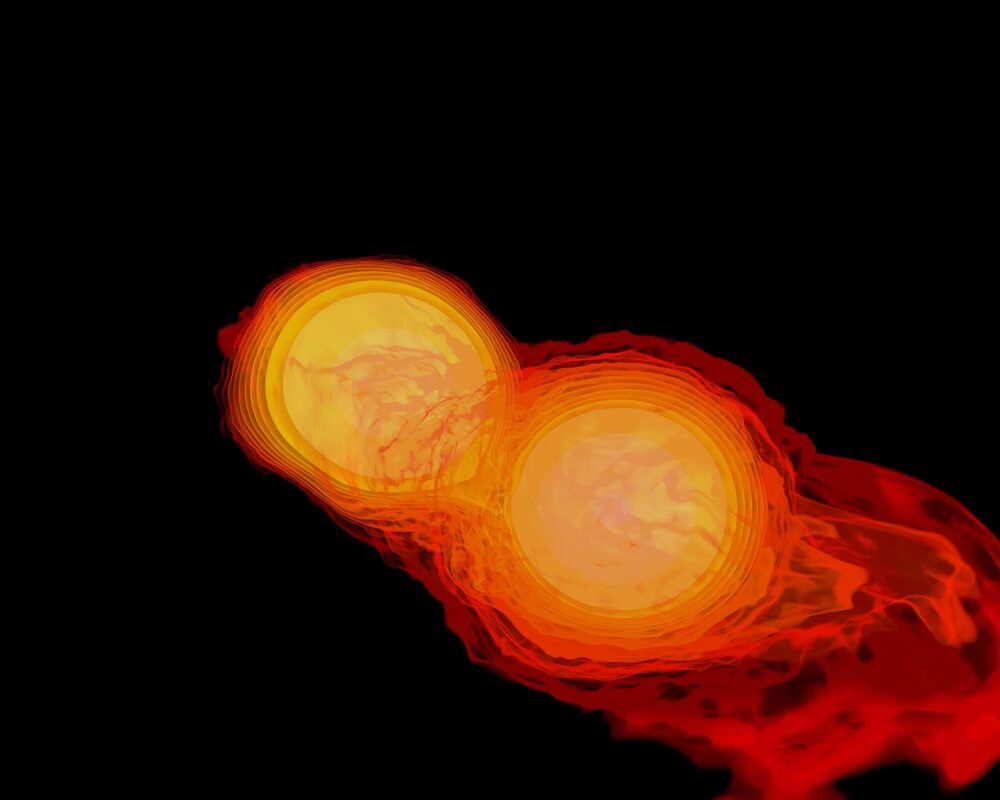
Some of the most violent events in the universe are also among the shortest. A paper submitted to arXiv on November 13, 2026, describes an X-ray flash that lasted only about eight seconds. Einstein Probe's Wide-field X-ray Telescope (WXT) recorded it at the same time as a short gamma-ray burst. The authors call the event EP260411a. They argue it came from the merger of two compact objects, and that it is a much briefer kind of merger-related X-ray signal than the long-lasting ones identified before.
The flash was not flagged in real time. The team found it later by going back through archived WXT data in a time-targeted search: they took the known times of short gamma-ray bursts and checked whether Einstein Probe had seen anything in X-rays at those moments. For GRB 260411A, it had.
A needle found by knowing where to look
The paper classifies EP260411a as an extragalactic fast X-ray transient, or EFXT: a sudden X-ray brightening from beyond our galaxy that rises and fades quickly. Einstein Probe was designed to find events like this. The mission is led by the Chinese Academy of Sciences, in partnership with the European Space Agency and Germany's Max Planck Institute for Extraterrestrial Physics. It launched on January 9, 2024, on a Long March 2C rocket from the Xichang launch center and reached a 600-kilometer orbit. It carries two instruments, the wide-field WXT and a narrower Follow-up X-ray Telescope, and its primary goal is to discover high-energy transients.
A wide field of view lets an instrument catch flashes it wasn't pointed at, but a short event can still sit unnoticed in the data. Searching at specific times is an efficient fix. If another observatory has already flagged a burst at a known time, analysts only need to check that slice of the X-ray record rather than combing the whole archive for faint blips. In this case, the timing came from the gamma-ray side.
Bringing in Fermi
The gamma-ray half of the analysis comes from the Gamma-ray Burst Monitor (GBM) on NASA's Fermi observatory. According to NASA Goddard, GBM provides low-energy spectral and timing measurements of gamma-ray bursts using scintillation detectors, with a predicted detection rate of about 200 bursts per year. NASA also notes that GBM extends Fermi's energy coverage down below the spectral break that typical bursts show at around 100 keV. That low-energy reach is what lets GBM data connect to measurements made in X-rays.
The researchers fit the Einstein Probe and Fermi-GBM data together. The best description of the combined spectrum was a cutoff power law with an additional break at low energies. A single model spanning the WXT X-ray band and the GBM gamma-ray band supports the view that the X-ray flash and the gamma-ray burst share a common origin, rather than being two unrelated signals that happened to coincide.
The timing also showed a clear pattern. Pulse width and peak time were both anticorrelated with photon energy: at higher energies the pulse was narrower and peaked earlier, while lower-energy emission arrived later and lasted longer.
Sorting the burst by type
The key question is what caused the burst. The paper places EP260411a in the Type I region of the Ep,z–Eiso plane, a standard diagnostic plot that compares a burst's spectral peak energy with its total isotropic energy output. Bursts thought to come from different kinds of progenitors tend to fall in different parts of that plot. The Type I region is where bursts associated with compact-object mergers fall, so the authors conclude the event's position supports a merger origin.
That fits the short duration of GRB 260411A. However, the classification rests on the energy measurements, not on duration alone.
Why It Matters
The main result is the timescale. According to the paper, the merger-driven Type I EFXTs known before this one came with long-lasting X-ray emission. EP260411a lasted only about eight seconds. If the merger interpretation holds, the Type I EFXT population can extend to timescales of a few seconds, not just the extended X-ray signals seen previously.
For comparison, Einstein Probe's earlier transient EP240315a lasted more than 17 minutes, according to the mission's Wikipedia entry. EP260411a was shorter by more than two orders of magnitude.
Two practical points follow. First, if merger-driven X-ray flashes can be this brief, some may already be sitting in archived wide-field data, unflagged because nobody checked the right few seconds. The method used here, matching archival X-ray data against known short-GRB times, offers a way to find them. Second, an event recorded in both X-rays and gamma-rays gives spectral coverage that neither instrument provides alone. The joint EP-WXT and Fermi-GBM fit, including the low-energy break, is only possible because both instruments saw the same burst.
There are limits. This is one event, reported in a preprint, and it was recovered from archival data rather than caught and followed up in real time. One example establishes that short merger-related X-ray flashes exist. It cannot say how common they are or whether EP260411a is typical. Answering those questions will take more events, and the time-targeted search method may make them easier to find.
