
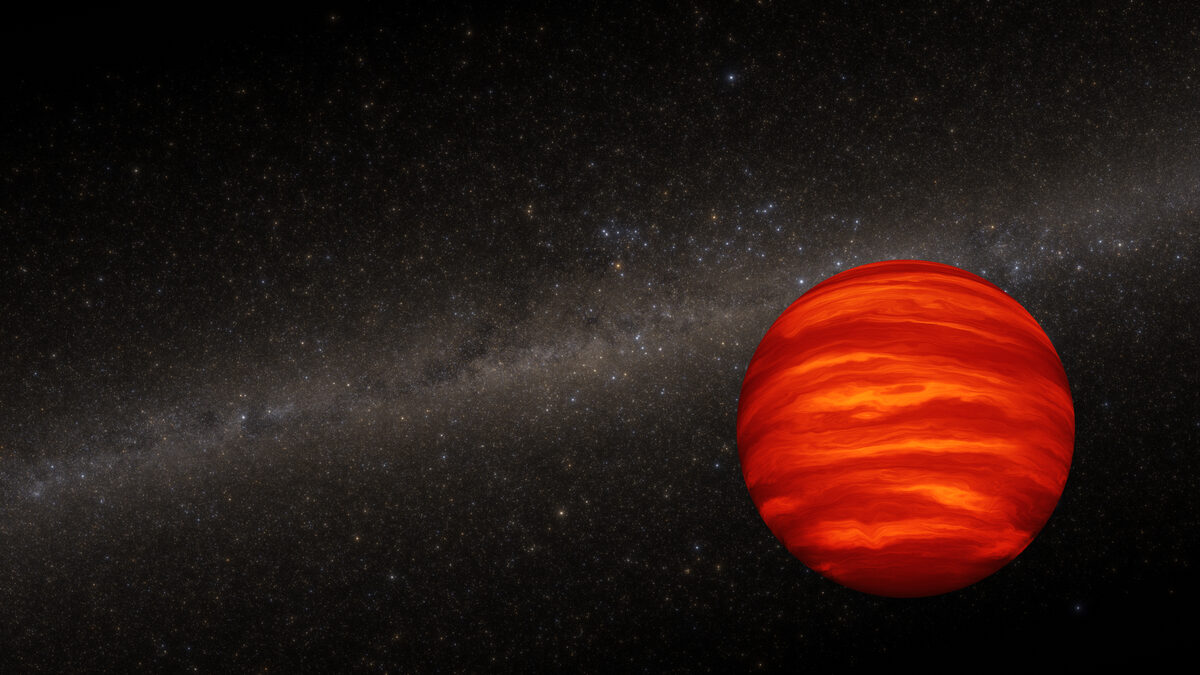
The definition of a star is surprisingly straightforward: it is an object massive enough to sustain hydrogen fusion in its core. The Sun does this at roughly 15 million Kelvin in its interior. The threshold for hydrogen ignition sits at about 80 Jupiter masses, or 0.08 solar masses. Below that mass, an object can fuse deuterium briefly in its youth, or lithium for a little longer, but it cannot sustain the proton-proton chain that keeps the Sun shining for billions of years. It glows, at first, from the heat of its formation. Then it fades. These are brown dwarfs, and they have been one of the major unsolved problems in astrophysics since their existence was first predicted in 1963 and their first confirmed member was discovered in 1995.
What makes brown dwarfs interesting is not their failure to be stars. It is what their atmospheres do. At 1,000 to 2,000 Kelvin — cooler than a red dwarf, but hotter than the coolest T-dwarfs — their upper atmospheres condense silicate and iron clouds that circulate like weather systems. Below 700 Kelvin, in the Y-dwarf class that sits at the cold end of the brown dwarf sequence, ammonia clouds form, methane absorption dominates the near-infrared spectrum, and temperatures approach those of gas giant planets. The coolest confirmed Y-dwarf, WISE J085510.83-071442.5, has an effective temperature around 250 Kelvin — warmer than a kitchen oven set to its lowest setting, cooler than the boiling point of water.
What Webb can see that Spitzer couldn't
Brown dwarfs are faint and red. Most of their luminosity emerges in the mid-infrared, where Earth's atmosphere is largely opaque. The Spitzer Space Telescope opened this window from 2003 to 2020 but lacked the sensitivity and spectral resolution to characterize brown dwarf atmospheres in detail. Webb changes this profoundly. Its MIRI and NIRSpec instruments cover 1 to 28 microns with sensitivity and resolution that allows detection of individual molecular species — ammonia, methane, carbon dioxide, carbon monoxide, hydrogen sulfide, phosphine — in brown dwarf spectra, building a complete inventory of atmospheric chemistry that can then be compared to atmospheric models.
Early Webb results have already forced revisions to those models. Silicate cloud features detected in VHS 1256b and other cloudy brown dwarfs show a grain size distribution different from model predictions. CO2 absorption in cold T-dwarfs is stronger than expected, implying vertical mixing that brings carbon species upward from deeper, hotter layers faster than the atmosphere has time to chemically equilibrate — a non-equilibrium chemistry that also operates in the giant planets of our own solar system. In several brown dwarfs, Webb has detected water vapor in the stratosphere where models predicted it should have rained out.
Free-floating planetary-mass objects
In 2023, a Webb survey of the Orion Nebula Cluster — a region of active star formation roughly 1,350 light-years away — produced a catalog of free-floating objects with masses between 0.6 and 13 Jupiter masses. Some of these are simply very young, very low-mass brown dwarfs, formed in the same collapse-and-fragmentation process that produces stars. But a significant subset were found in wide binary pairs — two Jupiter-mass objects orbiting each other at separations of hundreds of astronomical units, with no parent star anywhere nearby. These Jupiter-Mass Binary Objects, or JuMBOs, do not fit any straightforward formation model. They are too low in mass to have formed by the same cloud fragmentation that produces individual brown dwarfs, and they are too widely separated and too numerous to have formed as planets and then been ejected. Their origin is genuinely unknown.
The JuMBOs add to a growing catalog of anomalies at the low-mass end of the stellar sequence. The boundary between a very low-mass brown dwarf and a very massive planet, already blurry in theory, becomes nearly meaningless in practice when the same mass range includes objects formed in cloud collapse (a stellar formation process), objects formed in protoplanetary disks (a planetary formation process), and objects apparently formed through some third mechanism not yet understood. Webb is not resolving these ambiguities so much as mapping them in detail — which is the necessary precondition for eventually resolving them.
What the brown dwarf revolution tells us, provisionally, is that nature does not respect the clean categories astronomers have drawn. The sequence from massive star to neutron star to white dwarf to brown dwarf to free-floating planet to planet is not a taxonomy but a continuum, and the interesting physics lives at the boundaries.
