
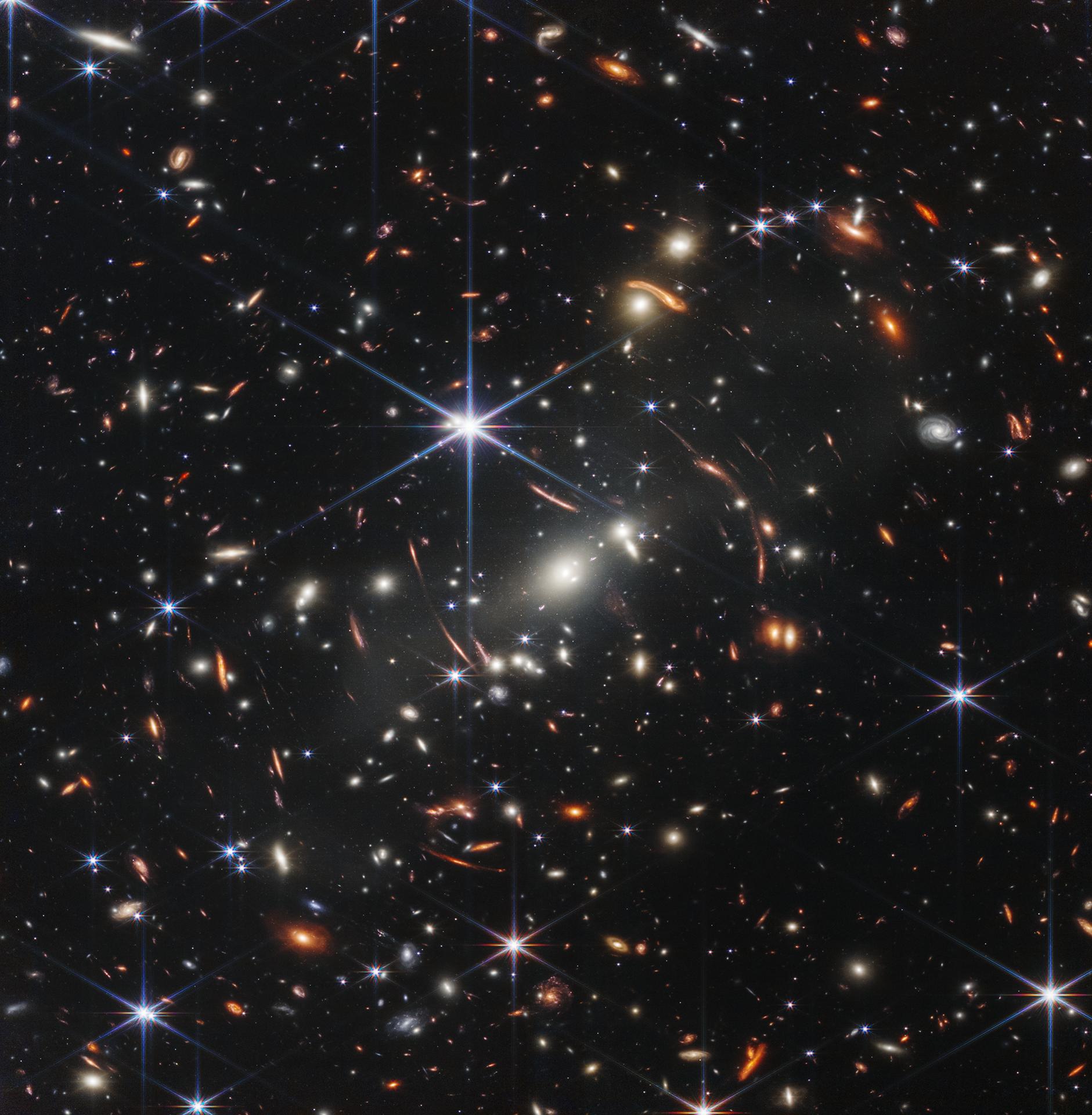
Astronomers have a durable habit of describing the universe's biggest galaxies as finished objects: elliptical, red, quiescent, done growing. The harder question has always been how they got that way. Big galaxies are not born big. The prevailing picture holds that they are assembled — stitched together over hundreds of millions of years from smaller pieces that collide, merge, and settle. That story is easy to state and notoriously hard to catch in the act, especially in the early universe where the relevant galaxies are faint, distant, and smeared into ambiguity by the limits of our instruments.
A new result from the James Webb Space Telescope offers an unusually direct look at the process. In a preprint reported on July 24, 2026, a team led by Ronaldo Laishram of the National Astronomical Observatory of Japan describes a compact proto-group they have named SCGG-z5: six spectroscopically confirmed galaxies packed into a small volume of the early cosmos, showing every sign of being in the middle of merging into one much larger object.
What Webb actually saw
The six galaxies sit at a redshift of z=4.97. In plainer terms, their light left them when the universe was roughly 1.2 billion years old — less than 10 percent of its current age. At that distance, confirming that a cluster of faint smudges is genuinely a physical group, rather than a chance alignment of objects at wildly different distances, is the whole ballgame. Line-of-sight coincidences are common; gravitationally bound neighbors are rare and far more interesting.
That is where JWST's spectroscopy earns its keep. The discovery draws on the SAPPHIRES survey, which combines the telescope's deep infrared imaging with slitless spectroscopy — a technique that spreads each source's light into a spectrum across the detector, letting astronomers pin down redshifts for many objects in a single field at once. All six members return consistent redshifts clustered at z=4.97, which is the evidence that turns a suggestive picture into a confirmed proto-group rather than a projection effect.
The six galaxies are confined within an extent of about 16,000 parsecs — a span comfortably smaller than the Milky Way's own diameter. Crowd six actively star-forming galaxies into that kind of space and gravity does the rest. The team reports that the members show disturbed, irregular morphologies: the stretched, asymmetric, tidally scrambled shapes that galaxies wear when they are pulling on one another. These are not tidy, isolated disks. They are galaxies mid-interaction.
A giant in progress
What makes SCGG-z5 worth the attention is not just its present state but its projected future. Based on the masses and configuration of the six components, the authors model the system forward and conclude that it is destined to coalesce into a single galaxy by a redshift of z~3–4 — a few hundred million years later in cosmic time — and to grow to roughly 100 billion solar masses in stars by z~1.
That endpoint matters. A hundred billion solar masses puts the merged remnant firmly in the class of genuinely massive galaxies, the kind whose early existence has repeatedly surprised astronomers since JWST began returning data. Finding such galaxies already assembled in the early universe raises an obvious question: how did they build up so fast? SCGG-z5 is a case where the answer is not inferred from a finished product but observed partway through — a construction site rather than a completed building.
The star formation adds to the picture. Of the six galaxies, three are forming stars at rates at or above what is typical for galaxies of that epoch. That is consistent with what interactions are expected to do: gravitational encounters funnel gas toward galaxy centers and light up bursts of star formation. A proto-group that is both merging and vigorously making stars is exactly the kind of engine you would want to catch if you are trying to understand how mass piles up quickly.
Why It Matters
Massive galaxies are among the best tests of how well our models of cosmic structure actually work. Simulations built on the standard cosmological framework predict that big galaxies grow hierarchically — small things merge into bigger things — and that the process should be well underway within the first couple of billion years. But predictions about early, rapid assembly have been easier to make than to verify, and JWST's early-universe discoveries have at times strained those expectations.
SCGG-z5 is valuable precisely because it is caught in the middle. Rather than showing an already-massive galaxy and forcing astronomers to reason backward about how it formed, it shows the constituent pieces still separate, still interacting, still forming stars — with a modeled trajectory toward a single ~100-billion-solar-mass galaxy. That is a direct, observational handle on the assembly of the universe's most massive galaxies, and it is the kind of measurement that only became feasible once an infrared observatory could confirm redshifts for faint proto-group members at z~5. One confirmed system does not settle the debate over how fast early galaxies grew, but it gives theorists a real object to test against instead of an inference.
What comes next
As a preprint, the Laishram team's analysis will move through peer review, and the specific numbers — the projected final mass, the merger timeline, the star-formation rates of individual members — are the sort of quantities that get refined as more data and modeling accrue. The broader value of SCGG-z5 is as a target and a template. Surveys like SAPPHIRES are built to sift Webb's deep fields for exactly these configurations, and each additional confirmed proto-group turns a claim about how massive galaxies form into a population astronomers can study statistically rather than one dramatic snapshot at a time. For now, SCGG-z5 stands as an unusually clean example of a process usually inferred rather than seen: a massive galaxy caught before it became one.
