
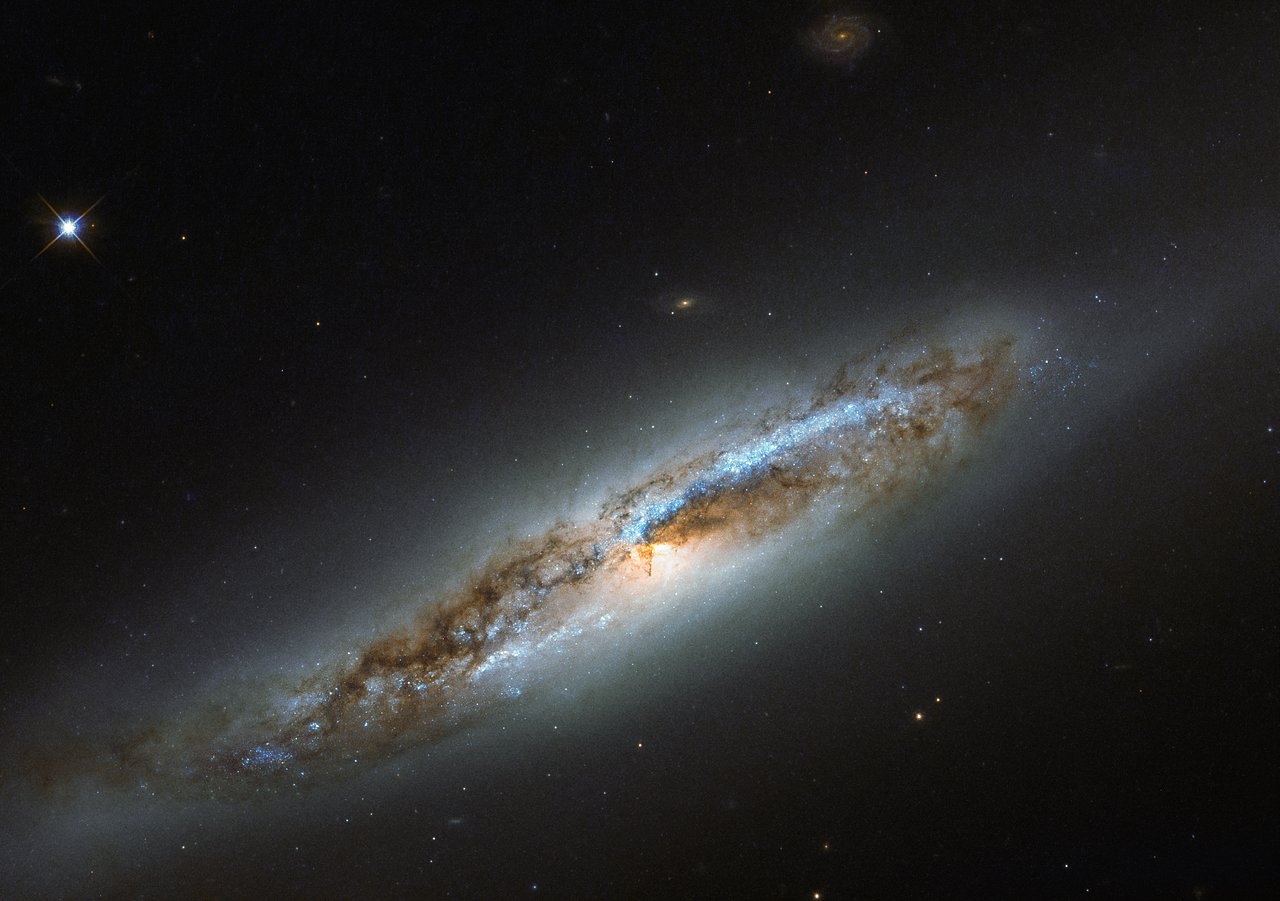
Most spiral galaxies look reassuringly balanced. Arms wind out from a central bulge in roughly matched pairs, dust lanes trace them, and the whole thing reads as a system in equilibrium with itself. NGC 4654, the subject of a Hubble image NASA released on July 24, 2026, does not read that way at all. One flank is crisp and rounded, its edge unnaturally well defined, as if something had pressed a thumb against it. The opposite flank simply trails off into a long streamer of gas.
That asymmetry is not a rendering artifact or a trick of orientation. It is a record of what the galaxy has been through — twice.
A galaxy caught in traffic
NGC 4654 is an intermediate spiral in the constellation Virgo, roughly 72 million light-years from Earth, and it sits inside the Virgo Cluster. It earns the "intermediate" label because its shape falls between spirals with a bar across their centers and those without; it has a weak bar. That cluster address is the detail that explains most of the picture. Galaxy clusters are not empty scaffolding holding galaxies apart; the space between cluster members is filled with hot, rarefied gas. A galaxy moving through that medium at high velocity does not glide. As NASA puts it, NGC 4654 "moves with such high velocity that it sweeps up and rams through the hot, rarefied gas filling the space between the Virgo Cluster's galaxies."
The result is ram-pressure stripping, and it is one of the most legible processes in extragalactic astronomy because it leaves such an obvious mark. On the leading side — the direction of travel — the intracluster medium pushes back against the galaxy's own gas, compressing it into a sharp, dense front. On the trailing side, there is nothing holding that gas in place, and it gets dragged out behind the galaxy. NGC 4654 shows both halves of that signature in a single frame: a rounded, clearly defined edge on one side and a long tail of gas stretching out from the opposite side.
Ram pressure alone would be a tidy story. But NASA's account points to a second culprit. Around 500 million years ago, NGC 4654 had a close gravitational encounter with a fellow Virgo Cluster galaxy, NGC 4639. The encounter ripped away NGC 4654's gas along one side and, having removed the raw material, limited star formation there. Two different mechanisms — one hydrodynamic, one gravitational — worked on the same galaxy, and the image is the superposition of their effects.
What the compressed edge is actually doing
Here is where the peer-reviewed literature makes NGC 4654 more interesting than a pretty picture. In a 2021 paper in Astronomy & Astrophysics, T. Lizée, B. Vollmer, J. Braine and F. Nehlig modeled the galaxy specifically as a system that is tidally interacting and ram-pressure stripped at the same time — and then looked closely at the strongly compressed gas region near the outer edge of the optical disk, on the northwestern side.
What they found there is a zone with atomic hydrogen surface densities significantly exceeding the canonical value of 10–15 solar masses per square parsec, and gas that has been pushed past a threshold. The Toomre parameter — the standard measure of whether a rotating gas disk can resist collapsing under its own weight — comes out around Q ≈ 0.8 in that region. Values below one mean the gas is self-gravitating and gravitationally unstable: it is no longer being held up, and it should be collapsing into stars.
It is. Star-formation efficiency in the compressed region runs 1.5 to 2 times higher than the typical disk value. The compression is not merely rearranging gas; it is converting it into stars faster than the same galaxy manages elsewhere. The modeling also estimated a CO-to-H2 conversion factor of one to two times the Galactic value in the high-surface-density region, with the higher end favored — a technical detail, but one that matters, because that conversion factor is the bridge between what a telescope sees in carbon monoxide emission and the molecular hydrogen mass astronomers actually want to know about.
Feedback as the brake
The obvious question about a runaway compression is why it does not run away. Squeeze self-gravitating gas and the naive expectation is a rapid, escalating collapse — density climbs, star formation climbs, density climbs further.
Lizée and colleagues' modeling points to stellar feedback as the regulator. Young, massive stars pump energy back into their surroundings, and the models require an increase in the velocity dispersion of about 5 km/s in the compressed region — combined with that Q ≈ 0.8 — as a necessary condition for reproducing the observed gas distribution and star formation rate. The effect of that added turbulence is to hold the line: feedback increases the turbulent velocity of the gas while the gas density increases only moderately, by less than a factor of two, during the compression. The galaxy is being squeezed, and it is pushing back just hard enough to keep the process orderly. The paper also finds a significant decrease in the ratio between the molecular fraction and the total ISM pressure in that high-surface-density region, another sign that the usual relationships between pressure and molecular gas do not hold cleanly when a disk is being externally compressed.
For all of it — the stripping, the tidal encounter, the gas hauled off into a tail — NGC 4654 remains a working galaxy. It is still forming nearly two Suns' worth of stars every year, a rate comparable to other galaxies of similar size.
What Hubble is contributing
The new image draws on data from two Hubble observing programs, #15654 and #17502, both aimed at linking the gas in galaxies with star formation. The observations pick up a wavelength of red light emitted by clouds of energized gas where newborn stars lurk; the bright pink bubbles scattered across NGC 4654 — from its forward spiral arm, to around its weak bar, and out to the edge of its disk — are the areas where those newborn stars shine. Mapping where they sit relative to the compressed edge and the depleted, tidally scoured side is precisely the point of the observations.
Why It Matters
Galaxy evolution is usually discussed in terms of internal properties — mass, gas fraction, black hole activity — because those are the variables that are easiest to isolate. NGC 4654 is a reminder that a galaxy's address can matter as much as its physiology. The same galaxy, dropped into a quiet corner of the universe, would presumably look symmetric and unremarkable. Placed in a cluster and moving fast through hot gas, with a neighbor passing close enough to pull, it becomes visibly deformed within a few hundred million years.
What makes this particular object valuable is that both processes are still legible at once. Ram-pressure stripping and tidal interaction often get studied separately because disentangling them is hard; here the geometry cooperates, with the compression front on one side and the tidal damage and gas tail on the other. And the physics of what happens inside the compressed zone — unstable gas, elevated star-formation efficiency, feedback capping the density rise — is the same physics that governs star formation everywhere, just turned up where it can be watched.
Clusters are where a large fraction of galaxies eventually end up, and stripping is one of the main ways those galaxies lose the gas they need to keep forming stars. NGC 4654 is a single frame that shows the mechanism partway through, before the gas is gone.
Sources
- Hubble Spies One-Sided Spiral — NASA Science, July 24, 2026
- Lizée, Vollmer, Braine & Nehlig, "Gas compression and stellar feedback in the tidally interacting and ram-pressure stripped Virgo spiral galaxy NGC 4654" (arXiv:2011.10531)
- Astronomy & Astrophysics 645, A111 (2021) — full text (DOI 10.1051/0004-6361/202038910)
