
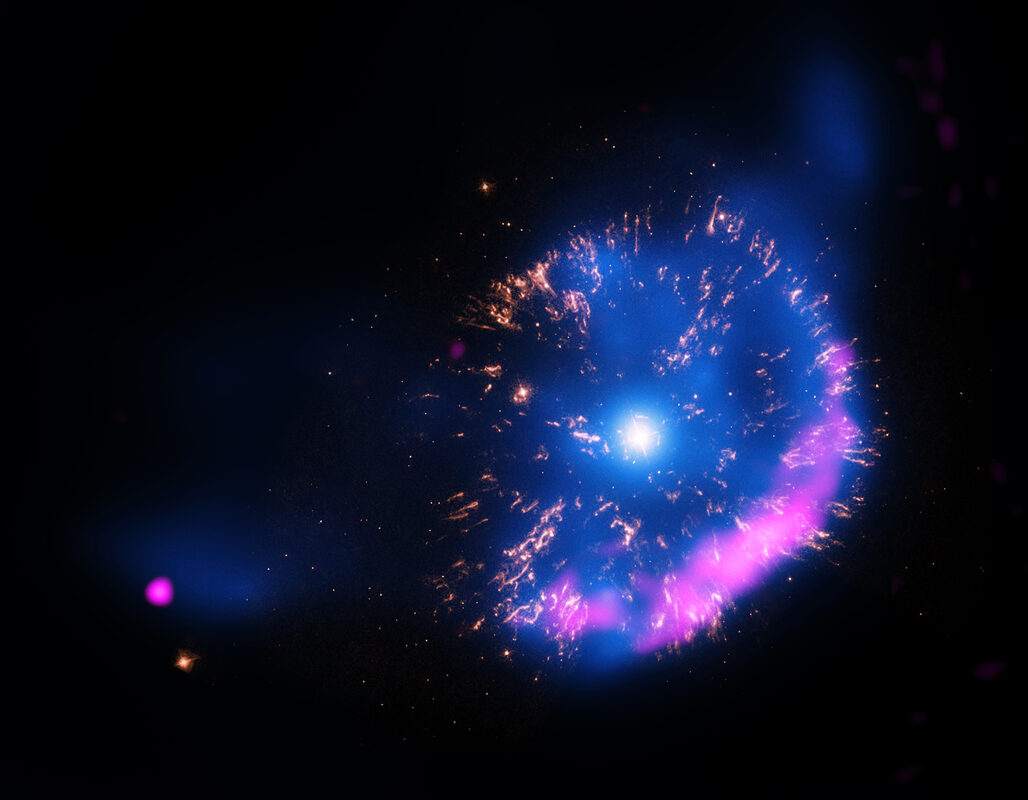
Novae are among the more repetitive spectacles in the galaxy. A white dwarf siphons hydrogen off a companion star, the stolen gas piles up on the dwarf's surface until it reaches a thermonuclear tipping point, and the whole envelope detonates in a runaway fusion flash. The star brightens by thousands of times, sheds a shell of gas, and — in the recurrent cases — settles down to do it all again. It is a well-understood cycle. Which is exactly why a nova that behaves unexpectedly is worth stopping for.
According to imagery from NASA's Hubble Space Telescope, reported on July 24, 2026, one such nova is doing something its textbook description does not obviously account for: it is firing dense, discrete clumps of material — described as "bullets" — outward through the Milky Way at roughly 20 million miles per hour. And the part that has drawn attention is not the speed alone. It is that astronomers reporting the observation say the origin of the bullets is a mystery.
What the observation actually shows
Strip the story down to what has been verified, and the core is compact. Hubble captured a nova. The eruption is not simply pushing out a smooth, expanding shell of gas, as the standard picture would predict. Instead, the ejecta include tight, fast-moving knots of material — the "bullets" — screaming outward at a velocity on the order of 20 million mph. That is close to three percent of the speed of light, extraordinarily fast for material flung off a stellar surface. Where those concentrated projectiles come from, and what focuses them into clumps rather than a diffuse cloud, is the open question.
It is worth being precise about what remains unconfirmed at the time of writing. The specific designation of the nova, its distance from Earth, the team that made the observation, and the peer-reviewed paper underpinning the result had not surfaced on NASA's or the Space Telescope Science Institute's public Hubble news feeds as of this report. Those feeds in late July 2026 were carrying other Hubble items — a "one-sided spiral" galaxy and the discovery of the first of a star cluster's long-missing black holes — but not this one. So while the phenomenon is on record, several of the details a reader would reasonably want are still pending the formal release.
Why 'bullets' are strange
To appreciate the puzzle, it helps to know what astronomers expect a nova to look like. The classic model is spherical, or close to it: the thermonuclear flash lifts the accreted layer off the white dwarf and it expands more or less evenly outward, forming a roughly shell-shaped remnant that thins and fades over years. Real novae are messier than the idealized sphere — clumping, filaments, and bipolar structures show up regularly, shaped by the binary's orbital motion, magnetic fields, and the density of surrounding gas. But highly collimated, fast knots moving at a substantial fraction of light speed are a different order of behavior, closer to the jets seen in more energetic systems than to a gentle expanding bubble.
Several mechanisms could, in principle, concentrate ejecta into fast bullets: a magnetic field on the white dwarf channeling outflow along preferred directions, the companion star or an accretion disk acting as a nozzle that shapes and speeds up escaping gas, or shocks within the ejecta itself carving the smooth flow into dense clumps. Each of those is a real process seen elsewhere in astrophysics. Which one — if any — is at work here is precisely what the reporting frames as unresolved. Calling the origin a "mystery" is not marketing; it is an accurate description of a result that a single image can raise but not settle.
Why It Matters
Novae are laboratories for physics that is otherwise hard to reach. They are among the sources that seed the interstellar medium with heavier elements, and they double as testbeds for how thermonuclear runaways, accretion, and stellar winds interact. A nova that launches material at 20 million mph in focused bullets is a stress test for the standard model of these explosions: if the textbook spherical-shell picture cannot produce those clumps, then something about the geometry — magnetic fields, the binary companion, or shock physics — has to be doing more work than the simple version allows. Pinning down the mechanism would sharpen models of not just novae but the broader family of accreting compact objects, up to and including the white-dwarf systems thought to trigger some Type Ia supernovae, the explosions cosmologists lean on to measure the universe's expansion. That is a lot riding on a fast-moving clump of gas. It is also why the missing details — the star's name, its distance, the paper behind the image — are not incidental. They are what will turn a striking picture into a testable claim.
For now, the honest summary is the interesting one: Hubble has caught a nova doing something the standard script does not neatly explain, at a speed that makes the "bullet" metaphor more literal than usual, and the people who caught it are saying, plainly, that they do not yet know why.
