
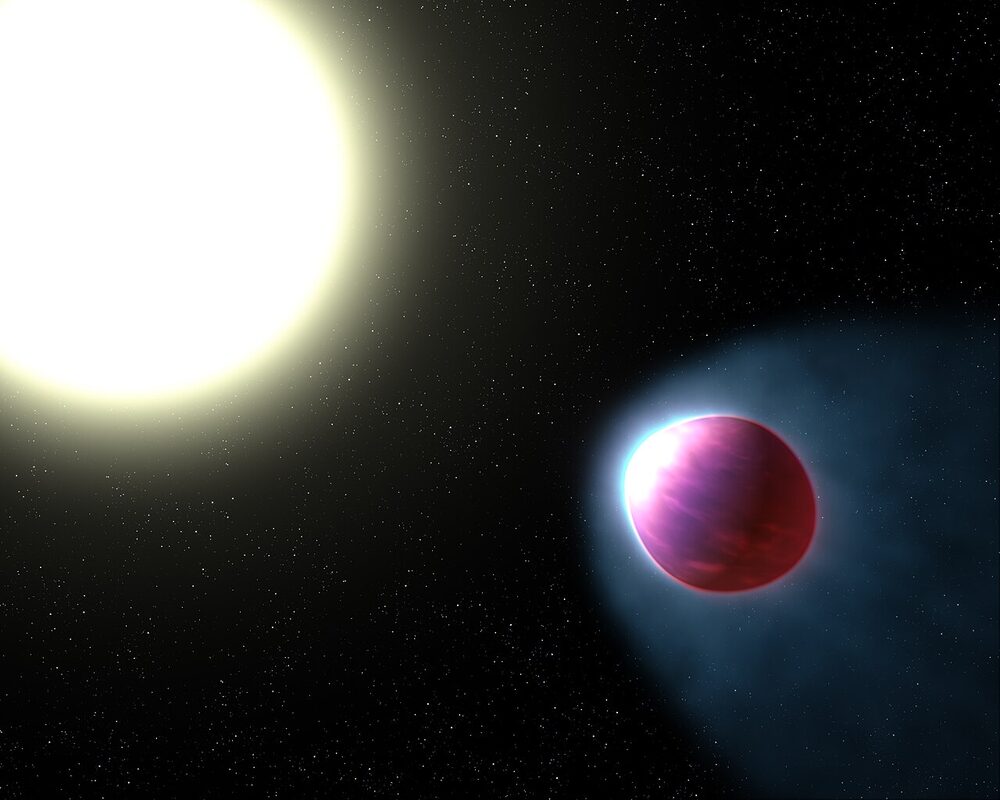
Most of what we know about exoplanet atmospheres comes from a single trick of geometry. When a planet crosses in front of its star, a sliver of starlight filters through the planet's atmosphere on its way to our telescopes, and the gases there leave fingerprints in the light. For years that technique has treated a planet's atmosphere as one thing — a single averaged blend of chemistry and temperature. A new result from the James Webb Space Telescope shows that the average can hide a planet at war with itself.
The world in question is WASP-121b, an ultra-hot Jupiter so close to its star that it completes an orbit in just over a day. A team led by Cyril Gapp, a doctoral student at the Max Planck Institute for Astronomy in Heidelberg, used JWST to separate the light passing through the planet's morning edge from the light passing through its evening edge — the two halves of the thin ring of atmosphere visible during a transit. Published in Nature Astronomy, the analysis found that those two edges are not the same. The dawn and dusk terminators of WASP-121b carry different temperatures and different chemistry.
Why a tidally locked world has weather
WASP-121b is almost certainly tidally locked, meaning one face is permanently roasted by its star while the other faces perpetual night. That arrangement sets up ferocious winds and temperature contrasts. Material heated on the dayside gets dragged around the planet by jet-stream-scale flows, cooling and changing chemically as it goes. By the time gas reaches the evening terminator — the edge rotating from day into night — it has a different history than the gas arriving at the morning terminator from the night side. JWST is now sensitive enough to read that history in the spectrum.
The asymmetry shows up as a difference in how infrared light is absorbed on the two sides: the evening terminator absorbs more starlight than the morning one. The team reads that as the fingerprint of powerful eastward winds dragging heat from the dayside around toward the night, so that the evening edge runs hotter and its water vapor is partly torn apart by the heat. The contrasts on this planet are staggering — the dayside averages around 2,770 kelvin while the nightside sits closer to 1,000 — so the two terminators are genuinely different environments. In effect, WASP-121b has a morning climate and an evening climate, and they are measurably distinct.
WASP-121b is an apt subject for this kind of scrutiny because it has long been one of astronomy's favorite laboratories. Its dayside runs so hot — thousands of degrees — that metals which would be solid rock on Earth exist there as vapor; earlier studies detected heavy elements such as iron and magnesium streaming through its atmosphere, and there is evidence the planet is slowly losing gas to space. Some models even suggest that metals vaporized on the scorching dayside could condense into clouds and fall as a kind of liquid-metal rain as they cycle toward the cooler nightside. A planet that violent is the perfect place to test whether our instruments can resolve regional differences, because the contrasts are large enough to measure. The lessons, though, are meant to scale down to subtler worlds.
What it changes
The finding is less about this one bizarre planet than about a blind spot in how the field has worked. If atmospheres routinely differ from limb to limb, then a spectrum that blends both sides together can mislead — averaging two real states into one that exists nowhere on the planet. Teasing the terminators apart, as this work does, is the path to atmospheric maps rather than atmospheric averages.
Ultra-hot Jupiters like WASP-121b are ideal test subjects precisely because they are extreme: bright, puffy, and chemically active, they push instruments and models to their limits. Lessons learned reading their lopsided skies will eventually carry down to smaller, cooler, more Earth-like worlds, where the differences between a planet's day and night edges may carry far more consequential information. For now, WASP-121b stands as a vivid demonstration that an exoplanet is not a single point of data but a place — with regions, circulation, and a morning that does not match its evening.
