
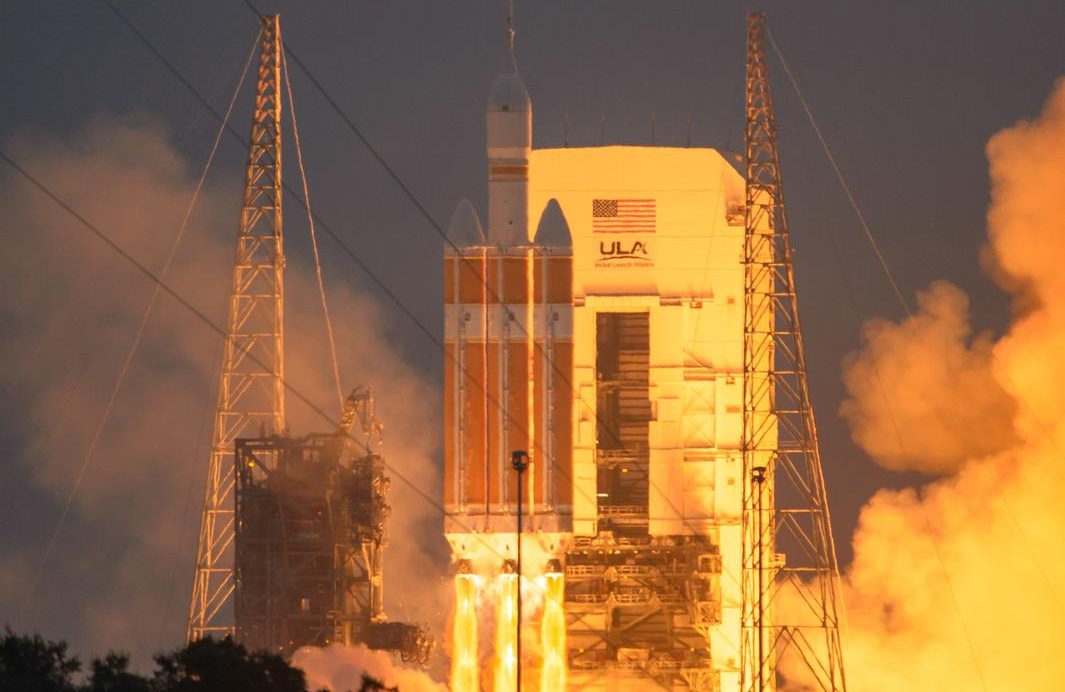
There is a particular kind of pressure that comes with replacing a rocket that has never failed. Atlas V flew 99 missions over two decades without losing a payload. Delta IV, including its Heavy variant, compiled a similarly enviable record. Together, those two boosters carried the satellites that define American military and intelligence capability — GPS constellations, reconnaissance platforms, classified national security payloads whose replacement cost alone would run into the tens of billions of dollars. The question hanging over Vulcan Centaur from the moment United Launch Alliance announced it in 2014 was not whether it could perform better than its predecessors. The question was whether it could perform at all, reliably enough, to be trusted with the same cargo.
Certification Flight 1 launched in January 2024 carrying Astrobotic's Peregrine lunar lander — a mission that ended in disappointment due to a propellant leak in the spacecraft, not the rocket. Vulcan itself performed nominally, delivering Peregrine to the correct trajectory. Certification Flight 2, carrying Sierra Space's Dream Chaser-adjacent payload under contract, completed the two-flight certification sequence required by the U.S. Space Force before Vulcan could carry national security payloads. That certification has now been granted. Vulcan Centaur is cleared for operational service, and ULA is loading its manifest accordingly.
What Vulcan actually is
Vulcan is not an iteration on Atlas V. It is a clean-sheet vehicle, though one informed by decades of operational experience. The first stage is powered by two BE-4 engines built by Blue Origin — a methane-liquid oxygen combination that produces roughly 550,000 pounds of thrust each. The choice of BE-4 was itself a saga: ULA initially considered the AR1 from Aerojet Rocketdyne before settling on Blue Origin, a decision that created a years-long dependency on an engine supplier that was itself developing the engine for New Glenn simultaneously. Engine delivery delays pushed Vulcan's first launch from 2020 to 2022 and ultimately to 2024.
The upper stage, Centaur V, is the spiritual and engineering descendant of a stage that has been flying since 1966. Centaur's hallmark has always been its high-energy liquid hydrogen and liquid oxygen propellant combination, which gives it exceptional specific impulse — a measure of fuel efficiency — making it particularly capable of delivering payloads to high-energy orbits: geostationary transfer, lunar trajectory, the escape velocities needed for deep-space missions. Centaur V is larger than its predecessors, with a 5.4-meter diameter to match Vulcan's first stage, and is designed to perform extended coast phases that allow it to raise payloads from low Earth parking orbits to their final destinations over hours rather than minutes.
The shroud comes in two diameters — 4 meters and 5.4 meters — and Vulcan can fly with up to six solid rocket boosters strapped to its first stage, giving it a payload range from roughly 27,000 kilograms to low Earth orbit in its heaviest configuration down to more modest performance in its baseline two-booster or no-booster modes. This modularity is deliberate: it allows ULA to right-size the rocket for the mission rather than always flying maximum capability, which has cost implications in a market where every dollar of launch price matters more than it once did.
The competitive context has transformed
When Vulcan was announced, SpaceX's Falcon 9 was already flying but had not yet demonstrated reusability at scale. Falcon Heavy was still on paper. New Glenn did not exist outside of a PowerPoint. The commercial launch market was a duopoly at best, with ULA commanding the national security segment almost exclusively and SpaceX competing at the margins of commercial geostationary satellite launches.
That world is gone. Falcon 9 has now completed well over 350 flights and lands its booster with near-routine reliability, allowing SpaceX to amortize first-stage costs across a dozen or more missions. Falcon Heavy, while less frequently flown, handles the heaviest national security payloads. New Glenn has reached orbit on its second attempt. Rocket Lab's Neutron is in development. Relativity Space pivoted away from Terran R before completing it, but others have filled the gap. Internationally, Arianespace's Ariane 6 has finally reached operational service after its own years of delays, and JAXA's H3 is flying. The launch market in 2026 offers more operational heavy-lift options than at any prior point in the space age.
Into this environment, Vulcan arrives without the one advantage that has come to define the economics of modern launch: reusability. ULA has discussed a concept called SMART — Sensible Modular Autonomous Return Technology — which would recover Vulcan's BE-4 engines from the falling first stage using an inflatable heat shield and midair capture by a helicopter. The concept has been demonstrated in subscale tests, but it is not operational, and even if it were, it would recover the engines rather than the entire stage. Full first-stage reuse in the SpaceX manner is not in Vulcan's design. ULA's argument is that Vulcan's economics remain competitive because its reliability record and mission assurance processes command a premium in the national security market, where the cost of launch is a small fraction of the cost of the satellite and the cost of failure is effectively incalculable.
That argument has held. The U.S. Space Force's Phase 2 Launch Services Procurement contract awarded ULA and SpaceX roughly equal shares of national security launches through the late 2020s. Vulcan is expected to carry approximately 40 percent of those missions. The arrangement acknowledges something implicit in American national security space policy: the government does not want a single-vendor dependency for access to orbit, regardless of which vendor that is.
What the manifest looks like from here
The immediate Vulcan manifest is anchored by two categories of mission. The first is United States Space Force and intelligence community payloads — GPS III satellites, protected communications satellites in the Advanced Extremely High Frequency series, and classified missions for the National Reconnaissance Office that ULA will not describe in any detail beyond trajectory parameters. These are the missions Atlas V was built to fly, and Vulcan inherits the relationship along with the infrastructure: the Cape Canaveral launch facilities, the processing flows, the integration teams that have spent careers learning exactly how much vibration a particular satellite bus can tolerate.
The second category is commercial and civil science. Amazon's Project Kuiper — the company's answer to Starlink — has contracted for a substantial number of Vulcan launches to deploy its broadband constellation. The Sierra Space Dream Chaser spaceplane, if it reaches operational status, is manifested on Vulcan for ISS cargo resupply missions under NASA's Commercial Resupply Services 3 contract. Several commercial geostationary communications satellites round out the near-term manifest.
What Vulcan cannot yet offer is the cadence that SpaceX has demonstrated. ULA has historically launched fewer than a dozen rockets per year, and Vulcan is not positioned to change that dramatically in the near term. The BE-4 production rate at Blue Origin is improving but is still a constraint. ULA's manifest for 2026 lists perhaps five to seven Vulcan flights, depending on customer schedule alignment. That is a reliable, methodical pace — appropriate for a company whose institutional culture was forged in an era when a launch every six weeks was considered aggressive.
The broader significance of Vulcan's entry into regular service is less about any individual mission and more about what it signals for the structure of the launch industry. The United States now has two domestically-developed heavy-lift rockets in operational service — Falcon 9 and Falcon Heavy on one side, Vulcan Centaur on the other — with New Glenn joining the active roster and SLS flying at minimal cadence for Artemis. That is a depth of capability without historical precedent. Whether the market can sustain all of these vehicles economically is a different question, and one the next five years will begin to answer.
