
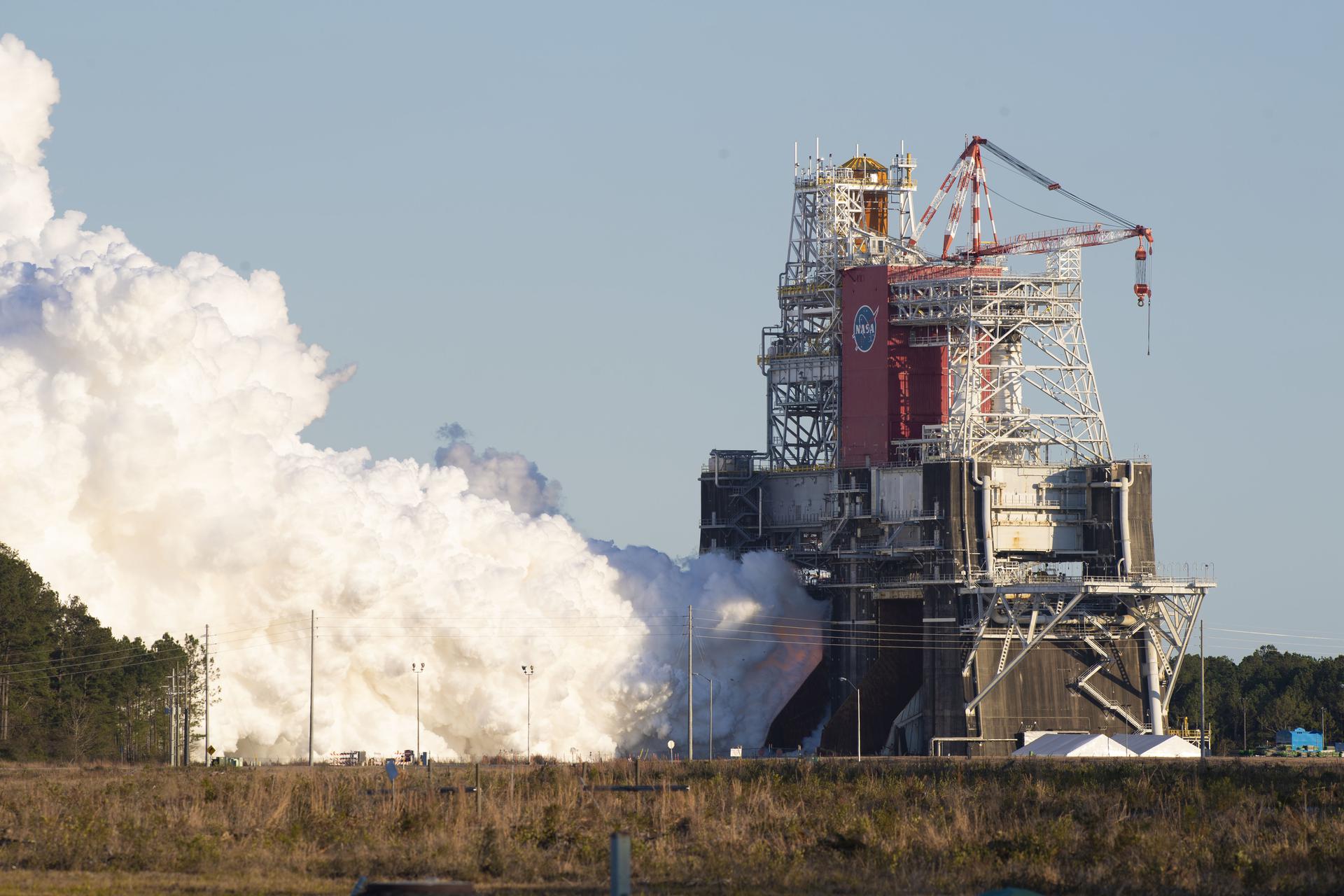
NASA is lending one of its most storied pieces of rocket infrastructure to Blue Origin. On July 24, 2026, the agency announced an agreement to ready the B-2 test stand at Stennis Space Center in Mississippi for hot-fire testing of New Glenn's second stage — the LOX/LH2 upper stage powered by a pair of Blue Origin's BE-3U engines. Testing is targeted for fall 2026, and NASA is framing the arrangement squarely as an Artemis play.
Under the deal, signed in early July, NASA will supply engineers, equipment, and building services to prepare B-2 for the campaign. In practical terms, Blue Origin is shifting hot-fire testing of its New Glenn upper-stage engines onto government infrastructure rather than standing up an equivalent capability entirely on its own — a shift Aviation Week likewise reported.
What Actually Gets Tested
The hardware in question is New Glenn's second stage. It runs on two BE-3U engines, each producing roughly 200,000 pounds of thrust in vacuum and burning liquid oxygen and liquid hydrogen. Hydrogen is a demanding propellant — cryogenically cold, prone to leaks, energetic — and validating a stage that carries two hydrogen engines feeding it is exactly the kind of work a full-scale hot-fire stand exists to do. You fire the integrated stage on the ground, under instrumented and repeatable conditions, before you trust it to light in space.
That's where B-2 comes in. The B-2 position is part of Stennis' large B-1/B-2 dual test stand, the same class of facility NASA has used for decades to prove out big liquid-propellant stages. Prepping it for New Glenn's upper stage means the second stage can be exercised at full scale on the ground rather than debugged in flight.
Why Blue Origin Wants NASA's Stand
The subtext of the announcement is timing. New Glenn is early in its operational life, and Blue Origin needs a way to wring out its upper stage quickly and repeatedly. Building a dedicated large-stage hydrogen hot-fire facility from scratch is expensive and slow; borrowing a proven NASA stand and staffing it with agency expertise compresses that schedule.
For NASA, the logic runs the other direction. The agency wants New Glenn flying reliably because it has assigned the rocket real jobs. NASA says New Glenn is slated to support Artemis, including the multi-launch campaign behind Artemis III — a plan that depends on rendezvous and docking in low Earth orbit, stitching together elements delivered across several launches. A rocket that anchors part of that architecture is a rocket NASA has a direct stake in maturing. Helping test the upper stage is, from the agency's view, helping its own program stay on schedule.
NASA Administrator Jared Isaacman and Blue Origin CEO Dave Limp both provided statements framing the agreement as a step toward that shared Artemis goal.
The Lunar Payload Riding This Fall
The agreement lands alongside a more immediate milestone. Blue Origin's Blue Moon Mark 1 Endurance lander is slated to deliver NASA payloads to the Moon's South Pole this fall, touching down at the Shackleton Connecting Ridge — a location of interest precisely because of the permanently shadowed, potentially ice-rich terrain that makes the lunar South Pole the focus of Artemis-era exploration.
So Blue Origin is running two lunar-relevant threads at once: proving out the New Glenn upper stage on the ground at Stennis, and putting a robotic lander on the Moon carrying NASA cargo. Both feed the same long-term objective of returning crew and hardware to the lunar surface, and both put Blue Origin's systems in front of NASA as working, tested articles rather than promises.
Why It Matters
Ground-testing an upper stage is unglamorous but decisive work — it is where hydrogen plumbing, engine start sequences, and stage-level behavior get proven before anyone bets a mission on them. By opening B-2 to New Glenn, NASA is doing more than renting out a stand: it is signaling that New Glenn's success is entangled with Artemis' own timeline. If the fall 2026 hot-fire campaign goes well, it de-risks a rocket NASA is counting on, including the intricate multi-launch, LEO-rendezvous approach to landing Artemis III. If it surfaces problems, better to find them on a Mississippi test stand than in orbit. Either way, the arrangement is a concrete example of the government and a commercial launch provider pooling infrastructure and expertise to move a national program forward — and a reminder that the hard part of a new rocket often happens on the ground, long before the cameras point at a launch pad.
