
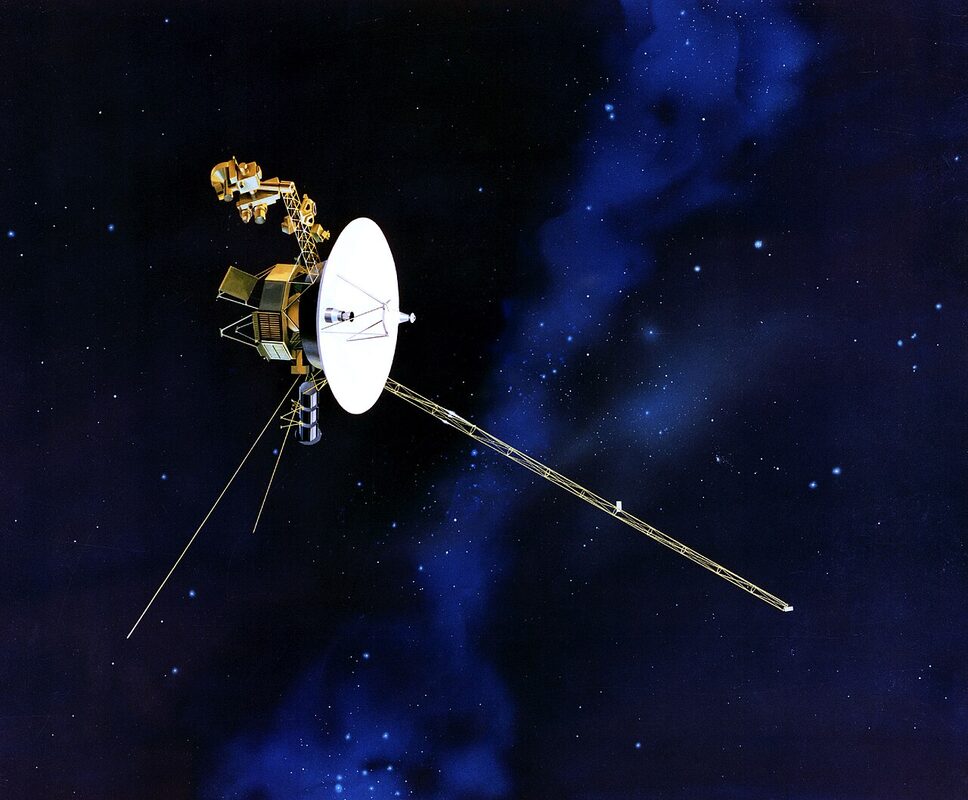
In 1977, NASA launched two spacecraft built with 1970s technology, computers less capable than a modern car key fob, on a tour of the outer planets. Nearly fifty years later, both Voyager 1 and Voyager 2 are still operating — and they are now the only human-made objects ever to cross into interstellar space, the region beyond the bubble of charged particles the Sun blows around itself. Voyager 1 made that crossing in 2012, Voyager 2 in 2018. They are each more than 20 billion kilometres away, so distant that a radio command travels for the better part of a day before reaching them, and an equal span before any reply returns.
Flying where nothing has flown
That the Voyagers still return useful data from interstellar space is a quiet triumph. After completing their famous reconnaissance of Jupiter, Saturn, and — for Voyager 2 alone — Uranus and Neptune, the probes kept flying outward, and their instruments began measuring something no spacecraft had ever sampled directly: the medium between the stars. They have charted where the solar wind gives way to the interstellar wind, measured the density of the surrounding plasma, and detected the faint, persistent hum of interstellar gas. These are first-ever, irreplaceable measurements, taken in a place we have no other way to reach.
Each probe also carries a Golden Record, a gold-plated phonograph disc bearing sounds and images of Earth — greetings in dozens of languages, music from Bach to Chuck Berry, the cry of a whale — a message in a bottle cast into the cosmic ocean on the slim chance that some future intelligence might one day find it. The records will outlast the spacecraft, the planet that built them, and very likely the human species, drifting between the stars for billions of years.
It is worth remembering what these two machines accomplished before they ever reached interstellar space. On their grand tour of the outer solar system they returned humanity's first close views of the giant planets and their moons, revealing wonders no one had predicted: active volcanoes erupting on Jupiter's moon Io, the intricate braided structure of Saturn's rings, the tilted blue blandness of Uranus, and the supersonic winds of Neptune — the only close-up visits those two ice giants have ever received. In 1990, as Voyager 1 looked back from beyond the planets, it captured the famous "Pale Blue Dot," Earth reduced to a single bright pixel suspended in a sunbeam, an image that quietly reframed how a generation understood its place in the cosmos.
The slow dimming
But the Voyagers are running out of power. Each is fueled by a radioisotope generator that converts the heat of decaying plutonium into electricity, and that heat source fades a little every year — the probes lose roughly four watts of available power annually, a relentless decline that no amount of clever engineering can reverse. To stretch the mission, controllers have been shutting down instruments and heaters one by one, making agonizing choices about which science to sacrifice to keep the rest alive. Subsystems that have run continuously for nearly five decades are going dark by deliberate choice, to leave just enough power for the most valuable measurements and the transmitter that carries them home.
Sometime in the coming years, probably before the 2030s are out, the last instrument will be switched off and the final signal will fade below the threshold of detection. The spacecraft will sail on, silent and inert, on trajectories that will carry them past other stars over timescales of tens of thousands of years. The Voyagers are a reminder of how far a well-built machine and a patient team can go: two probes, designed for a four-year tour of the giant planets, that instead became humanity's first emissaries to the space between the stars, still whispering back across the void half a century later — for now.
