
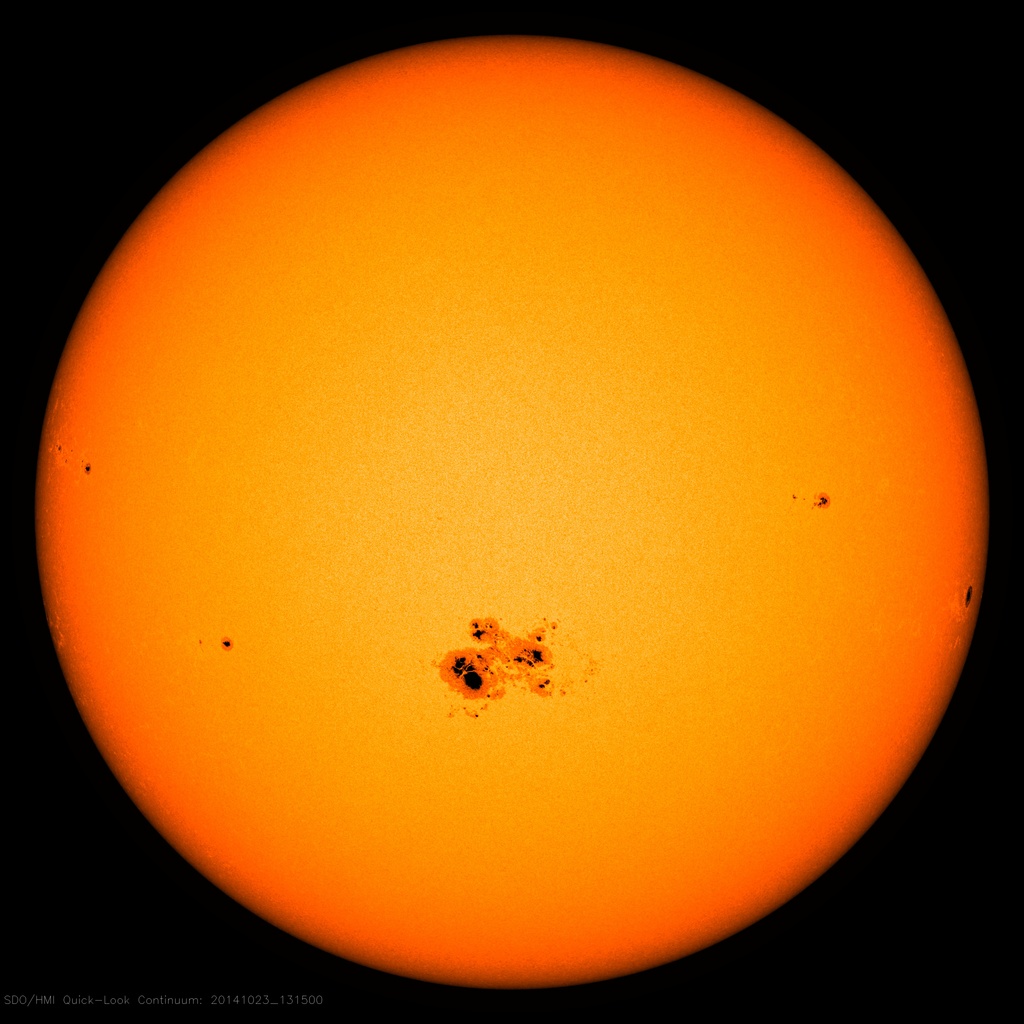
For decades, the standard picture of the solar cycle has been a gentle rise and fall: sunspots and storms build to a raucous maximum roughly every 11 years, then trail off into a quiet minimum before the whole thing begins again. It is a tidy story. According to work presented at the UK's National Astronomy Meeting (NAM 2026) on 20 July 2026, it is also, in one important respect, wrong.
Sandra Chapman, Professor of Physics and Director of the Centre for Fusion, Space and Astrophysics at the University of Warwick, argues that the Sun's most violent space weather does not fade away. It shuts off. There is a specific moment in each cycle - a 'switch-off' - after which the extreme storms simply stop, and the exact number of sunspots present when that switch flips turns out to carry a message about the strength of the cycle still to come.
What actually switches off
The mechanism Chapman describes hinges on where the Sun's active regions live. Sunspots and the magnetically tangled active regions around them do not stay put over a cycle; they migrate. Early in a cycle they emerge at higher solar latitudes, and as the cycle matures they drift steadily toward the equator.
The switch-off happens when those active regions cross below roughly 15 degrees of solar latitude and settle into a co-rotating band near the equator. Above that band, the Sun's differential rotation - the fact that different latitudes spin at different rates - shears and stresses magnetic fields, and it is that shearing that drives the most powerful coronal mass ejections, the enormous eruptions of plasma and magnetic field responsible for the worst geomagnetic storms at Earth. Once the active regions sink into the equatorial band, differential rotation weakens where it matters, and the CME-driving machinery falls quiet.
In other words, the extreme space weather doesn't taper. It has an off point, tied to a geometric threshold on the Sun's surface. And that turns the whole thing into a clock.
Reading the next cycle in the leftovers
Here is the part that makes the finding a forecasting tool rather than a curiosity. The number of sunspots present at the switch-off moment correlates with how strong the following cycle will be. Count the spots as the switch flips, and you get an early read on the next solar maximum.
Because the switch-off occurs years before the next cycle peaks, the method delivers a forecast six to seven years ahead of solar maximum - a strikingly long lead time in a field where many models must wait for the current cycle to bottom out at solar minimum before they can say much at all about the next one.
Applied to the present, Chapman's early estimate puts the coming Solar Cycle 26 at a moderate sunspot number of roughly 100 to 120 - similar to, or a touch weaker than, the current Cycle 25. That is not a forecast of a monster cycle, nor of an unusually feeble one. It points to more of the same.
The estimate should firm up soon. Researchers are roughly two years out from Cycle 25's own switch-off point. Once the Sun crosses that threshold, observations alone - rather than extrapolation - will sharpen the Cycle 26 prediction.
Why anyone should trust it
A novel forecasting claim about the Sun is easy to make and hard to earn confidence in. The reason Chapman's method is getting attention is its track record on the cycle we are living through now.
When Cycle 25 was ramping up, consensus models generally called for a relatively weak cycle. Chapman's approach disagreed, predicting that Cycle 25 would come in stronger than the mainstream expectation. That contrarian call was borne out in dramatic fashion by the geomagnetic storms of 10 to 13 May 2024 - among the most powerful in decades, strong enough to push auroras far from the poles and rattle operators of power grids and satellites. A method that correctly bet against the consensus, and was then validated by one of the most severe storm episodes in living memory, has bought itself a serious hearing.
Why It Matters
Space weather is no longer an abstract concern for a handful of solar physicists. Coronal mass ejections and the geomagnetic storms they trigger can degrade or damage satellites, disrupt GPS and radio communications, force airlines to reroute polar flights, accelerate orbital decay of spacecraft, and in the worst cases stress high-voltage power grids on the ground. As more of civilization's infrastructure moves into orbit and grows more dependent on precise timing and positioning signals, the cost of being caught off guard climbs.
The practical value of Chapman's switch-off signal is time. Most operational forecasting works on short horizons - days for a specific storm, and often only after the current cycle has reached minimum for the shape of the next one. A method that flags the strength of the coming cycle six to seven years before its peak gives satellite operators, grid managers and mission planners a genuinely long runway to harden hardware, schedule launches, and design for the environment they will actually face. A moderate Cycle 26 forecast is itself reassuring news - but the deeper significance is that the Sun may be telling us how its next act will go far earlier, and far more reliably, than we assumed. If the switch-off holds up when Cycle 25 crosses its own threshold in about two years, space-weather forecasting gains a physically grounded early-warning line it did not have before.
