
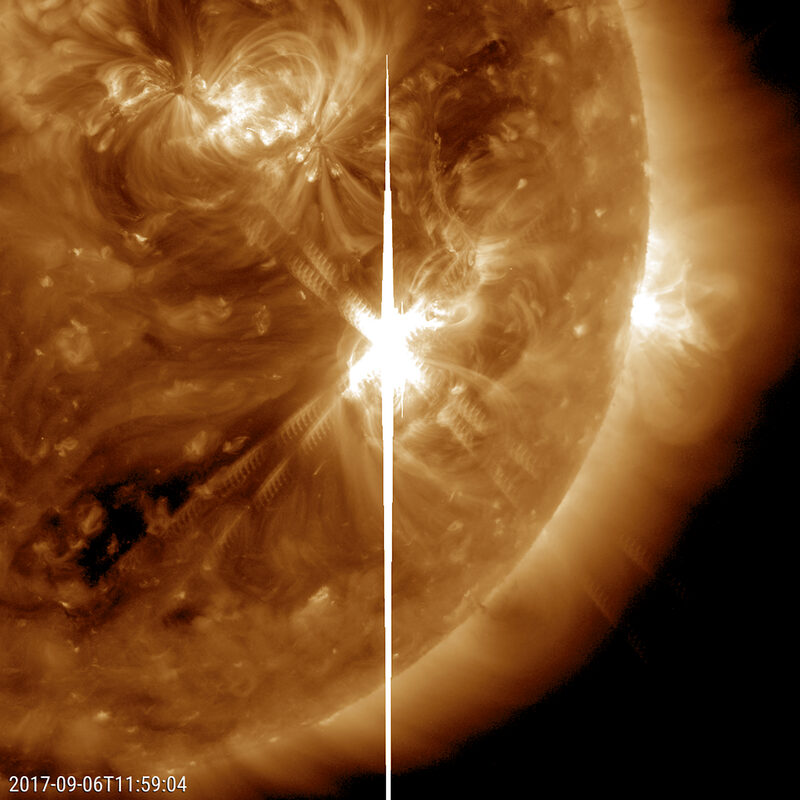
The Sun has a habit of doing two things at once, and this week it is obliging on both fronts. A brand-new sunspot region has emerged already carrying the most complicated magnetic layout our forecasting language has a name for, and it spent the past 24 hours firing off flares to prove it. At the same time, a fast stream of solar wind pouring out of a large coronal hole is on a collision course with Earth's magnetic field. Together, the two are lining up a modest but genuine space-weather event for July 21 and 22 — one worth watching if you live far enough north or south to catch an aurora.
Here is the important framing up front: this is not a rerun of earlier flare-and-aurora coverage tied to other active regions. The star of this show, AR4493, is newly arrived, and the driver of the geomagnetic side of the story — a coronal-hole high-speed stream — is a separate mechanism from the flares entirely. Two distinct pieces of solar machinery are simply scheduled to make noise at the same time.
What AR4493 actually did
Over a 24-hour window, the Sun produced 18 flares: three in the M-class and 15 in the C-class. The C-class events are the low rumble of an active Sun — common, mostly inconsequential for Earth. The M-class flares are the ones that get a forecaster's attention.
The strongest was an M3.4 flare at 22:25 UTC on July 20, out of AR4493. The Sun also fired an M2.5 at 14:36 UTC and an M1.1 at 19:20 UTC, both on July 20. What makes this notable is not just the tally but the region's magnetic classification: AR4493 is a beta-gamma-delta region — the maximum complexity rating on the scale forecasters use. In plain terms, the magnetic field threading through the sunspot group is badly tangled, with opposite polarities crammed close together. That tangling is exactly the condition that stores energy and then releases it as flares. A delta configuration is the flag that a region can produce the biggest events, so a newly emerged region already wearing that label is a genuine wild card.
AR4493 is not alone on the Earth-facing side of the disk. Four regions are currently turned toward us — AR4493, AR4492, AR4489 and AR4491 — but AR4493 is the one carrying the load right now.
The odds, and what they mean
NOAA's Space Weather Prediction Center puts the chance of another M-class flare at 55 percent, and the chance of a major X-class flare at 5 percent. Those numbers are worth reading carefully. A 55 percent M-class probability means more moderate flares are more likely than not — unsurprising given AR4493's behavior over the last day. The 5 percent X-class figure is small, but it is not zero, and with a delta-class region in the mix it is the kind of small number that a forecaster keeps one eye on. X-flares are the events capable of causing radio blackouts on the sunlit side of Earth and, if paired with an Earth-directed coronal mass ejection, the raw material for a much larger geomagnetic storm.
For now, though, the flares themselves are the sideshow. The aurora forecast for July 21-22 rests on the other half of the story.
The coronal hole is the real driver
A coronal hole is a region of the Sun's outer atmosphere where the magnetic field opens up and lets solar wind escape at high speed rather than looping back down. When a large one rotates to face Earth, the fast stream it launches eventually sweeps past our planet, and the collision between that faster wind and the slower wind ahead of it can rattle Earth's magnetic field for a day or more.
That is what is inbound now. A fast solar-wind stream from a large coronal hole is due to reach Earth late on July 21. SWPC's forecast tracks the expected response closely: conditions are pegged as quiet-to-unsettled on July 21, with a possible G1 (minor) geomagnetic storm near the end of the day as the stream arrives, and G1 conditions possible throughout July 22 as it continues to blow past. The planetary K-index — a rough gauge of geomagnetic disturbance that runs from 0 to 9 — is currently sitting at 3, and is forecast to climb toward roughly 5, the threshold that defines G1 storm level.
Where the aurora might show up
A G1 storm is the mildest rung on NOAA's five-step geomagnetic scale, but it is enough to nudge the auroral oval down to latitudes where a lot more people can see it. Under these conditions the aurora is possible over Seattle, Edinburgh, southern Scandinavia and Hobart — a spread that neatly covers both hemispheres, since a geomagnetic storm lights up the southern auroral oval just as readily as the northern one.
A few honest caveats belong here. "Possible" is doing real work in that sentence: G1 aurora at these latitudes is typically faint, often better captured by a camera's long exposure than by the naked eye, and it depends on the storm actually reaching Kp 5 at the right time of night. Timing matters — the stream is expected late on the 21st, so the window tilts toward the overnight hours into the 22nd. And as always, a dark sky away from city light and a clear view toward the pole are the difference between a memorable night and nothing at all.
Why It Matters
Individually, neither piece of this story is dramatic. An M3.4 flare is moderate. A G1 storm is minor. But the value of watching a setup like this is precisely that it is ordinary — it is the Sun's baseline hum during an active stretch, and it is a clean illustration of how space weather actually works. Flares and coronal-hole streams are two different physical processes, driven by different structures on the Sun, and here they happen to overlap on the calendar without being causally linked.
There is also a live risk to keep in view. AR4493 is new, magnetically complex, and Earth-facing. That combination is the one that occasionally graduates from "minor aurora watch" to something that grid operators and satellite controllers actually care about. A 5 percent X-class chance is low, but the region is capable, and the difference between this week's gentle forecast and a genuinely disruptive event could come down to a single well-aimed flare and its associated ejection. Watching the quiet setups is how you learn to read the loud ones. For skywatchers in the right latitudes, meanwhile, the practical takeaway is simpler: keep an eye on the K-index late on July 21 and into the 22nd, and if it climbs toward 5, get somewhere dark and look toward the pole.
