
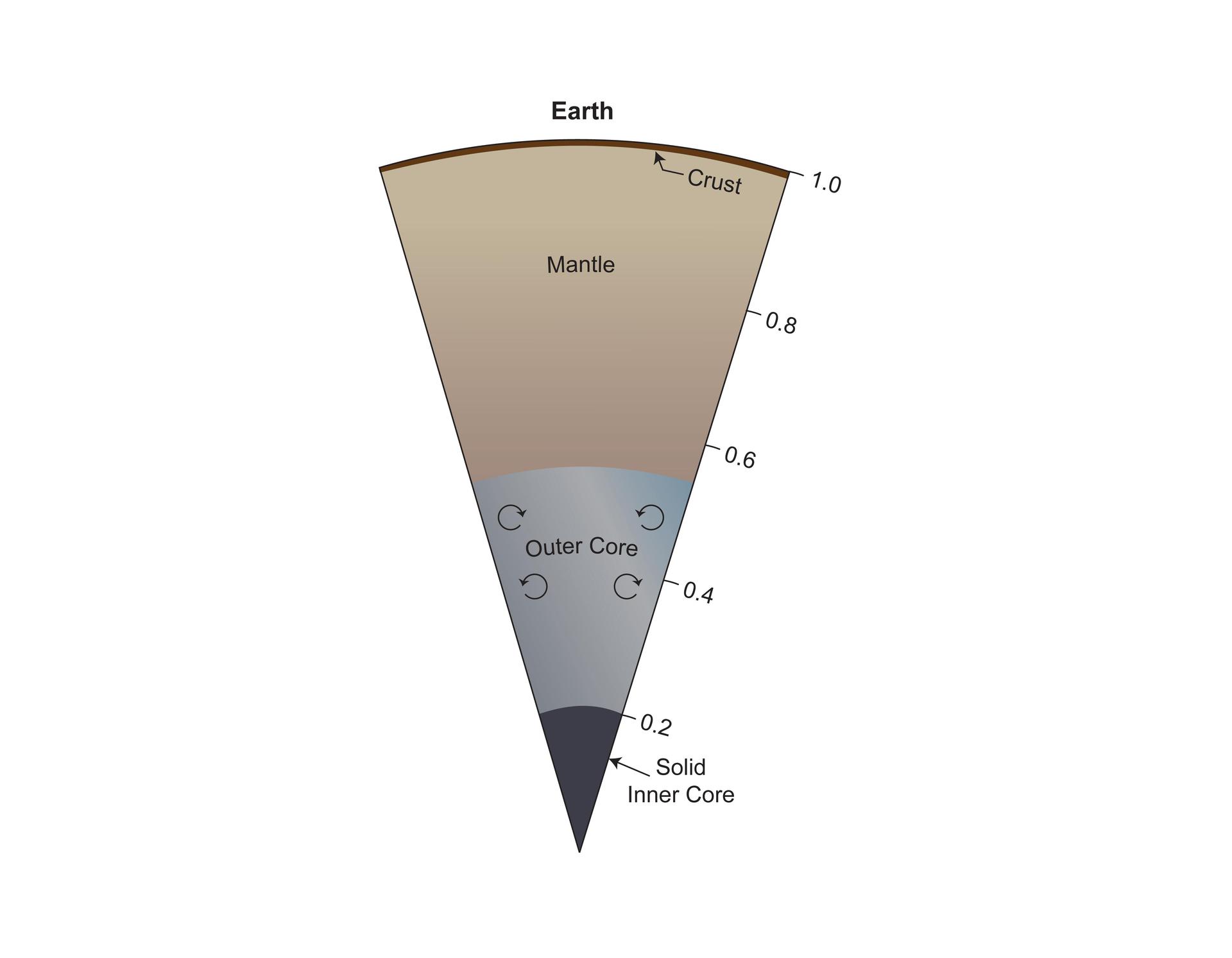
Some of the best evidence about what the solar system looked like 4.5 billion years ago is not in a telescope image. It is dissolved in lava erupted at ocean island volcanoes.
Basalts fed by deep mantle plumes — Iceland, the Galapagos, Hawaii, the Discovery plume in the south Atlantic — carry noble gases, and among them is neon that does not match anything Earth makes on its own. That anomaly is the starting point for a paper by Vincent Savignac and Eve J. Lee, both affiliated with the Department of Astronomy & Astrophysics at UC San Diego and the Department of Physics at McGill University, published June 2, 2026 in The Planetary Science Journal and highlighted in an AAS Nova feature on July 24. The authors treat the deep mantle as an instrument — a gas sample sealed at the moment of Earth's assembly — and use it to constrain how massive the proto-Earth was when it was still wrapped in a hydrogen envelope.
Their answer is unusually specific: about 0.3 Earth masses, with the paper's stated range running to 0.4.
A gas that cannot be faked
The logic hinges on chemistry that refuses to happen. Noble gases are chemically inert; they do not participate in the reactions that build minerals, and the primordial isotopes are not manufactured by terrestrial processes in the way that, say, radiogenic argon accumulates from potassium decay. So when neon carrying a nebular isotopic signature turns up in deep-mantle-sourced lavas, there is no plausible way to have made it here. It had to be inherited.
The only reservoir available to inherit it from is the solar nebula — the gas disk the young Sun was still embedded in while the planets were forming. For nebular neon to end up locked in the mantle, it has to be delivered while the growing Earth still had a primordial hydrogen-rich atmosphere sitting on top of a molten surface, so the gas can dissolve out of the envelope and into a magma ocean. Once the nebula disperses and the magma ocean solidifies, that reservoir is closed. Whatever is down there now is a fossil.
That framing turns a geochemical measurement into an astronomical constraint, which is why the result reads more like exoplanet science than petrology. The physics being modeled — a rocky embryo accreting a gaseous envelope from a disk — is the same physics invoked for the super-Earth and sub-Neptune regime around other stars. Earth, on this account, is a planet that started down that road and then lost the atmosphere.
The Goldilocks embryo
Savignac and Lee model the whole chain: how much primordial gas an embryo of a given mass can gather, how hot its magma ocean gets, how much neon dissolves into that melt, and how much survives everything that happens afterward. They simulate embryos from 0.1 to 0.5 Earth masses, then ask which mass reproduces the neon actually observed today.
The constraint tightens from both directions. Too small — at or below 0.2 Earth masses — and the embryo gathers so little gas that accretional heating never lifts the surface to the roughly 1,800 K melting temperature of basalt; with no molten mantle, there is nothing for the neon to dissolve into. Too large, and the opposite problem: the embryo holds onto more gas than the modern mantle can account for, overshooting the neon budget by at least an order of magnitude. In the AAS Nova summary, the window works out to roughly 20 to 40 percent of Earth's present mass; the paper concludes that protocores of about 0.3 to 0.4 Earth masses are required, with the constraint tightest near 0.3.
The observational anchor starts with the present-day deep mantle inventory of neon-22, (5.8 ± 3.2) × 10-15 mol/g, derived from a global mass-balance analysis of Earth's argon-40. Because the deep mantle has been leaking ever since, the authors correct that figure upward: they take the initial reservoir to have been about 18.7 times more enriched than the present-day budget, giving a primordial concentration of (1.08 ± 0.60) × 10-13 mol/g. That corrected number is the target the model has to reproduce. The neon sampled in plume lavas today is the residue of a much larger original dose.
A nearly empty disk
The second headline result concerns the nebula rather than the planet. To match the observed neon, the gas the embryo was breathing had to be thin — depleted by at least a factor of 100 in gas density relative to the minimum-mass solar nebula, with viable solutions spanning depletion factors of 10-4 to 10-1 of that baseline. The envelope itself is barely an atmosphere at all: less than 10-5 of the embryo's rock mass.
That is not a minor adjustment. It means Earth's primordial gas was not scooped up during the disk's fat, opaque youth. It was captured near the disk's end, as photoevaporation and disk winds cleared out what remained. And the uptake itself is fast: the authors calculate that the time needed to dissolve the required neon-22 is under about 0.01 years — effectively instantaneous next to the million-year timescales over which disks disperse. The paper places the emergence of these embryos up to roughly 3 million years into the solar system's history, coinciding with the dispersal of the gas disk.
Two archives, one planet
The paper's most useful organizing idea may be that the noble gases are not one record but two. The light ones — helium and neon — are the gas-phase archive: they trace the primordial envelope and the magma ocean that absorbed it. The heavy ones — argon, krypton, xenon — are better explained by early solid accretion, arriving with chondritic material rather than out of the nebular gas.
Read that way, a single suite of measurements from the same rocks covers two distinct channels of planet building. Earth's own interior preserves both the nebular gas phase and the solid-delivery phase, separated by atomic mass.
Why It Matters
Constraining the mass of the proto-Earth has been hard because the object no longer exists — it was reprocessed by giant impacts, including the collision with Theia that made the Moon, dated to roughly 30 to 100 million years after the solar system's first solids condensed. Most estimates come from dynamical models with wide latitude. Anchoring the number to a measured concentration in real rock is a different kind of argument, and a much less flexible one: the neon is either there in the right amount or it is not.
The nebula result matters for the same reason. Astronomers watch protoplanetary disks disperse around other stars but cannot easily time our own system's disk clearing relative to Earth's growth. A requirement that the gas was already heavily depleted when Earth's envelope arrived is a direct, if indirect-seeming, statement about when our disk died. The authors are careful here: the deep mantle does not by itself pin down the disk dissipation timescale, but it does argue that embryo formation and nebular dispersal overlapped.
The obvious caveats apply. This is a modeling result built on assumptions about envelope structure, gas solubility in basaltic melt, and how much outgassing the mantle has done since, and that 18.7-fold correction is doing real work in the answer. The neon budget itself comes from extrapolating ocean island basalt compositions to the deep mantle — an extrapolation the authors flag as uncertain, noting that a competing analysis puts the figure about one sigma lower. But the direction of the argument is what stands out: deep-sourced geology, used as a telescope pointed backward at the solar nebula.
Sources
- Savignac & Lee, "Constructing the Earth's Formation History Using Deep Mantle Noble Gas Reservoirs," The Planetary Science Journal 7, 135 (2026), DOI 10.3847/PSJ/ae64f7
- arXiv:2511.16859 — Constructing Earth Formation History Using Deep Mantle Noble Gas Reservoirs (preprint, v1 Nov 20, 2025; v2 May 1, 2026)
- "Noble Gases Along for the Ride," AAS Nova, July 24, 2026
