
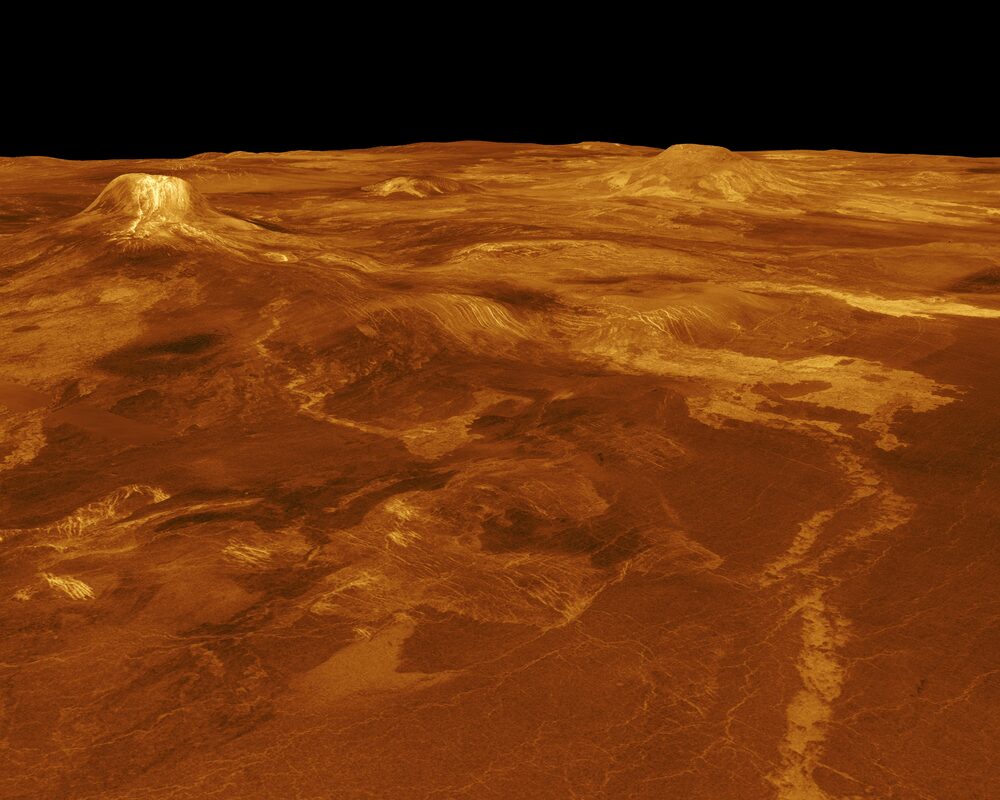
Venus has a tectonics problem, and it is mostly a problem of evidence. The planet is carved by rift valleys — long, fault-bounded troughs where the crust has been pulled apart — and some of those systems stretch as far as 10,000 kilometers. That is a scar big enough to run most of the way around a planet. What nobody has been able to say with confidence is whether any of it is still happening, or whether Venus tore itself open long ago and then went quiet.
A paper published in Nature Geoscience on July 24, 2026 makes the case for "still happening." A team at ETH Zurich built what it describes as the first high-resolution, three-dimensional computer simulations of Venusian rifting, and the modeled landscapes match features seen in radar images of the real surface — captured by NASA's Magellan probe in the 1990s — only if extension is ongoing, or stopped very recently, in at least some places. The authors' summary is blunt: Venus remains an active planet, with a more dynamic interior than had been previously believed.
The lead author is Xi Yang, who did the work as part of a Master's degree at ETH Zurich, supervised by Taras Gerya, Professor of Geodynamics in the Department of Earth and Planetary Sciences, with collaborator Paul Tackley.
The ridge is the clock
The clever part of the result is not the rift valleys themselves. It is the ground on either side of them.
Venusian rift valleys are flanked by broad ridges — "rift flanks" — that stand above the surrounding terrain. In the ETH simulations, those flanks are not permanent furniture. They form while a rift is geologically young and either still actively moving or only recently stopped. Then they go away: the flanks flatten quickly once movement ceases, and older systems show shallower, narrower features. On Earth, erosion would do that work. On Venus, the sources are explicit that the mechanism is crustal relaxation — the surface subsiding as the crust below it relaxes.
That decay is what turns a static map into something closer to a timer. If a rift's flanks are still high and broad, the model says the rift is young in the geological sense — either still opening or only recently halted. If the flanks have slumped, the system has been dead long enough for the crust to relax the load. Compare simulated topography to what radar shows, and you can start sorting Venus's rift network into the living and the finished.
Run that comparison and the rates that fall out are faster than the field had assumed. The models put widening at 3 to 10 centimeters per year — more rapid, the team says, than previously believed. Most of Venus's rifts are still thought to have formed more than 100 million years ago. But some of them, on the flank evidence, may have formed recently.
Why this took until 2026
Rifting is an awkward thing to simulate. It involves rock that behaves as a brittle solid on short timescales and a viscous fluid on long ones, faults that localize strain into narrow zones, and a deep thermal structure that decides how much of the lithosphere can stretch before it necks and fails. Doing that in full three dimensions, at a resolution fine enough to resolve the flank topography rather than just the trough, is expensive.
Earlier attempts at Venusian rifts relied on simplified material assumptions and were mostly two-dimensional — effectively a cross-section through a rift, extended indefinitely sideways. That is fine for first-order questions about whether a lithosphere can be pulled apart at all. It is much weaker for the question actually at issue here, which is about the three-dimensional shape of the terrain a rift leaves behind, and how that shape changes once the pulling stops. The ETH group's contribution is the first high-resolution 3D run at the problem, and the wide, high rift flanks the model produces are also visible in the Magellan imagery.
Worth being precise about what that does and does not establish. This is not a measurement of present-day motion on Venus. Nobody has watched a Venusian fault move. What the team has produced is a physical argument that certain surface shapes are unstable over long timescales and therefore imply recent activity — inference from morphology, validated against simulation. It is a strong argument, and it is the kind of argument that gets settled, one way or the other, by better data.
Which is where EnVision comes in
ESA's EnVision orbiter is the obvious instrument for settling it. ESA approved the mission in January 2024, cleared it to move toward construction in January 2025, and on 13 May 2026 announced that a UK company had started work on the spacecraft. Launch is planned for November 2031, followed by a 15-month cruise to Venus and roughly 11 months of aerobraking to reach the final science orbit — the slow, atmosphere-skimming grind that trades time for fuel. The science operations phase is planned to run four Earth years.
EnVision carries six instruments and is designed to work at 10-meter ground resolution, with the stated goal of providing "a complete view of Venus from its inner core to its upper atmosphere to determine how and why Venus and Earth evolved so differently." It will be ESA's second Venus mission, after Venus Express. Gerya and Tackley are themselves involved in developing instruments for it.
Ten-meter resolution over a planet is a lot of pixels and not a lot of time. Missions like this live or die on target selection: you cannot stare hard at everything, so you need a defensible shortlist of places where staring hard is most likely to pay off. That is the practical payoff the ETH team is pitching — the researchers say their model results could help pinpoint active regions worthy of detailed investigation by the Venus missions now being prepared by ESA and NASA. If flank topography really does discriminate active rifts from fossil ones, the model output becomes a guide for where to point a high-resolution radar.
Why It Matters
Venus and Earth are near twins in size and bulk composition, and they ended up nothing alike. Any explanation for that divergence has to say something about the interiors, because the interior is what drives resurfacing, outgassing, and the long-term chemistry of the atmosphere above it. A Venus that is tectonically dead and a Venus that is still pulling itself apart at centimeters per year demand different stories — and a Venus that is quietly active means the planet's heat is still finding its way out through the crust rather than having been sealed in.
There is a second audience for this result, and it is not in the solar system. Rocky exoplanets are, for the foreseeable future, dots. We will infer their geology from mass, radius, orbit, and whatever atmospheric signal we can wring out of a transit — never from a radar map. That inference chain runs through the one worked example we can actually check: two planets that started similar and diverged. Getting the Venus half of that comparison right, including whether it is still geologically alive, sets the priors for everything we will say about worlds we can only see as points of light. Which is a reasonable amount of weight for a Master's thesis to carry.
