
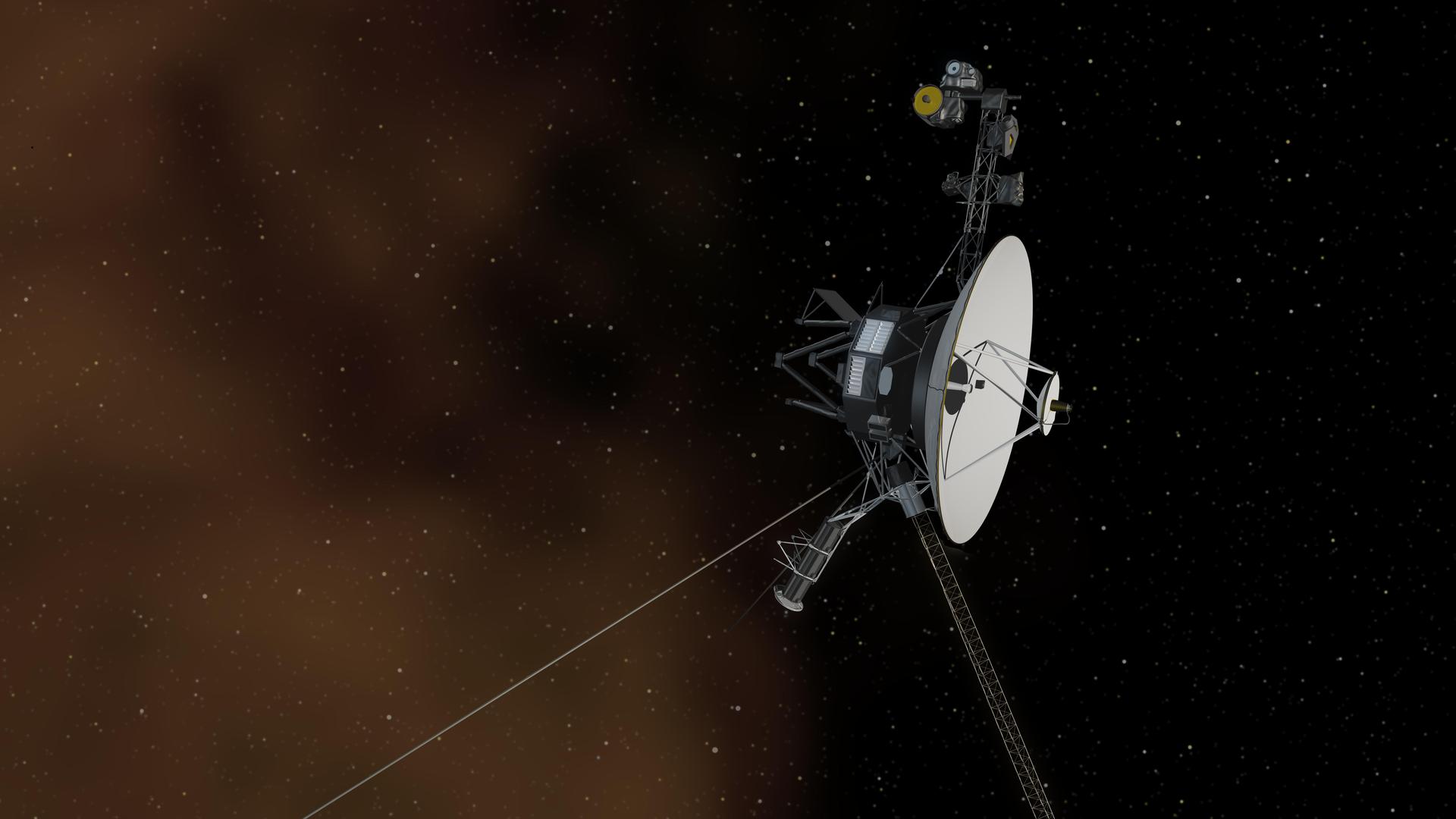
This month a radio signal from Voyager 1 will start taking a full day to reach Earth. According to NASA, the spacecraft will be one light-day from Earth on November 18, 2026; NASA's mission page counts down to 5:16 a.m. EST that day. No human-made object has been that far away before. Launched in 1977, the probe will be about 16.1 billion miles (25.9 billion kilometers) out, or roughly 173 astronomical units, where one AU is the average distance between Earth and the Sun.
The milestone was announced well ahead of time. It's back in the news because the date is close and because NASA's November "What's Up" skywatching video, published November 2, made Voyager its lead item. The video tells viewers where in the sky to look and invites the public to a November 17 event called "Shine Bright for Voyager's Light-Day." Details are at nasa.gov/voyager.
What "one light-day" actually means
Light-years and light-minutes are units of distance. A light-day is how far light, or a radio signal, travels through a vacuum in 24 hours. Once Voyager 1 reaches that distance, any command from Earth will take a day to arrive. Any data the spacecraft sends back will take another day. So asking the probe a question and hearing its answer will take at least 48 hours.
EarthSky uses NASA's figures to put the distance at 173.14 AU. In early October the spacecraft was about 15.98 billion miles away. Getting from launch to this point took 49 years, 2 months and 11 days.
The spacecraft doesn't do anything at that moment. Nothing on board switches on and no boundary is crossed. The milestone is a round number that marks how long and how far the mission has gone.
A note on the date
Sources differ slightly on timing. A Popular Science piece published in November 2025 put the crossing on November 15, 2026. NASA's current mission page and skywatching video point to November 18. EarthSky gives the time as 12:16:07 a.m. CST on November 18, which does not line up with the 5:16 a.m. EST countdown on NASA's page, so the exact hour is best checked at nasa.gov/voyager. The Popular Science article is still useful for the basic physics: Voyager 1 travels at about 11 miles per second, or roughly 3.5 AU per year.
Eleven miles per second is very fast by Earth standards. Even so, after nearly five decades the spacecraft is only one light-day from home. That shows how large even the space near the Sun is.
Where to look
The spacecraft is far too small and faint to see with any telescope. NASA's November skywatching guide still gives a direction: look toward the constellation Ophiuchus, the Serpent Bearer, to imagine where Voyager 1 is traveling. NASA's chart marks its position in Ophiuchus on November 17 at about 5 p.m., looking toward the western horizon. EarthSky also notes that Voyager 1 is headed toward Ophiuchus.
The timing works well for anyone already planning to be outside. NASA says the Leonid meteor shower is best in the early morning hours of November 17 and 18, after the Moon sets, with about 15 meteors per hour under ideal conditions. That's the same night as the light-day crossing.
A mission still running on reduced power
NASA's Voyager 1 mission page lists the main dates. The spacecraft launched on September 5, 1977, and crossed into interstellar space in August 2012, the first spacecraft to exit the heliosphere. It's now more than 49 years into its mission.
Voyager 1 is still sending data, but engineers have been turning things off to save power. On April 17, 2026, the Jet Propulsion Laboratory shut down an instrument to keep the spacecraft going. EarthSky identifies it as the Low-Energy Charged Particle instrument, or LECP, and says NASA could turn it on again later for new measurements. NASA's mission page is not consistent on how many science instruments remain: one passage says two are operating, while another lists four still functioning. Either way, the team is trading science capability for more time.
The light-day milestone makes that work harder. Every command now needs a day to arrive and another day for confirmation, so the team will wait at least two days to learn whether a command worked.
Why It Matters
Voyager 1 is the farthest spacecraft from Earth, and it is still returning data from interstellar space, the region outside the heliopause. The light-day mark doesn't change that science. It shows how long and how thin the link to Earth has become.
It also gives a sense of scale that's hard to get any other way. People are used to light-years. A light-day is a distance we've actually reached, and it took nearly half a century. EarthSky reports that Voyager 2, which is headed toward the constellation Andromeda, will reach the same distance in November 2035, nine years from now.
Voyager 1 will keep moving away, and its signals will take longer to arrive each year. Popular Science notes that its three radioisotope thermoelectric generators are expected to run out of power sometime in the 2030s.
Also in November's sky
NASA's November skywatching guide, narrated by Raquel Villanueva of NASA JPL, also includes:
- Taurid meteors: The Southern Taurids peak around November 5, with occasional bright fireballs, and the Northern Taurids peak around November 12 at about 5 meteors per hour under ideal conditions.
- Mars and Jupiter: The two planets appear about 1.2 degrees apart before sunrise on November 15 and 16.
- Leonids: Best in the early morning of November 17-18, up to about 15 per hour under ideal conditions.
- Supermoon: November 24 brings a full supermoon, the first of three in a row.
Sources
- What's Up: November 2026 Skywatching Tips from NASA (NASA Science)
- Voyager 1 mission page (NASA Science)
- Voyager 1 will reach 1 light-day from Earth on Nov. 17-18 (EarthSky)
- Voyager 1 is almost one light-day from Earth (Popular Science)
