
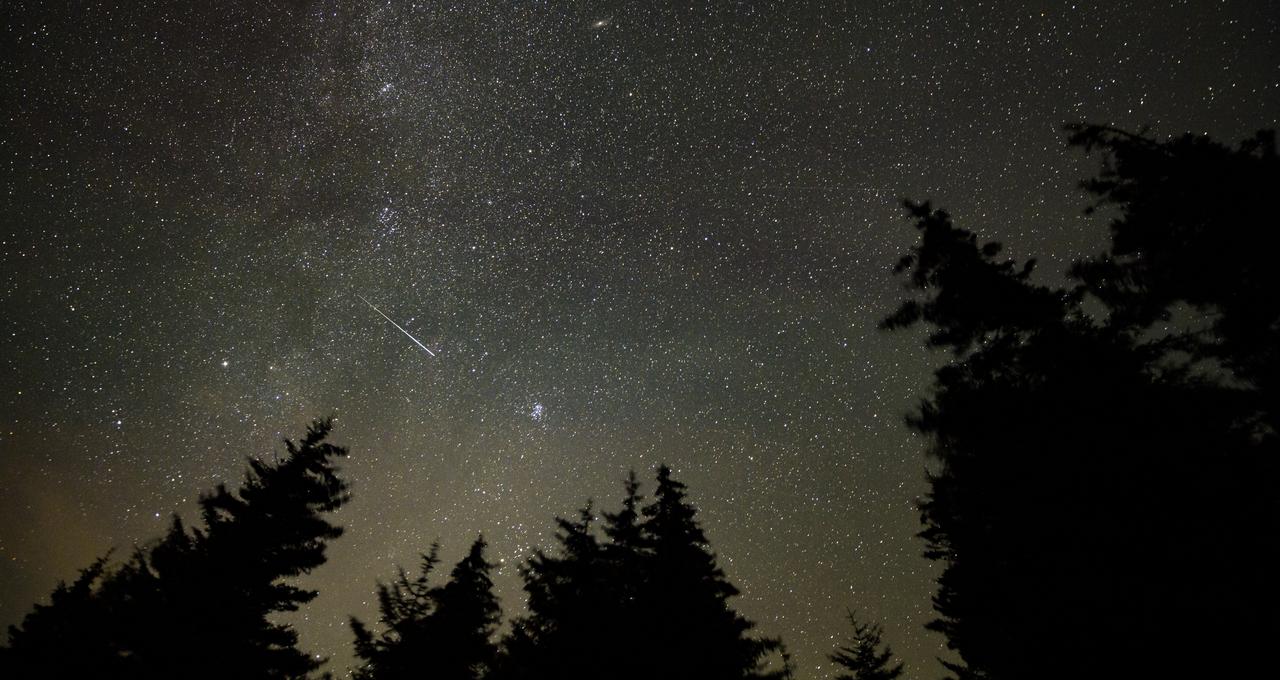
Every autumn the Taurid meteors put on a slow, sometimes spectacular show. The shower is modest by the numbers, but it has a habit of throwing out bright fireballs around Halloween. This year that familiar show came with an unusual warning attached, and the warning came with caveats of its own.
On October 30, EarthSky reported that planetary-defense physicist Mark Boslough of the University of New Mexico had reached out that week with new calculations. They suggest the Taurids could carry some risk of an airburst in 2026. Boslough was just as clear that the result rests on two big "ifs," and neither has been shown to be true. So this is a hypothesis, and one that can be tested. It is not a forecast.
The stream behind the fireballs
The Taurids come from debris shed by Comet Encke. Earth's orbit crosses that debris stream twice a year: near Halloween, when we see the autumn Taurid fireballs, and again in June, when the encounter produces the Beta Taurids. The June shower is a daytime event that is hard to watch from the ground.
According to EarthSky, the Taurid debris sits in a 7:2 resonance with Jupiter. That gravitational relationship can herd material into denser clumps instead of letting it spread evenly around the orbit. The stream is also linked to asteroid 2004 TG10, which the Spacewatch survey discovered on October 8, 2004, and which EarthSky describes as a parent body of the stream. Together, the comet, the asteroid and the resonance underpin the question the 2025 paper asks: whether there is a significant coherent component to impact risk. The idea is that the danger is not spread evenly through time. Instead it may cluster in particular years, when Earth passes through the thickest part of a swarm.
The 2025 study that set this up
Boslough's latest numbers build on work published a year ago. In October 2025, UNM announced research he led that appeared in Acta Astronautica as part of the Planetary Defense Conference proceedings from Cape Town. The paper's title asks its central question directly: "2032 and 2036 risk enhancement from NEOs in the Taurid stream: Is there a significant coherent component to impact risk?"
That study pointed to 2032 and 2036 as years when Earth's geometry relative to the Taurid stream could raise the odds of an encounter with larger near-Earth objects hidden in the debris. Those objects would be much bigger than the grains that make ordinary meteors. The paper treats this as a possible change in risk to be checked, not a confirmed threat.
Where 2026 comes in
The new calculations start from a different hypothetical: a swarm of objects locked in an 18:61 resonance with Earth. Bodies in that resonance would come back to the same configuration every 61 years. Counting back from 2030 gives 1969 and then 1908, the year of the Tunguska event. The same resonance would also produce a close encounter around Halloween 2026, about four years before a June 2030 return.
This is where the two big ifs come in. For the 2026 risk to be real, the Tunguska object would need to have been part of a cluster rather than a lone body. That cluster would also need to share the same orbital elements as the hypothetical 18:61 swarm. If either assumption fails, the elevated risk for 2026 goes away. Boslough's own framing is that the idea can be tested. "We will know for sure in 2032," he told EarthSky.
That kind of claim deserves attention in a field where speculation can easily be dressed up as prediction. A hypothesis that names the year in which it will be confirmed or ruled out invites checking. That is how this sort of work should be done.
Who is watching the sky now
Bright meteors are no longer seen only by backyard observers and all-sky cameras. A November 1 Space.com report describes how military and civil satellites have become a quiet but important part of planetary defense by recording fireballs as they happen.
The examples show how many kinds of instruments now pick up these events. A bolide over the South Atlantic on April 1, 2026 reached peak brightness at nearly 60 miles (90.5 km) altitude. It was detected by U.S. military and civil sensors, and also by the lightning imagers on NOAA's GOES-E and Europe's MTG-I1 weather satellites. Space.com notes that lightning-watching instruments were not designed to detect bolides, yet they caught this one.
Ground instruments help too. A fireball over south-central Alaska on April 24, 2025 was recorded by a network of 37 seismic stations, along with infrasound sensors, video and weather radar. And the May 20, 2023 bolide over Queensland, Australia released energy equal to about 7.1 kilotons, which puts it among the 20 most energetic events in the CNEOS fireball record since 1988.
Networks like these could help test Boslough's idea, though Space.com does not link them to it. If Earth really does pass through clumped Taurid material in a given year, satellites, cameras and seismometers should record more bright, energetic Taurid events than usual. If those years come and go with nothing unusual, the hypothesis loses support.
Why It Matters
Most impact-risk thinking treats the sky as a random place, with large objects arriving at a steady background rate. The Taurid resonance work questions that assumption for one specific stream. If some of the risk really does cluster in certain years, then survey time, telescope targeting and public communication could be focused on those windows instead of being spread evenly across the calendar.
It also matters to be honest about what is known. Nothing in the new calculations says an airburst is coming. They say that if two unproven conditions hold, the window around Halloween 2026 would carry higher risk than a typical year. The 2025 study's 2032 and 2036 projections were published in a peer-reviewed proceedings volume. The 2026 scenario is a more speculative extension of that work.
For stargazers, the practical advice is to keep watching. The autumn Taurids are still a good excuse to spend a dark evening outdoors looking for slow, bright meteors. Every well-documented fireball, whether it's caught by a phone camera, a weather satellite's lightning sensor or a seismometer, adds to the record that will eventually confirm or rule out the clustered-swarm idea.
Sources
- Could the Taurid meteors bring a risk of airbursts in 2026? (EarthSky, Oct 30, 2026)
- UNM research suggests Halloween fireballs could signal increased risk of cosmic impact or airburst in 2032 and 2036 (UNM Newsroom, Oct 29, 2025)
- Planetary defense: How military and civil satellites are watching fireballs (Space.com, Nov 1, 2026)
