
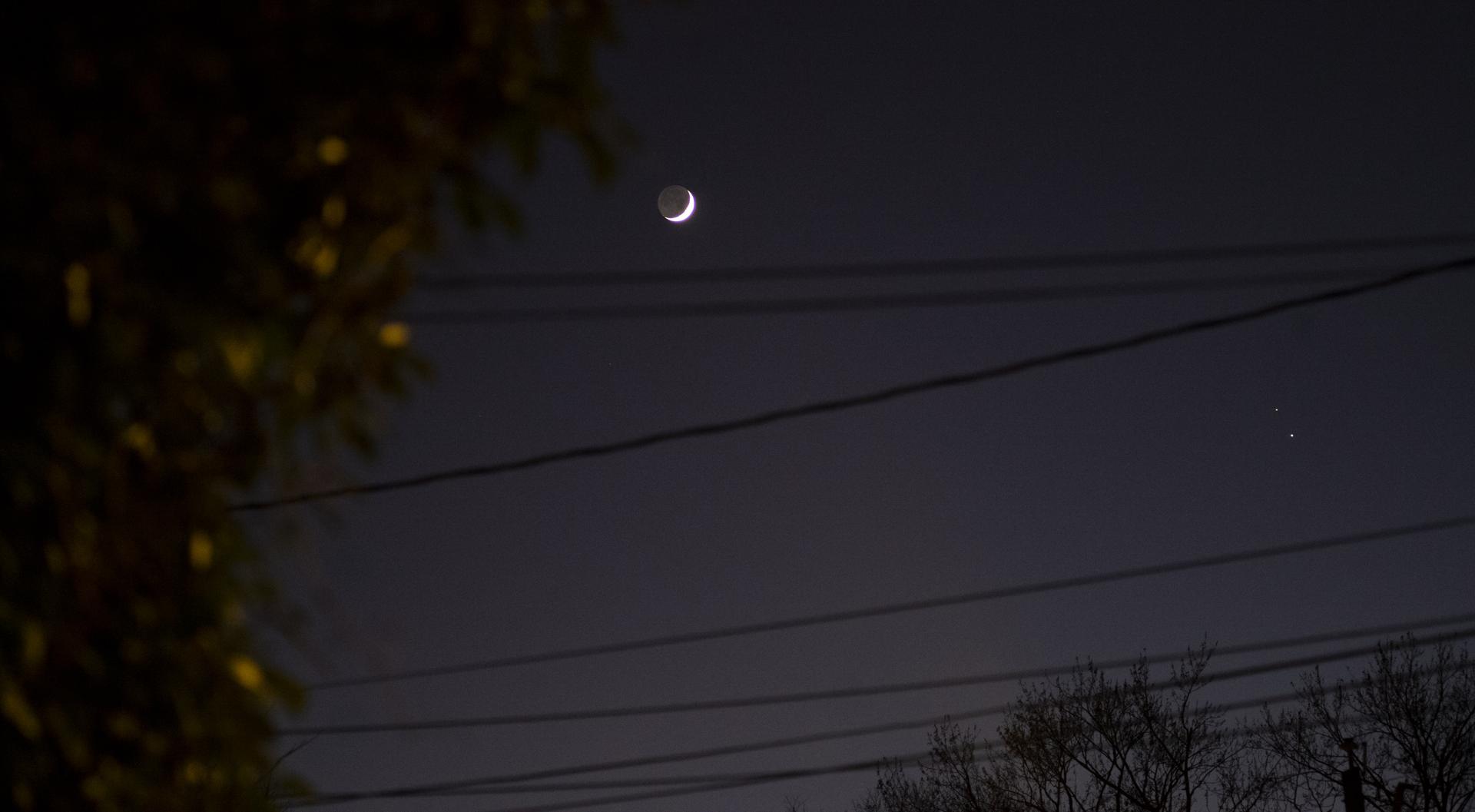
Stay up past midnight on the night of Nov. 1 and look east. You will see a short diagonal line of bright objects climbing out of the horizon. At the top is a moon just past third quarter. Below it are Mars, then Jupiter, then Regulus, the brightest star in Leo. Seen from our side of the solar system, they all appear crowded into the heart of the Lion. Over the next 48 hours the moon keeps moving east through the group, and for some observers in the Southern Hemisphere it will pass directly in front of two of them.
Where to look, and when
According to Space.com's sky guide, the best time to start is about an hour after midnight, looking east. The moon will be about 45 percent lit and waning; the third quarter phase falls on Nov. 1. It will sit less than 5 degrees from Mars, which is roughly the width of three middle fingers held at arm's length. Jupiter sits just below Mars, and Regulus lies beyond Jupiter. The four together form a rough line pointing down toward the horizon.
The ordering is easy to check. Mars and Jupiter are both planets, but they look quite different. Jupiter is much brighter and has a steady, cream-colored glow. Mars is fainter and appears as a smaller point. Regulus, the farthest from the moon, is the dimmest of the three.
If you have binoculars, look a little past the dark edge of the moon. Space.com notes that the Beehive Cluster (M44) lies about 10 degrees from the unlit side of the moon, in the middle of Cancer. In a dark sky the Beehive is a faint smudge to the naked eye. In binoculars it breaks up into a loose swarm of stars. A bright moon nearby will wash out some of that, so give your eyes time to adjust and keep the moon out of the field of view.
Checking the geometry against Horizons
Sky guides round their numbers, so we checked them against NASA/JPL's Horizons ephemeris system. We queried it for 06:00 Universal Time on Nov. 2, which is the small hours of the morning for North American observers.
Horizons returns geocentric positions, meaning positions as seen from the center of the Earth rather than from any particular backyard. Those positions put the moon at right ascension 137.339 degrees and declination +17.473 degrees. It is 45.68 percent illuminated, with an apparent magnitude of -10.0. Mars is at RA 141.827, Dec +16.711. It shines at magnitude 0.82 and shows a nearly full disk, 89.5 percent illuminated. Jupiter is at RA 146.644, Dec +14.142, at magnitude -2.01.
Those coordinates put the moon about 4.4 degrees from Mars. That matches Space.com's "less than 5 degrees." Mars and Jupiter are about 5 degrees apart, and Jupiter lies east of Mars. Objects farther east rise later, so as the group climbs out of the eastern horizon, Jupiter hangs below Mars. That is the arrangement the sky guide describes. Your own view will differ slightly depending on where you are. The moon is close enough that parallax shifts its apparent position against the background, but the overall picture holds.
The magnitudes show how different these objects really are. Jupiter, at -2.01, is nearly three magnitudes brighter than Mars, or roughly 14 times brighter. Part of that is size: Space.com points out that Jupiter is more than 20 times wider than Mars. The star at the end of the line is bigger than any of them. Regulus is up to four times larger than the sun, and it looks faint here only because it is so far away.
Two occultations in two days
The moon moves roughly its own width across the sky every hour, so a lineup like this does not last. It also means the moon can pass directly in front of some of these objects. When it does, the event is called an occultation, and this pass produces two.
Jupiter, Nov. 2. Space.com, citing In-The-Sky.org, says the moon will occult Jupiter for observers in Australia, Indonesia and other island nations in that region. The event begins at 2045 GMT (3:45 p.m. EST) on Nov. 2. For those observers, Jupiter will disappear behind the moon's edge and reappear some time later. Exact timings depend on location, so anyone in the occultation zone should look up local times rather than rely on the global start time.
Regulus, Nov. 3. The following day the moon reaches the star at the end of the line. Space.com says that by moonrise on Nov. 3, observers in the United States will see a crescent moon about 1 degree from Regulus. Farther south the moon actually covers the star. The occultation of Regulus is visible from Brazil, Peru, Argentina and Bolivia, starting at 1024 GMT on Nov. 3, according to Space.com.
Watching a star disappear behind the moon is different from watching a planet. Jupiter has a visible disk, so it is covered gradually as the moon's edge crosses it. A star is effectively a point and simply vanishes. Seeing both happen within about a day is a good way to see that difference for yourself.
A busy month on the calendar
This lineup is the first of several things worth watching in November. EarthSky's planet guide lists these dates:
- Nov. 1, midnight to dawn: the moon near Pollux and Castor in Gemini, before it reaches Leo.
- Nov. 2 and 3, mornings: the moon near Jupiter, Mars and Regulus.
- Early November: the South and North Taurid meteor showers.
- Nov. 5-7, mornings: the moon passes Venus and Spica.
- Nov. 15-17, mornings: Jupiter and Mars come together in a conjunction.
- Nov. 17, overnight: the Leonid meteor shower.
- Nov. 19-20, evenings: the moon near Saturn.
The Nov. 15-17 conjunction follows from this weekend's view. Mars and Jupiter are already only about 5 degrees apart, and EarthSky says they come within a little more than two full-moon widths of each other on Nov. 15. If you note where they are on Nov. 2 and check again in mid-November, you can watch the gap shrink over the month.
Why It Matters
Events like this are easy to dismiss as pretty pictures, but they are some of the most accessible astronomy there is. You need no telescope, no dark-sky site and no special equipment. You only need to be awake at the right hour and face the right direction. Watching the moon move from Gemini through Cancer and into Leo over a few nights is a direct way to see how fast it travels against the background stars.
The occultations are useful as well. For most people they are simply a striking event: a bright planet or star disappears without warning and comes back a little later, and seeing both in the same pass shows the difference between a planet's disk and a star's point of light.
Finally, the numbers above come from a public tool. Anyone can query NASA/JPL Horizons and get the same coordinates we did. Sky guides give you the general picture, and Horizons gives exact positions you can check for yourself. It is worth using both.
