
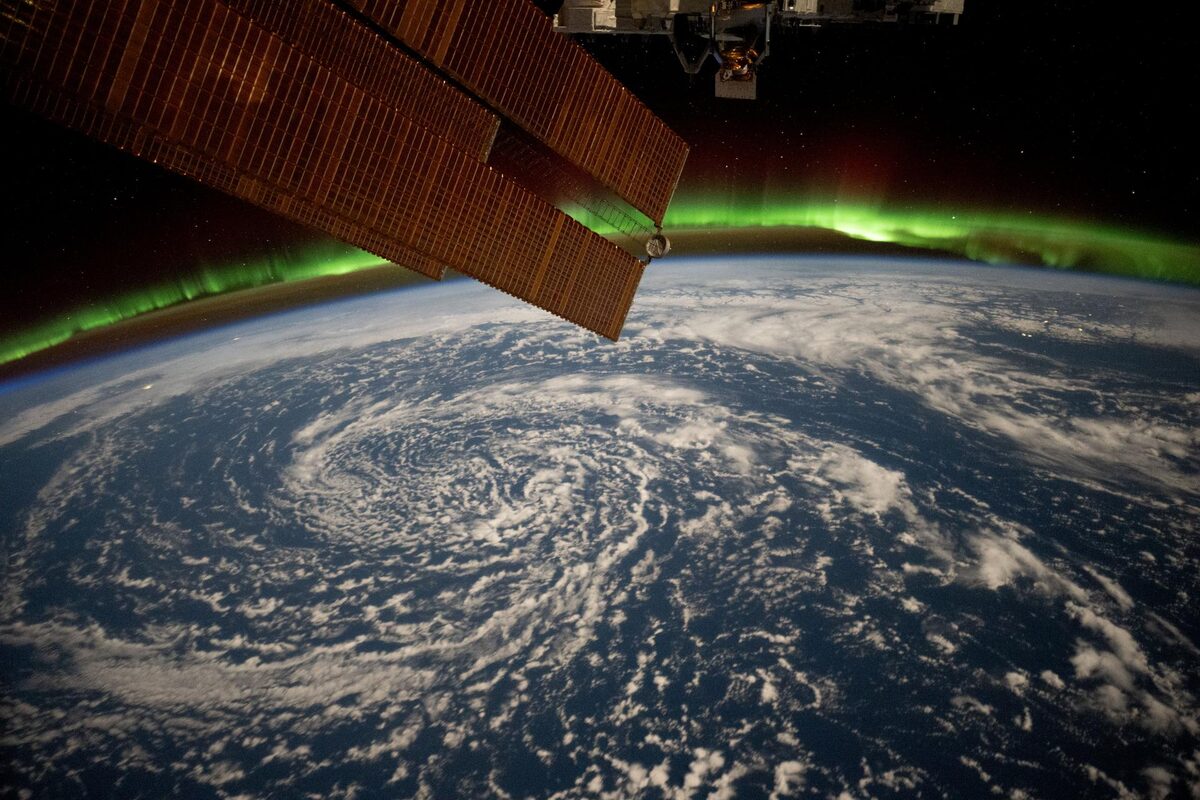
Halloween came with a geomagnetic storm this year, but not from the source many people expected. Over the 24 hours ending early on Nov. 1 (UTC), Earth's magnetic field reached G2, or "Moderate," storm levels. The greatest observed three-hour Kp index was 6, according to NOAA's Space Weather Prediction Center (SWPC). The storm did not come from a big solar flare or a fast coronal mass ejection (CME). NOAA's forecasters attribute it to a stream of fast solar wind flowing out of a coronal hole, a gap in the Sun's corona where magnetic field lines open into space.
For skywatchers, the practical question is whether the auroras will last. In short, they may last a little longer, but the storm is winding down.
What Hit Us
NOAA's forecast discussion, issued at 0030 UTC on Nov. 1, describes the event step by step. Solar wind speeds were near a calm 350 km/s when a corotating interaction region (CIR) arrived. A CIR is a compressed zone that forms where fast wind runs into the slower wind ahead of it. Behind it came a positive-polarity coronal-hole high-speed stream, and wind speeds rose to between 550 and 615 km/s.
Speed alone does not drive a storm. Magnetic orientation matters too. The total interplanetary magnetic field strength rose as high as 12 nT, and its north-south component, Bz, swung as far south as -11 nT. A strongly southward Bz is the setting that lets solar wind energy couple most easily into Earth's magnetosphere. That combination of stronger field, southward tilt and faster wind lifted conditions to G2.
SpaceWeather.com's readings tell the same story. Its 24-hour maximum Kp reached 6.00, labeled "storm." The site had flagged a coronal hole's solar wind as due at Earth on Oct. 31-Nov. 1, and that arrival matched the forecast. Its Nov. 1 headline reported a G2-class storm underway and said the glow could intensify as Earth moved deeper into a stream of high-speed solar wind.
The CME That Wasn't the Main Event
Earlier forecasts pointed in a somewhat different direction. EarthSky's Oct. 31 update said forecasters expected a G1 storm that day, driven mainly by a glancing blow from a CME launched on Oct. 26, with a coronal-hole stream possibly adding to the mix. EarthSky reported that Kp had ranged from 1 to 4 over the previous day, reaching 4 at 22:35 UTC on Oct. 30.
NOAA's later discussion does not credit a CME. It explains the storm through the CIR and the high-speed stream, and it says no Earth-directed CMEs were observed. The two accounts don't strictly contradict each other. Forecasts made before the solar wind arrives involve uncertainty, and the discussion written after the event reflects what the instruments actually recorded. The storm also beat the earlier outlook: EarthSky's forecasters expected G1, and the field reached G2.
This is a common pattern in space weather forecasting. CME arrivals, and especially glancing blows, are hard to time and harder to size. Coronal-hole streams are often more predictable, but they can still surprise forecasters when the embedded magnetic field tilts sharply southward, as it did here.
A Quiet Sun Behind a Noisy Night
The Sun itself did very little. NOAA describes solar activity as very low, with only a chance of isolated C-class flares through Nov. 3. The two numbered sunspot regions on the disk, 4564 and 4565, showed only minor changes. SpaceWeather.com listed the sunspot number at 36 on Oct. 31, with a six-hour X-ray flare maximum of just B5. Its daily note said all current sunspots have simple magnetic fields that pose no threat for strong flares.
EarthSky's flare probabilities matched: a 25% chance of a C-class flare, and only 1% each for M-class and X-class events. NOAA puts the chance of an S1-or-greater solar radiation storm at 1% per day for the next three days.
So the Sun's visible face was calm, while the solar wind it had already released stirred up Earth's magnetic field.
Why It Matters
For aurora hunters, the timing matters most. NOAA's 3-Day Forecast puts the greatest expected Kp for Nov. 1-3 at 4.67, which counts as G1 (Minor) storm conditions. That peak is expected during the 06-09 UT window on Nov. 1. After that, the forecast drops steadily, with Kp near 2 to 2.67 on Nov. 2 and about 1.3 to 1.7 on Nov. 3. NOAA's discussion says the enhanced solar wind continues through Nov. 2, with quiet to unsettled conditions that day and quiet conditions on Nov. 3.
EarthSky's guidance for the G1 levels expected around Halloween said auroras could reach as far south as Maine and Michigan in the U.S., and Oslo and Helsinki in Scandinavia. EarthSky expected Nov. 1 to stay active with a G1 storm possible, and Nov. 2 to be unsettled.
In practice, the best remaining chance is the 06-09 UT window on Nov. 1. Where that falls in local darkness, look toward the northern horizon from somewhere far from city lights. After Nov. 1, the odds drop quickly.
The event also shows why CME headlines alone can mislead. A modest coronal-hole stream with the right magnetic orientation produced a stronger storm than the CME-driven forecast that came before it. Watching real-time solar wind data, especially Bz, often tells you more than counting sunspots.
An Anniversary Worth Remembering
EarthSky's update also pointed to a larger anniversary. In late October 2003, CMEs that followed an X17 flare on Oct. 28 and an X10 flare on Oct. 29 each sparked a G5 geomagnetic storm, the top of NOAA's scale. This year's Halloween storm, a G2 from a coronal-hole stream on a quiet Sun, was much smaller. It was enough, though, to put the aurora back in the forecast for the first night of November.
