
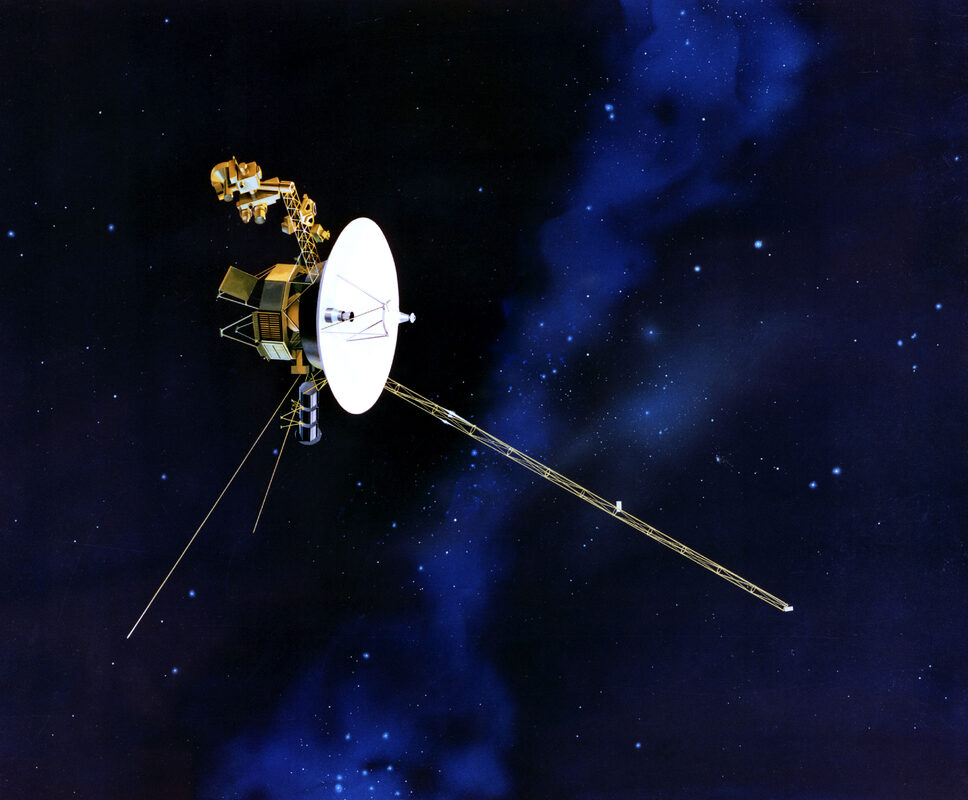
In August 2012, an instrument on Voyager 1 recorded a sudden change in the particle environment around the spacecraft. The density of low-energy particles associated with the Sun dropped sharply; the density of galactic cosmic rays rose. The transition was abrupt — taking place over a matter of days rather than the gradual fade many physicists had expected. The spacecraft had crossed the heliopause, the boundary where the solar wind is compressed to a stop by the interstellar medium. Voyager 1, launched in September 1977, had become the first human-made object to leave the Sun's sphere of influence and enter the space between stars.
The crossing was not immediately confirmed — the plasma science instrument on Voyager 1 had failed in 1980, leaving the team without the direct plasma density measurement that would have clinched the case. The confirmation came in 2013, when plasma wave oscillations driven by a coronal mass ejection from the Sun reached the spacecraft. Those oscillations allowed the team to measure the local electron density: it was 40 times higher than in the heliosheath just inside the heliopause, consistent with interstellar plasma density from models. Voyager 1 was unambiguously in interstellar space.
What interstellar space actually is
The interstellar medium in Voyager 1's vicinity is not empty, but it is sparse — about 0.1 hydrogen atoms per cubic centimeter, compared to roughly 10 per cubic centimeter in the inner heliosphere. The magnetic field direction changed at the heliopause crossing, rotating from the orientation imposed by the Sun's magnetic field to the orientation of the local interstellar magnetic field, which had been estimated from polarimetry of nearby stars but never measured in situ. The measured interstellar field direction was surprisingly close to the ecliptic plane — a result that did not match models and that is still being investigated.
The plasma wave science instrument, the only operating plasma sensor since the plasma analyzer failed, has detected multiple plasma oscillation events driven by solar energetic particle events propagating out to Voyager's position. These events allow periodic measurements of local electron density. The density data show the interstellar medium is not uniform — Voyager has passed through regions of slightly higher and lower density, consistent with predictions of density structures in the local interstellar cloud that the solar system is currently traversing.
The 2023-2024 computer crisis
In November 2023, Voyager 1 began sending garbled telemetry — interpretable housekeeping data and no science data. Engineers at JPL spent five months diagnosing the problem across a one-way communication distance of 22.5 hours, working with documentation of a computer system designed in the 1970s. In April 2024, they identified the cause: a single corrupted memory chip in the Flight Data System computer was preventing it from encoding science and engineering data correctly. By sending commands to route data around the damaged memory chip, the team restored full communication in June 2024.
As of mid-2026, Voyager 1 is approximately 24.3 billion kilometers from the Sun — 162 astronomical units — and receding at about 17 kilometers per second. Its radioisotope thermoelectric generators are producing enough power to run the plasma wave, magnetic field, and cosmic ray instruments, but several other instruments have been shut down to conserve power. Power will continue to decline at about 4 watts per year. At some point in the 2030s, the remaining instruments will need to be turned off. After that, the spacecraft will coast in silence through the interstellar medium for millions of years, carrying its golden record outward into the galaxy. The golden record itself — a copper disc plated with gold, carrying sounds, music, and images selected by Carl Sagan's committee — is a physical object that will outlast every civilization on Earth. Voyager 1 will reach the vicinity of the nearest stars not in any human lifetime but in tens of thousands of years. The golden record is humanity's slowest and most durable message in a bottle, cast into a sea vast enough that its transit time is measured in geological epochs.
