
Docking two spacecraft together sounds like solved engineering. Astronauts have been doing it in low Earth orbit since Gemini, and cargo ships rendezvous with the International Space Station routinely. But the environment near the Moon is a different problem entirely — and on July 24, 2026, NASA announced a mission built specifically to prove that machines can find, approach and station-keep with one another out there, far from the tidy physics of a single dominant gravity field.
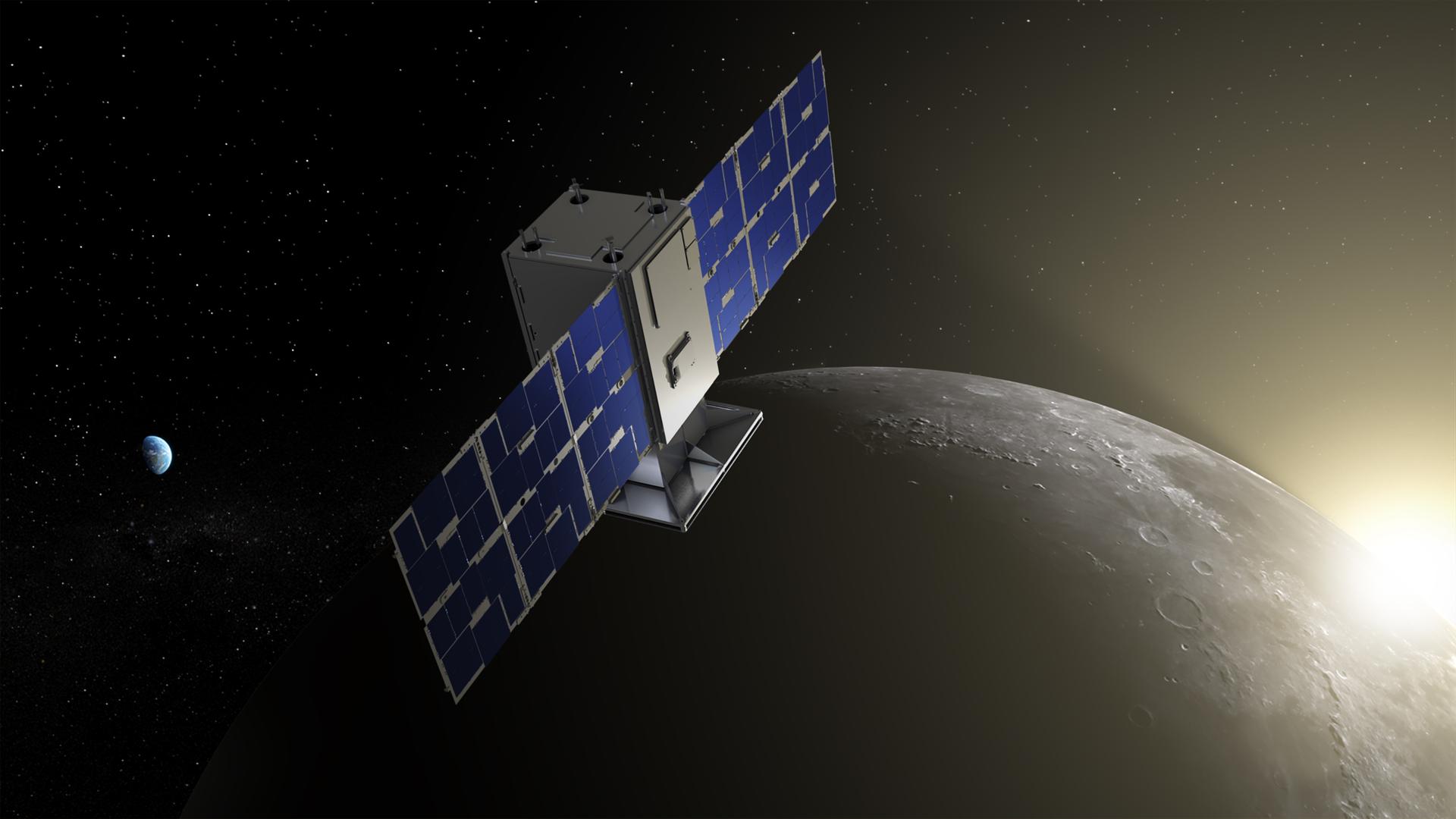
The mission is called CAPSTONE 02, and it is not one spacecraft but two. NASA describes a pair of identical small spacecraft, each weighing approximately 400 kilograms (882 pounds), targeting launch in 2027 into a near-rectilinear halo orbit — a wispy, stretched-out class of orbit around the Moon, following the model of the original CAPSTONE, which operated in that same regime. Once there, the two vehicles will spend their mission rehearsing the choreography that future crewed and robotic operations will depend on.
Two Spacecraft, Interchangeable Roles
The clever part of the architecture is that neither spacecraft is permanently the pursuer or the pursued. According to NASA, each vehicle can switch between a "chaser" role and a "target" role, allowing the pair to test a broad range of operational scenarios from both sides of the interaction. That flexibility matters: real rendezvous operations aren't a single clean approach but a sequence of hold points, drifts and corrections, and being able to reassign roles in flight lets the mission wring far more test data out of two identical vehicles than a fixed hierarchy would.
The stated objectives are a checklist of the capabilities that cislunar infrastructure will lean on: rendezvous and proximity operations, autonomous navigation, cislunar communication, and characterization of the radiation environment. In plain terms, the twins will practice finding and approaching each other, figuring out where they are without constant hand-holding from Earth, talking across the Earth-Moon gulf, and measuring how much radiation their electronics soak up along the way.
Why Near-Rectilinear Halo Orbits Are Hard
To understand why NASA needs a dedicated demonstration for something that seems routine, it helps to understand where these spacecraft are going. A near-rectilinear halo orbit, or NRHO, is not a simple ellipse around the Moon. It is a three-body orbit shaped by the combined tug of Earth and Moon gravity — a balance point that keeps the spacecraft in a stable, fuel-efficient loop but also makes its motion far less intuitive than a low orbit around a single body.
NASA says the mission will test the trajectories of the spacecraft under the simultaneous influence of Earth and Moon gravities — otherwise known as three-body orbits. Navigation that works fine when one planet dominates the math gets murkier when two bodies are pulling comparably. Trajectories that look stable can drift; a maneuver that would be trivial in low Earth orbit has to account for a gravitational landscape that shifts as the spacecraft swings through its loop. Doing rendezvous in that regime — two objects each following complex three-body paths, trying to meet — is genuinely new territory for autonomous systems.
The Software Is the Real Payload
CAPSTONE 02 is, at heart, a software validation mission dressed in hardware. NASA plans to use it to test three of the agency's navigation software suites and to mature the Cislunar Autonomous Positioning System, or CAPS — technology first demonstrated on the original CAPSTONE and designed to let spacecraft determine their own position near the Moon rather than depending entirely on ground tracking from Earth. As more traffic moves into cislunar space, that kind of self-reliance stops being a convenience and becomes a bottleneck-buster: there are only so many deep-space antennas on Earth, and only so many spacecraft they can track at once.
Supporting the navigation work is an optical imaging payload supplied by Lawrence Livermore National Laboratory. Cameras that can spot and track another spacecraft against the black of space feed directly into autonomous rendezvous — if a vehicle can see its partner and reason about the relative geometry on its own, it needs far less help from mission controllers a light-second away.
Who Is Building It
The contract went to Advanced Space, the company NASA selected to lead the mission. The name carries a lineage: the original CAPSTONE was the first U.S. commercial mission to the Moon, and it was there that the Cislunar Autonomous Positioning System was first demonstrated. That is the reason for the "02" in the name — this is a successor mission, not a re-flight of the first. The two new spacecraft themselves are being built by Terran Orbital.
Funding comes jointly from NASA's Human Spaceflight Mission Directorate, with support from its Research and Technology Mission Directorate, and the mission is managed by Small Spacecraft & Distributed Systems, based at the agency's Ames Research Center. That split funding is a tell about intent: this is technology development, but technology development explicitly in service of crewed exploration.
A Note on the Name
It is worth being precise here, because the naming invites confusion. The original CAPSTONE — Cislunar Autonomous Positioning System Technology Operations and Navigation Experiment — was a single small satellite that proved out the near-rectilinear halo orbit as the first U.S. commercial mission to the Moon. CAPSTONE 02 is a distinct, two-spacecraft mission with a different emphasis: not "can we get to this orbit and survive," but "can two vehicles operate together autonomously once they're there." Same research lineage, different mission.
Why It Matters
NASA's stated reason for CAPSTONE 02 is to mature the infrastructure that Artemis and a future lunar "Moon Base" will require. That framing is worth taking seriously rather than reading as boilerplate. Every element the twins are set to demonstrate — autonomous rendezvous, self-determined navigation, reliable cislunar comms, a measured radiation environment — is a prerequisite for the kind of sustained lunar presence NASA is planning, where spacecraft, stations and landers will need to find and dock with each other without a human piloting every meter and without Earth in the loop for every decision.
Proving those capabilities on relatively cheap ~400 kg small spacecraft, before betting crewed hardware on them, is exactly the sort of de-risking that pays off later. If the twins can reliably locate, approach and loiter near one another in an NRHO — and if CAPS lets them do it while knowing their own positions — then autonomous operations near the Moon move from aspiration to demonstrated capability. That is the difference between a lunar base that depends on constant ground support and one that can run more of its own logistics. CAPSTONE 02 won't build that base, but in 2027 it aims to prove that the traffic control underneath it can work.
