
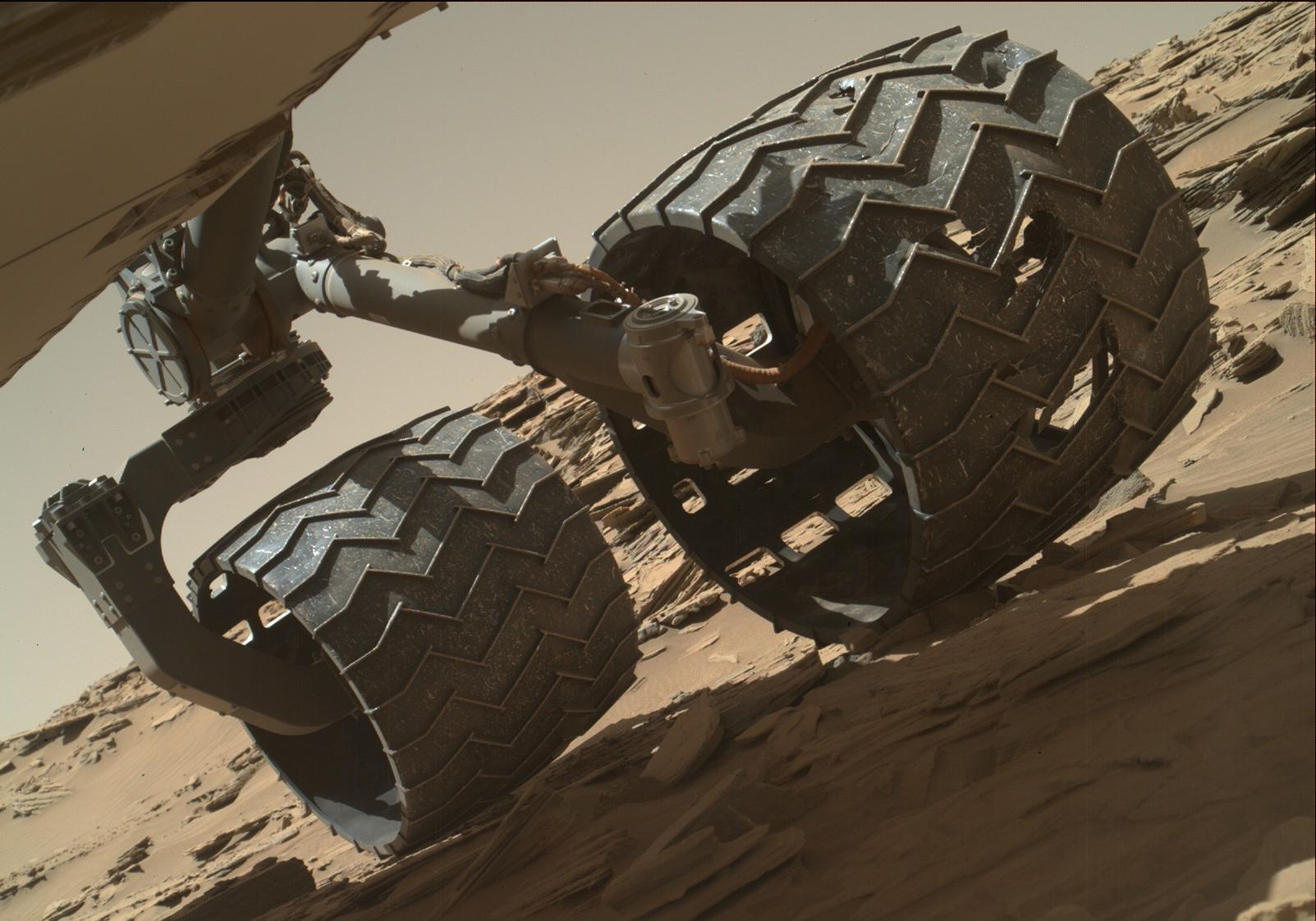
On July 23, 2026 — Sol 4963 of a mission that was only ever supposed to run two years — Curiosity turned its Mars Hand Lens Imager toward one of its own wheels and took a picture that looks less like spacecraft hardware and more like a piece of scrap metal pulled off a junkyard fence. The image, flagged as Space.com's Space Photo of the Day for July 24, shows a wheel surface stitched with cracks and punched through with holes, the accumulated damage of nearly 14 years of rolling across rocky, rugged Martian terrain.
It's not a new problem, and it's not a secret one. NASA and the Jet Propulsion Laboratory periodically use Curiosity's cameras to check on the condition of its wheels, a practice that stretches back across the years since the rover set down inside Gale Crater on August 6, 2012. What's notable about the latest image isn't that damage exists — it's how much of it has accumulated on a rover that, at over a ton, was the largest and most capable rover NASA had ever sent to Mars when it launched in 2011, and one that is still, as of this week, actively working.
Why It Matters
Curiosity's wheels were never designed to be replaceable. Once damage reaches a critical threshold, the rover's mobility — and with it, its ability to reach new science targets — is directly at risk. That's precisely why NASA has tracked wheel condition so closely for so much of the mission: unlike a flat tire on Earth, there's no roadside assistance on Mars. Every crack documented in these MAHLI images is data engineers use to model how much driving life the rover has left, and by extension, how ambitious the mission's remaining road map can be.
The wheels have effectively become a long-running structural experiment nobody planned for. Gale Crater's terrain has proven rocky and rugged, embedding rocks and gouging metal as Curiosity has driven across it. That the rover has still logged more than 20 miles (32 km) of driving despite that wear says as much about the mission team's careful operation of the vehicle as it does about the hardware itself.
There's also a broader stakes question. Curiosity is currently in the middle of some of its most scientifically significant work to date — exploring boxwork formations, a region of low geologic ridges the rover has been studying for about six months, and analyzing rock samples that have turned up the largest organic molecules ever discovered on Mars, long-chain compounds detected in a drilled sample and hypothesized to be remnants preserved in ancient mudstone. A mobility failure now wouldn't just end a photogenic road trip; it could cut short investigations directly relevant to the search for past habitability on the planet.
How Bad Is It, Really?
By NASA's own account: bad-looking, but not alarming. In a 2024 statement cited alongside the new imagery, the agency said the wheels are "holding up well despite taking some of the worst abuse from Mars." That statement predates this latest photo, meaning the wear visible in the July 23 image represents an additional stretch of driving on top of damage NASA had already characterized as within acceptable limits.
The wheels themselves were built for exactly this kind of scrutiny. Engineers have periodically directed Curiosity to pause and photograph its own wheels using MAHLI — a camera mounted on the end of the rover's robotic arm and originally intended for close-up geological imaging of rocks and soil, not self-inspection. Turning a geology camera into a maintenance tool has effectively given the mission a built-in health-monitoring system that requires no additional hardware, just careful use of instruments already on board.
A Mission Well Past Its Warranty
Context matters here. Curiosity is now nearly 14 years into a mission that has kept it driving, drilling, and transmitting long past its early years on Mars. NASA's raw image archive for the mission, pulled directly from the rover's ongoing operations, shows the scale of that continued activity: as of a recent fetch, the archive had grown to more than 1.48 million total images since landing, with 511 newly added in the most recent update and Sol 4966 the latest sol represented. That's not the output of a mission coasting to a quiet end — it's a spacecraft still working a full schedule.
Curiosity has now collected 42 powdered rock samples via drilling over the course of the mission, each one adding to a chemical and mineralogical record of Gale Crater that didn't exist before the rover arrived. The wheel damage is, in a sense, the visible cost of gathering that record — 20-plus miles of terrain contact required to reach each new drill site, each new boxwork outcrop, each new vantage point.
Whether the wheels can sustain the mission through its next major milestones remains an open question NASA will keep answering the same way it has for years: with a camera, a robotic arm, and a periodic look downward at the hardware taking the hit.
