
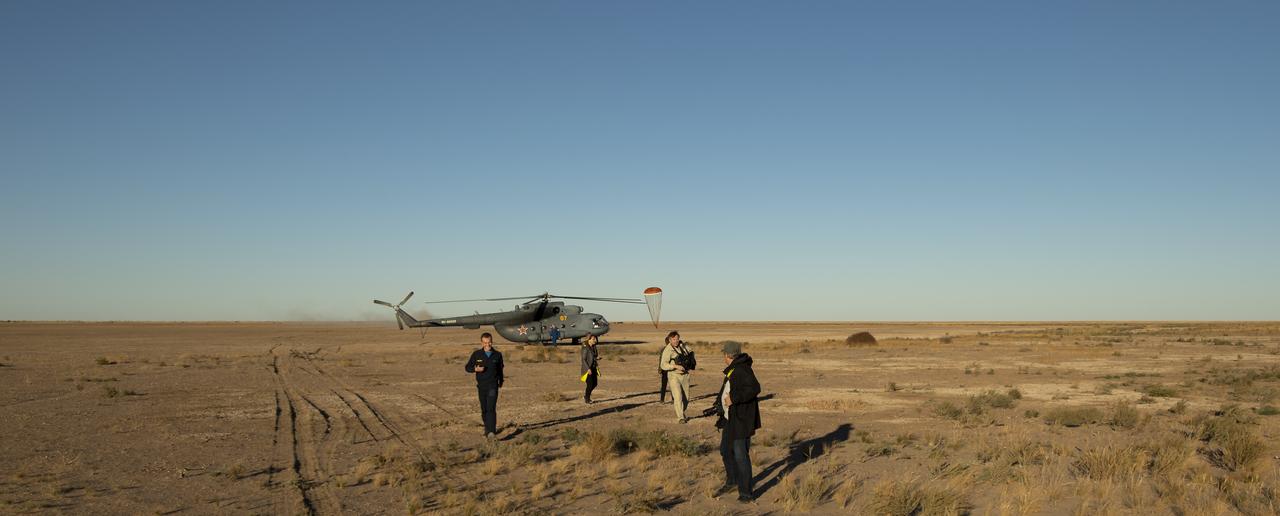
A three-person crew closed out eight months aboard the International Space Station on Sunday, dropping back through the atmosphere under a single orange-and-white parachute and thudding down on the Kazakh steppe. NASA astronaut Chris Williams and Roscosmos cosmonauts Sergey Kud-Sverchkov and Sergei Mikaev touched down southeast of the town of Dzhezkazgan at 5:27 a.m. CDT on July 26, 2026, wrapping a mission that had begun on November 27, 2025.
The return followed the familiar choreography of a Soyuz descent. The crew's spacecraft, Soyuz MS-28, undocked from the station's Rassvet module at 3:02 a.m. EDT and then spent roughly three and a half hours maneuvering away from the orbiting laboratory, firing its engines to drop out of orbit, and shedding its orbital and service modules before the crew-carrying descent module made its fiery plunge to the ground. By the time the capsule settled onto the steppe, the trio had logged about 241 days in space.
Who Came Home
For Williams, the landing capped a first long-duration stay in orbit. He shared the ride down with Kud-Sverchkov and Mikaev, the two Roscosmos cosmonauts who had launched with him the previous November. The descent was carried live for viewers on the ground, as is standard for a crew returning from the station.
The handoff on the station itself is worth noting. As the departing crew sealed themselves into Soyuz MS-28 and pulled away, Expedition 74 formally came to a close. The undocking marks the boundary between one expedition and the next, and the remaining residents carry on aboard the orbiting laboratory.
The Anatomy of a Soyuz Landing
There is nothing routine about riding a capsule back through the atmosphere, but the Soyuz has been doing it for decades, and the sequence is well rehearsed. After undocking, the spacecraft backs away to a safe distance and then performs a deorbit burn, slowing itself just enough to begin falling toward the planet. Shortly before atmospheric entry, the vehicle separates into three parts; only the bell-shaped descent module carries the crew, and only it is built to survive the heat of reentry.
From there, aerodynamic drag does most of the braking, parachutes handle the rest, and a last-second burst from soft-landing engines cushions the final contact with the ground. The whole descent, from undocking to touchdown, unfolds in a matter of hours—here, about three and a half of them. The landing zone southeast of Dzhezkazgan is a long-standing target for returning Soyuz crews, a stretch of open Kazakh steppe with room for recovery teams to reach the capsule quickly.
Why It Matters
Crew rotations rarely make headlines, and that is precisely the point. The steady rhythm of arrivals and departures is what keeps the International Space Station permanently staffed, and every clean return is evidence that the machinery of human spaceflight—spacecraft, ground teams, and the international partnership behind them—is still working as intended.
This landing also underscores how deeply intertwined the US and Russian programs remain in orbit even amid strained relations on the ground. A NASA astronaut launched aboard a Russian Soyuz, lived and worked alongside two cosmonauts for eight months, and came home in the same capsule, with the descent carried live. That kind of integrated operation is a legacy of the station era, and each successful mission extends it a little further.
For the science aboard the station, the transition matters too. An eight-month expedition represents hundreds of days of continuous research and maintenance, and the smooth transition between expeditions means that work continues without interruption as one crew heads home and the remaining residents carry on. The station's value lies in that continuity—an unbroken human presence stretching across expedition after expedition—and Sunday's landing was one more link in that chain.
