
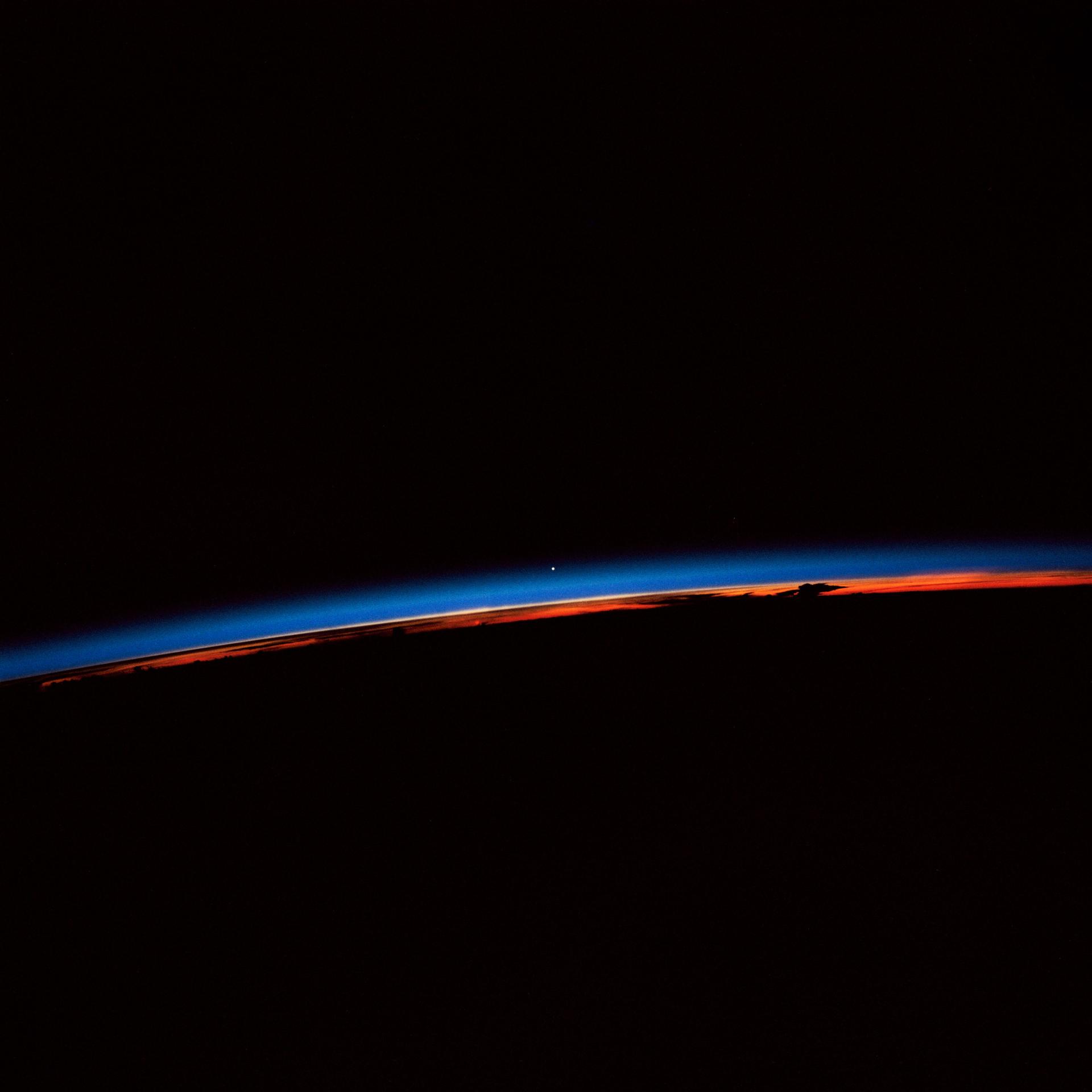
The evening star is leaving the evening sky. At 4:00 UTC on Oct. 24, 2026, which is 11 p.m. CDT on Oct. 23 for North American observers, Venus reaches inferior conjunction. At that moment it lies roughly between Earth and the Sun. According to EarthSky, the planet passes 6.6 degrees south of the Sun against the background stars of Virgo. That gap is the reason nothing dramatic happens: Venus does not cross the solar disk, and there is no transit this time.
The event still matters for anyone who has been watching Venus in the west after sunset. Conjunction ends the current evening apparition. Over the next few weeks the planet moves into the morning sky and becomes a pre-dawn object, the "morning star."
What Is Actually Happening Up There?
The cause is an orbital race. EarthSky puts Venus's orbital speed at about 35 kilometers per second, compared with Earth's 30 or so. Venus also follows the shorter inside track, so it keeps gaining a lap on Earth, passing between us and the Sun about every 19.5 months.
Inferior conjunction is the moment of that pass. For months Venus has trailed the Sun in our sky and set after it, which made it an evening object. As it overtakes Earth on the inside lane, its apparent position swings across the Sun's line of sight to the other side. Once it is there, it rises before the Sun.
The term "inferior" just means the conjunction happens with Venus between us and the Sun, not on the far side. The dates follow the 19.5-month rhythm. EarthSky lists the previous inferior conjunction on Mar. 23, 2025, and the next one on June 2, 2028.
Can You See It on the Day?
In practice, no. EarthSky says Venus is not likely to be visible on the day of conjunction unless you are an extremely careful and experienced telescopic or photographic observer. It also asks readers not to attempt to observe Venus near the Sun unless they are experienced sun observers. A slender crescent Venus crosses the daytime sky right alongside the Sun, deep in the glare. Casual skywatchers should skip the conjunction itself and wait for Venus to come back out.
Why No Transit This Time?
If Venus passes between Earth and the Sun every 19.5 months, why don't we see it cross the Sun's face each time? EarthSky explains that Venus doesn't go directly between the two. If it did, there would be a transit. This year it passes 6.6 degrees south of the Sun, a clear miss.
Transits are rare, and they come in pairs. EarthSky notes that the most recent transits of Venus came in June 2004 and June 2012. The next pair will not arrive until December 2117 and December 2125, so the ordinary near-miss conjunctions are what our generation gets.
When and Where to Look Next
EarthSky expects Venus to return to the dawn sky around mid-November, when it should be visible low in the east about 20 to 30 minutes before sunrise. That is a narrow window, and you will need a clear, flat eastern horizon to catch it.
When the Curves Line Up, which tracks planetary alignments, flags a possible early opportunity. On Nov. 7, Venus and a thin crescent Moon line up near the bright star Spica before sunrise, spread across about 3 degrees. The site places Venus nearly 10 degrees above the east-southeast horizon 45 minutes before sunrise. That is a little earlier than EarthSky's general mid-November estimate. It makes a good test for observers with a clear view low in the east-southeast, and the crescent Moon will help point the way.
Venus will not be alone in the morning sky. When the Curves Line Up says Mars is closing in on Jupiter before sunrise and overtakes it on Nov. 16, with Jupiter about 7 degrees from Regulus. In the evening, the Hunter's Moon appears near Saturn after sunset. Even with Venus temporarily out of sight, both ends of the night have something to watch.
A Quick Reminder of What You're Looking At
The bright point that will soon rise before the Sun is a hostile place. NASA describes Venus as the second planet from the Sun and Earth's closest planetary neighbor. It is the third brightest object in our sky, after the Sun and the Moon.
Its brightness hides harsh conditions. NASA puts the surface temperature at about 467 degrees Celsius (872 degrees Fahrenheit), and the surface pressure is about 93 times that at sea level on Earth. The planet's timekeeping is odd too. A Venus year lasts 225 Earth days, but one sunrise-to-sunset cycle on the surface would take 117 Earth days. Venus also spins backward compared with Earth, so the Sun there would rise in the west and set in the east.
Why It Matters
Inferior conjunction is not a spectacle. You cannot safely watch it, and this year it will not produce a transit. It is still one of the main turning points in Venus's cycle, the hinge between its evening and morning apparitions, and it repeats on a schedule set by orbital mechanics: a faster inner planet gaining a lap on Earth about every 19.5 months.
Knowing when it happens lets skywatchers plan. It explains why Venus has dropped out of the western twilight, and it tells you when and where to look for its return: low in the east before dawn, starting in early to mid-November. Following the planet through the cycle, from evening star to conjunction to morning star, is one of the simplest ways to see the solar system's geometry with your own eyes. The 6.6-degree miss is also a reminder of how precise the alignment has to be for a transit, which is why the next one is more than 90 years away.
