
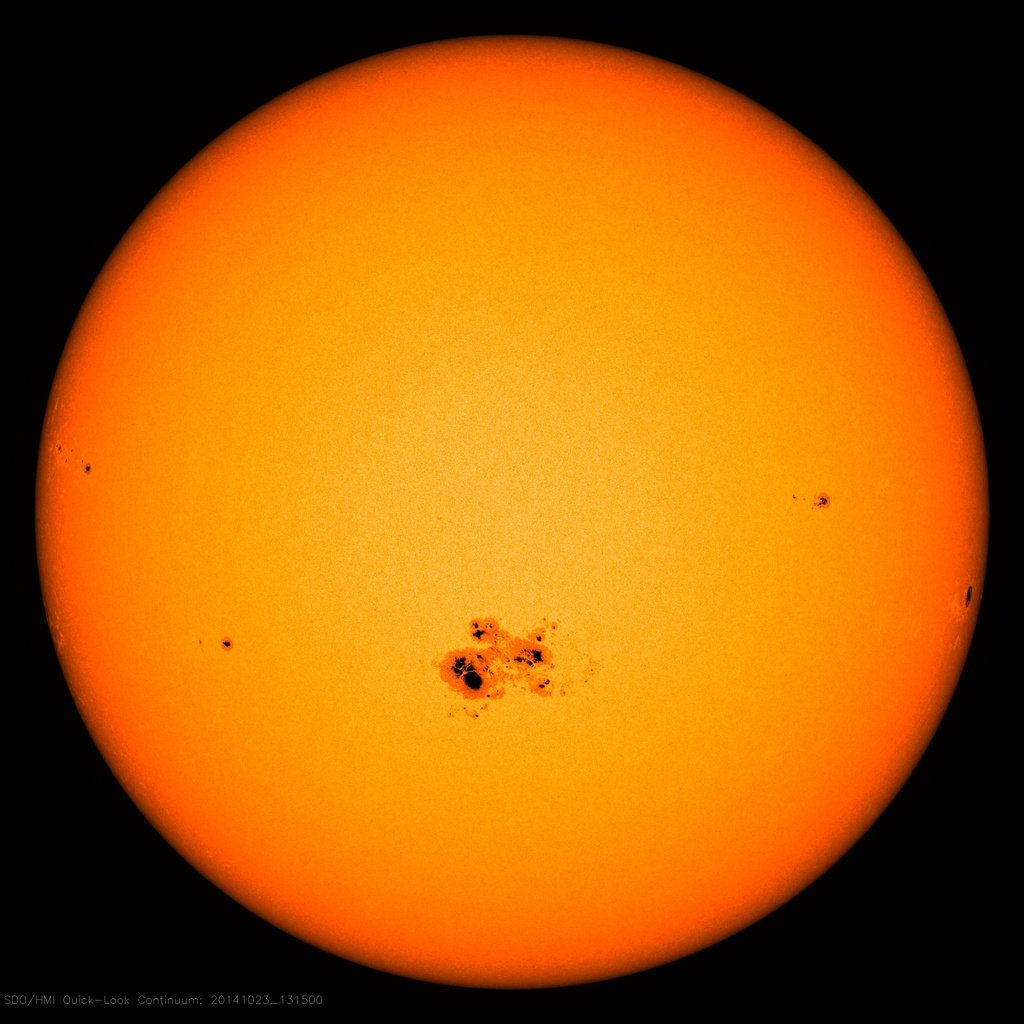
For the past several days one region on the Sun has produced nearly all of its flares. Sunspot region AR4551 sits close to the center of the Earth-facing disk. It has kept a complex magnetic arrangement that forecasters watch closely, and NOAA's Space Weather Prediction Center (SWPC) now names it as the main source of flare potential over the next few days.
So far the region has been loud without being powerful. Every flare it has produced in the recent reporting periods has been C-class, a moderate level. Forecasters care less about what it has done than about what its magnetic structure could still do.
A region that grew up fast
According to EarthSky, AR4551 first emerged on the Earth-facing side of the Sun on October 9. At that point it showed a beta configuration. It grew rapidly, and for three days it has carried a beta-gamma-delta magnetic classification, which EarthSky calls the strongest configuration there is. EarthSky calls it the top flare producer on the disk.
SWPC's forecast discussion issued at 00:30 UTC on October 16 gives more detail. It places Region 4551 at S15W06, south of the solar equator and slightly west of the central meridian. It lists the sunspot group as type Eki with a beta-gamma-delta configuration. The center also reports several areas of new magnetic flux emerging around the region's leader spot, which means the region is still developing and not settling down.
The flare tally
The numbers show which region is doing the work. SWPC reports that the largest flare of its most recent reporting period was a C4.9 at 15:55 UTC on October 15, from Region 4551. The same discussion says the region produced the majority of the period's X-ray flares.
EarthSky lists other events from the same region, including a C2.8 flare at 17:55 UTC on October 15 and a C3.1 at 00:19 UTC on October 16. In one reporting period EarthSky counted 14 flares from AR4551 and just 3 from its nearest rival, AR4557.
That rival is worth a brief mention. SWPC describes Region 4557 at N07E29 as a beta region that showed growth over the second half of the period. For now it is a minor source compared with its larger neighbor.
What "beta-gamma-delta" signals
The classification sounds technical, and forecasters take it seriously for a practical reason. SpaceWeather.com calls big sunspot 4551 "potentially dangerous" and says its beta-gamma-delta magnetic field holds enough energy for X-class flares. EarthSky likewise says the region has the potential for M-class and even X-class flares.
Those odds appear in SWPC's forecast. Solar activity is expected to stay low through October 18, but the center gives a 25% chance of M-class flares, which correspond to R1 to R2 radio blackouts. It also sees a slight chance of an X-class flare, an R3 event, coming mainly from Region 4551. The forecast also includes a slight chance of an S1 solar radiation storm through October 18, again tied to the flare potential of Region 4551.
The forecasts differ slightly. EarthSky's update put the M-class chance at 20% and the X-class chance at 5%. Both point the same way: an M-class flare is plausible but unlikely, and an X-class flare is possible but not expected.
Why It Matters
The key factor is where the region sits. SpaceWeather.com notes that sunspot 4551 directly faces Earth, so any eruption from it would be geoeffective, meaning it could affect conditions around our planet. The region's position near the center of the disk, at S15W06, is what makes a strong flare from it relevant to Earth.
The current situation is calm. SWPC reports that no Earth-directed coronal mass ejections (CMEs) were observed in available coronagraph imagery. The solar wind is elevated, but under diminishing high-speed stream activity, not because of anything AR4551 has launched. SWPC also expects the flux of electrons above 2 MeV near Earth to be high on October 16, which is separate from the sunspot's flare risk.
For skywatchers and anyone who relies on radio communication, AR4551 is the region to follow over the next few days. SWPC's scale ties M-class flares to minor or moderate radio blackouts and X-class flares to strong ones. Any CME that came with such a flare would then need to be assessed for whether it is heading toward Earth. Until that happens, the region remains a risk with no effects so far: it has the magnetic setup for a major event, but it has produced only C-class flares in the periods EarthSky reported.
What to watch
- Flare class: The first M-class flare from AR4551 would show that the region is turning its stored energy into stronger events.
- Magnetic evolution: SWPC has flagged new flux emerging near the leader spot. Continued growth would keep the complex configuration in place.
- CME reports: No Earth-directed CMEs have been seen yet. A change there would matter most for any aurora prospects.
- Timeline: SWPC's current outlook runs through October 18, with solar activity expected to stay low.
