
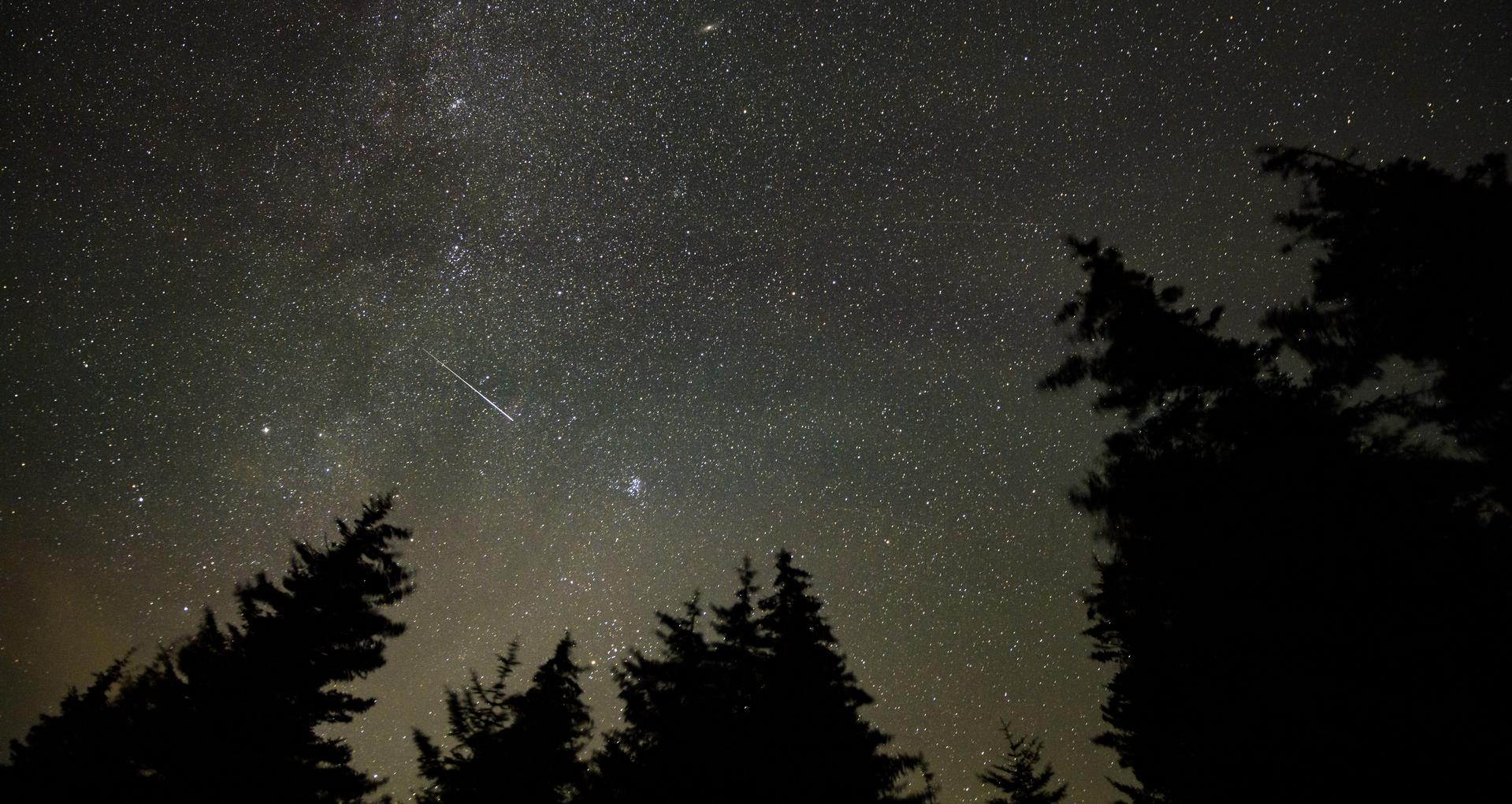
Most meteor showers are judged by volume. The Perseids and Geminids get attention because they produce a torrent of "shooting stars" across a dark sky. The Taurids are different. They are sparse and spread out, with two streams running for weeks. They're worth a cold night outside because of their quality: a reputation for slow-burning, unusually bright fireballs, which explains the seasonal nickname Space.com uses for them: the "Halloween Fireballs."
This year's conditions are good, but you should set your expectations first. According to Space.com, Earth isn't expected to pass through the denser debris that produced the fireball-rich Taurid displays of 2008, 2015 and 2022. The next predicted swarm is in 2032, so 2026 should be an ordinary Taurid year. An ordinary year can still deliver a fireball that stops you mid-sentence.
Two showers that look like one
"The Taurids" is shorthand for two related streams: the Southern Taurids and the Northern Taurids. Both radiants sit near the constellation Taurus and the Pleiades star cluster, and Space.com notes they can be seen from both hemispheres. Because the streams overlap for weeks, a Taurid seen on any given November night could belong to either one.
The dates depend on which source you read, so the figures below are attributed:
- Southern Taurids: Space.com lists the stream as active from Sept. 20 to Nov. 20. It describes an annual component that peaks around Oct. 14 and a separate component linked to fireballs that peaks overnight Nov. 4-5. EarthSky gives a predicted South Taurid peak of 19:00 UTC on Nov. 5, 2026.
- Northern Taurids: Space.com lists activity from Oct. 20 to Dec. 10 and expects a peak overnight Nov. 11-12. EarthSky predicts the North Taurid peak at 18:00 UTC on Nov. 12, 2026.
Don't treat the peak dates as one-night events. EarthSky says neither Taurid shower has a very definite peak; they "ramble along" through October and November, so the nights either side of a listed peak are worth watching too.
What you'll actually see
Both outlets agree on the numbers. Each stream produces about 5 meteors per hour, and when the two overlap the combined rate is about 10 per hour. Space.com explains that zenithal hourly rate (ZHR) describes what an observer could see under ideal conditions with the radiant directly overhead. From a suburban backyard you'll probably see fewer.
Speed figures vary by source. Space.com puts the Southern Taurids at about 17 miles per second (27 km/s) and the Northern Taurids at about 18 miles per second (29 km/s), and calls that relatively slow for a meteor, which helps make some Taurids conspicuous as they cross the sky. NASA's page on the parent comet gives one figure for the shower, 65,000 mph (104,607 kph), and calls the meteors fast. The two figures are in the same ballpark; the difference is in how each source describes them.
Fireballs are the main attraction. NASA describes the Taurids as known for fireballs as bright as or brighter than Venus, around magnitude -4. They are rare, though. EarthSky says fireballs make up about 1% of Taurids in most years, rising to as much as 7% in exceptional years when Earth crosses a concentrated field of debris. In 2026, expect the 1% end of that range. At that rate, EarthSky puts the normal fireball frequency at about one every 20 hours of observing, so most observers won't see one in a single session.
The Moon is mostly out of the way
Moonlight usually spoils a shower like this, because faint meteors disappear in a bright sky and the Taurids have few meteors to spare. EarthSky notes that the new moon falls at 7:02 UTC on Nov. 9, 2026, and says moonlight will not interfere with Taurid meteors this year.
Space.com also covers the overnight Nov. 4-5 Southern Taurid peak. On that night the Moon rises a couple of hours before dawn as a 17% waning crescent, which Space.com calls too dim to affect visibility of meteors. For the Northern Taurid peak on Nov. 11-12, Space.com says the Moon will be a 5% waxing crescent, practically absent from the night sky.
How to watch
EarthSky says the best hours are around midnight, when Taurus is highest in the sky. This isn't a dawn-only shower, which helps if you don't want to set a 4 a.m. alarm.
- Get dark. At a ZHR of about 5, light pollution decides whether you see anything. Space.com advises finding somewhere away from bright lights with as wide a view of the sky as possible, and giving your eyes about 20 minutes to adjust.
- Don't stare at Taurus. Space.com says meteors can appear anywhere in the sky, and staring directly at the radiant can mean seeing shorter trails. Look at a wide, dark patch of sky instead.
- Skip the optics. Space.com says binoculars and telescopes restrict your field of view and make meteor watching impossible. Your eyes are the right tool.
- Give it time. At about five meteors an hour, expect gaps between sightings. Plan for an hour or more, and bring a reclining chair and warm layers.
- Pick a window, not a date. With both streams active from late October into November, any clear, dark night in that period is worth trying. The overnight Nov. 4-5 Southern Taurid peak and the Nov. 11-12 Northern peak are good targets.
The source: Comet Encke and its family
NASA identifies Comet 2P/Encke as the parent of the Taurid meteor stream. The comet is unusual. Its orbital period is 3.30 years, the shortest of any known comet, and its nucleus is about 2.98 miles (4.8 km) across. Pierre Méchain discovered it on Jan. 17, 1786, but the comet is named after Johann Encke, who computed its orbit. NASA's MESSENGER spacecraft imaged it on Nov. 17, 2013.
The Taurids are more than one comet's debris. Space.com says they belong to a much larger complex of dust, rocks, comets and asteroids, possibly created when a much bigger object fragmented thousands of years ago. EarthSky adds that the Northern Taurids may have a second source: asteroid 2004 TG10, discovered by the Spacewatch program on Oct. 8, 2004, and considered part of what's called the Encke Complex. EarthSky cites a recent study suggesting it may be one of about 10 related asteroids, in which case no single asteroid is producing the Northern Taurid material.
Why It Matters
The Taurids show that meteor showers aren't always reliable. The swarm years EarthSky lists (2008, 2015 and 2022) show that Earth sometimes crosses a concentration of larger debris and the fireball count rises sharply, while in other years the shower is a slow trickle. EarthSky says the next predicted swarm, in 2032, looks exceptional, with a new moon and Earth passing very close to the center of the swarm.
For backyard observers, the case for going out is simpler. This autumn has little moonlight, a shower active for weeks, and a small but real chance of a Venus-bright fireball. It won't be a swarm year, so the payoff is less predictable, but if you have a clear night and some patience it's worth the attempt.
