
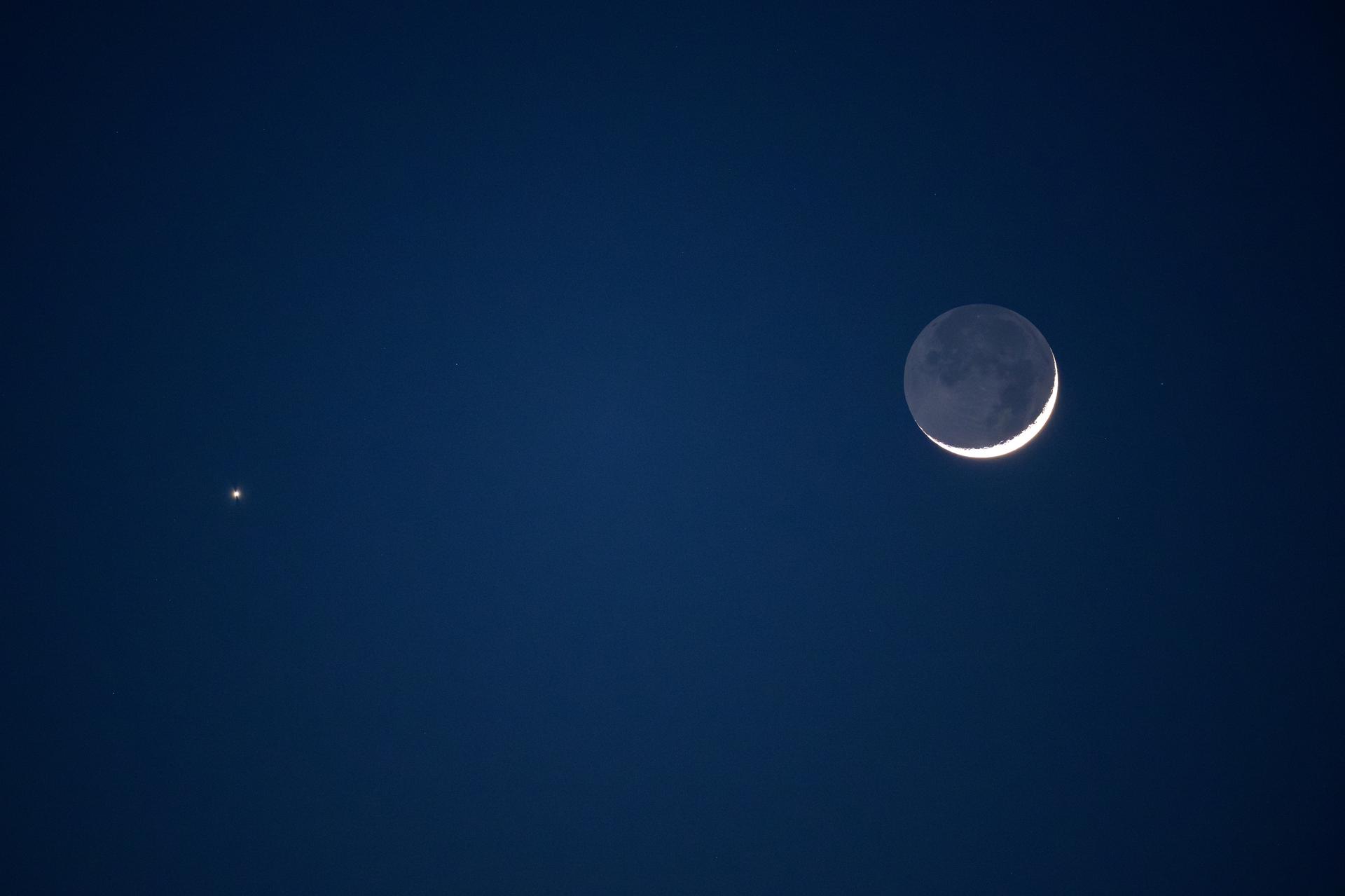
If you have stepped outside before sunrise lately and noticed a very bright light low in the southeast, that is Venus. This week the planet reaches the brightest point of its current run as a "morning star." According to Space.com, which cites figures from the In-The-Sky astronomy website, Venus reaches peak brightness for this morning apparition at 1:37 p.m. EST (1837 GMT) on November 27.
That moment falls in daylight for observers in the United States, so nobody there will see the actual peak. It hardly matters. The planet is at its most dazzling around this week, and the mornings on either side of the peak should look much the same: Venus climbing into the southeastern sky ahead of the rising Sun.
How bright is "brightest"?
BBC Sky at Night Magazine puts Venus's Greatest Brilliancy in late November 2026 at about magnitude -4.7 to -4.9, with the maximum around November 27. Astronomical magnitudes run backwards: the more negative the number, the brighter the object. A value near -4.8 makes Venus by far the brightest "star" in the predawn sky.
The peak comes from changes in the planet's phase and distance. Space.com notes that Venus will appear increasingly illuminated over the coming weeks and months as it moves farther away from Earth in its orbit, while its apparent size through a telescope gradually decreases. So the part of the disk lit by the Sun keeps getting larger while the planet itself moves farther away. Those two trends pull against each other, and Greatest Brilliancy is the point where Venus looks brightest from Earth. Sky at Night Magazine adds that through December, as Venus climbs higher above the horizon before dawn, it will remain exceptionally bright and hard to miss.
Where to look
Sky at Night Magazine advises looking toward the east-southeast about one to two hours before dawn, with a clear, flat eastern and southeastern horizon. On the morning of November 27, Space.com places Venus in the southeast with Spica, the brightest star in Virgo, less than five degrees away, roughly the width of three middle fingers held at arm's length. Mercury clings close to the horizon below.
That gives you a ladder to climb. Venus is the obvious anchor. Spica is the much fainter point of light nearby. Mercury is the hard one: it hugs the horizon, so you will want an unobstructed view to the southeast with no trees or buildings in the way.
Spica deserves a closer look than its modest brightness next to Venus suggests. Space.com notes that it is actually a double system of two stars orbiting each other once every four days, separated by approximately 11 million miles. That is far too close to split visually, even with the most powerful amateur equipment. The single point you see is a tight pair of stars locked in a fast orbit.
A four-planet morning
Venus is not alone before dawn. Sky at Night Magazine describes Venus lining up alongside Mercury, Jupiter and Mars in a four-planet parade across the predawn sky throughout late November and December 2026. Earlier in the month, NASA's November skywatching guide highlighted Mars and Jupiter appearing 1.2 degrees apart before sunrise on November 15-16. That close pairing is now past, but both planets are still part of the morning gathering.
If you head out for Venus, take a moment to scan the rest of the eastern sky. Venus and the brighter planets need no equipment, just an early alarm and a clear horizon, though Mercury may be harder to pick out low on the horizon.
Mark the calendar: December 4 and 5
Venus stays brilliant through December, and the Moon will soon pass through the scene. Sky at Night Magazine reports that on December 4 Venus will be visible in the southeast before dawn with the crescent Moon to its right and, between the two, the bright star Spica, forming a line. On December 5 Venus, Spica and the crescent Moon form a triangle in the morning sky. Both mornings make an easy target for observers and a good subject for photographers. A crescent Moon beside a bright planet is a beautiful sight, and the magazine notes these meetings are best seen with the naked eye so you can take in the whole view of the morning sky.
For context, the Moon has had a busy stretch. NASA notes that the November 24 full Moon was a supermoon, the first in a series of three consecutive supermoons in November, December and January.
Why It Matters
Greatest brilliancy is not a rare cosmic event, and no headline should claim otherwise. It is still one of the most accessible astronomy experiences of the year. Sky at Night Magazine says no telescope is needed to spot Venus, which is easily visible with the naked eye. It takes no special knowledge, only the willingness to look southeast before sunrise. For anyone who has never knowingly seen another planet, a magnitude -4.8 Venus is the easiest place to start.
The surrounding sky makes this week especially good. Venus gives you a fixed reference point. From there you can find Spica, try for Mercury low on the horizon, and look for Jupiter and Mars in the same session. That is a quick, hands-on lesson in how the planets keep moving against the background stars. The December 4-5 line-up with the Moon then gives a clear reason to come back and compare.
A note on sources: the brightness timing and figures in this piece come from Space.com (citing In-The-Sky) and BBC Sky at Night Magazine. NASA's November skywatching guide provides the broader context for the month but does not itself discuss Venus's peak brightness.
