
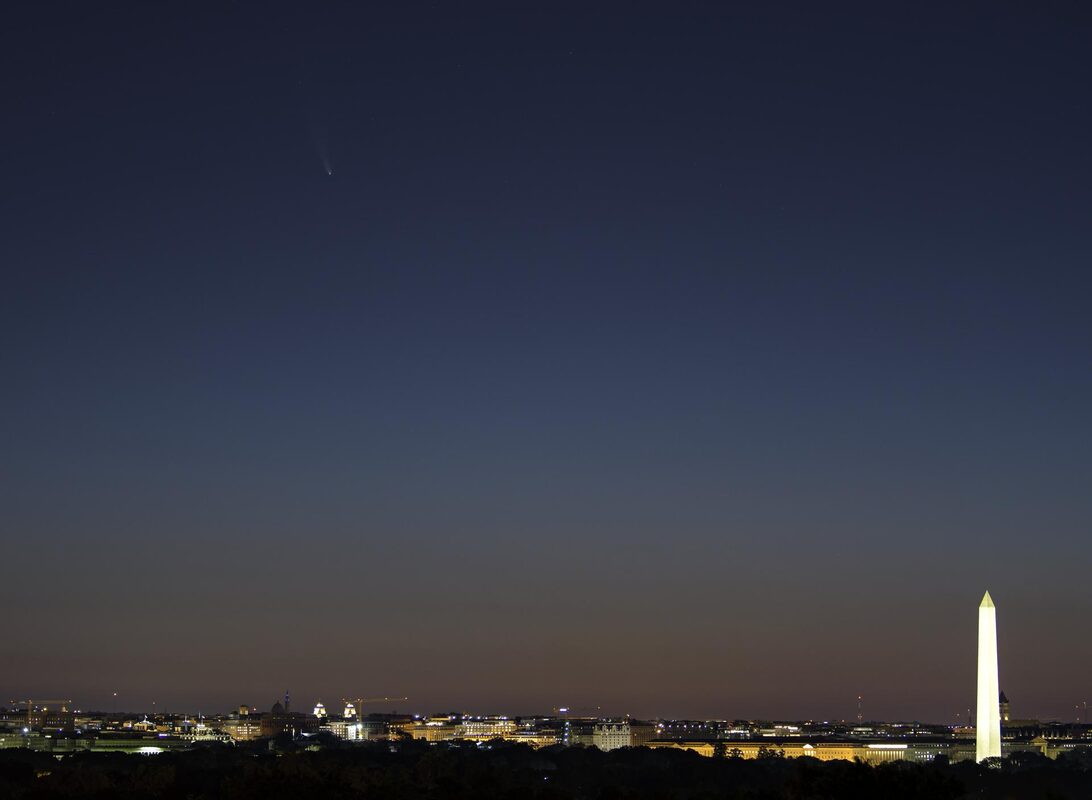
Most comets that reach amateur telescopes either flare and fade within a few weeks or show up years apart with little warning. Periodic comet 161P/Hartley-IRAS is easier to plan for. It comes back on a known orbit about every 21.5 years, and this weekend it is at perihelion, its closest point to the Sun. It is not a naked-eye object, and it is not putting on a tail. It is a steady target for a small telescope, and in photographs its core shows a distinctly green glow.
The timing is also good. As the comet reaches perihelion, the early evening goes dark again. The Moon has been washing out the sky, and now there is a stretch of real darkness after sunset before it rises.
When Is Perihelion, Exactly?
The answer depends on which orbit solution you use, and the spread between them is worth explaining.
NASA's Jet Propulsion Laboratory lists 161P in its Small-Body Database. Its current solution, computed on Nov. 4, 2026, puts the time of perihelion at Julian Date 2461373.018 TDB, which works out to about Nov. 28. The IAU Minor Planet Center's comet elements file, citing MPEC 2026-W99, gives a perihelion time of 2026 Nov. 27.1779, a bit less than a day earlier. Astronomy magazine's observing column ties perihelion to the end of the Moon's interference this week.
The honest summary is that 161P reaches perihelion around Nov. 27 to 28, depending on the orbit solution. For an object that spends most of its 21-year orbit far from the Sun, a difference of under a day in the predicted moment of closest approach is ordinary. Separate solutions use different sets of observations and different modeling choices, and comets don't help. Their outgassing acts like small, irregular thrusters, which makes their motion harder to pin down than an asteroid's. For an observer, none of this matters. The comet's brightness and position barely change across those few days.
The Orbit in Numbers
The two catalogs agree closely on the shape of the orbit, even though they disagree slightly on timing:
- Perihelion distance: about 1.28 au in the JPL solution and 1.265 au in the MPC elements. That keeps the comet outside Earth's orbit even at its closest to the Sun.
- Eccentricity: 0.835 (JPL) and 0.836 (MPC), a long, stretched ellipse.
- Semi-major axis: 7.72 au, according to JPL.
- Aphelion: about 14.2 au, the far end of the orbit. That is well beyond Saturn's distance from the Sun.
- Period: about 7,841 days, or about 21.5 years.
- Inclination: 95.79 degrees in both JPL and MPC solutions.
The inclination is the oddest number on the list. An inclination just over 90 degrees means the orbit is tipped nearly perpendicular to the plane the planets orbit in, and slightly past it. Technically, that makes the comet's motion retrograde. Most short- and intermediate-period comets orbit much closer to the plane of the planets. A 161P that rises so steeply out of it is an unusual member of the population.
JPL's solution also shows how well the comet is now tracked. It uses 1,446 observations over a data arc of 8,034 days, from Nov. 3, 2004, to Nov. 2, 2026. Its condition code is 0, the database's best rating for orbit certainty.
What You'll Actually See
Set your expectations first. According to Astronomy, 161P has held fairly steady at 10th to 11th magnitude. That is far too faint for the naked eye or casual binoculars, but well within reach of a modest telescope under dark skies. The magazine says even a small 4-inch scope will show it. Don't look for a tail, because the comet has no appreciable one. What it has is a green glow around the nucleus, which comes out in astrophotos more than it does at the eyepiece.
Owners of larger telescopes have something extra to look for. Astronomy says bigger apertures will show more detail around the nucleus, including a possible sharpened southern flank. Comparing a sketch or image over several nights is a worthwhile project.
For a sense of how catalogs model the comet's brightness, the MPC elements file gives H = 8.5 with a slope of 6.0. That figure comes from a fitting convention and is not a direct prediction of what you'll see in the eyepiece. The roughly 10th-to-11th-magnitude reports are the practical guide.
Finding It: A Star-Hop Through Sagitta
Look west a few hours after sunset. Astronomy's guide for Nov. 27, figured for 40 degrees north latitude, 90 degrees west longitude, puts the comet about 30 degrees above the horizon around 7 p.m. local time. It sits in western Sagitta, the small constellation of the Arrow.
The magazine suggests this route:
- Start at Zeta Aquilae. This 3rd-magnitude star in Aquila is easy to pick out. The comet lies about 6.3 degrees north-northeast of it.
- Sweep that 6.3 degrees. A low-power, wide-field eyepiece or a good finder is the right tool. You're looking for a small, fuzzy glow that doesn't come to a sharp point like a star.
- Use the Coathanger to check. From the comet, move 2.1 degrees northeast to reach the Coathanger asterism in Vulpecula. It is a 1-degree-long grouping of stars that looks like a coat hanger, with the hook on its southern side, and it makes a reliable landmark. If you can find the Coathanger, you're in the right neighborhood.
Mind the clock. On Nov. 27 the Moon was a waning gibbous, 82 percent lit, rising at 7:53 p.m. local time at the reference location. That leaves a usable dark window between the end of twilight and moonrise. A faint, diffuse object like this one disappears quickly once moonlight brightens the sky, so try to observe early in the evening.
Why It Matters
A comet at 10th magnitude won't make headlines. 161P is still worth the effort for several reasons.
First, the opportunity is rare. With a period of about 21.5 years, anyone who skips this perihelion waits until the late 2040s for the next one.
Second, the orbit itself is interesting. The comet travels on a steep, slightly retrograde path that swings from just outside Earth's orbit to beyond Saturn's. It is a different kind of object from the low-inclination comets that make up most of the periodic population. Its orbit is also very well determined. JPL's solution rests on more than two decades of observations and the database's best certainty rating, a reminder of how much astrometry adds up over time.
Third, the small disagreements between catalogs are useful. JPL and the MPC differ by under a day on perihelion and by roughly 0.011 au on perihelion distance. That is how comet orbit work normally looks. Each new set of positions helps narrow those differences for the next return.
Finally, it is simply a good observing target. It is steady in brightness, well placed in the evening, has a clear star-hop, and has a green core that rewards a camera. You can plan a session around it with confidence, which isn't true of many comets.
