
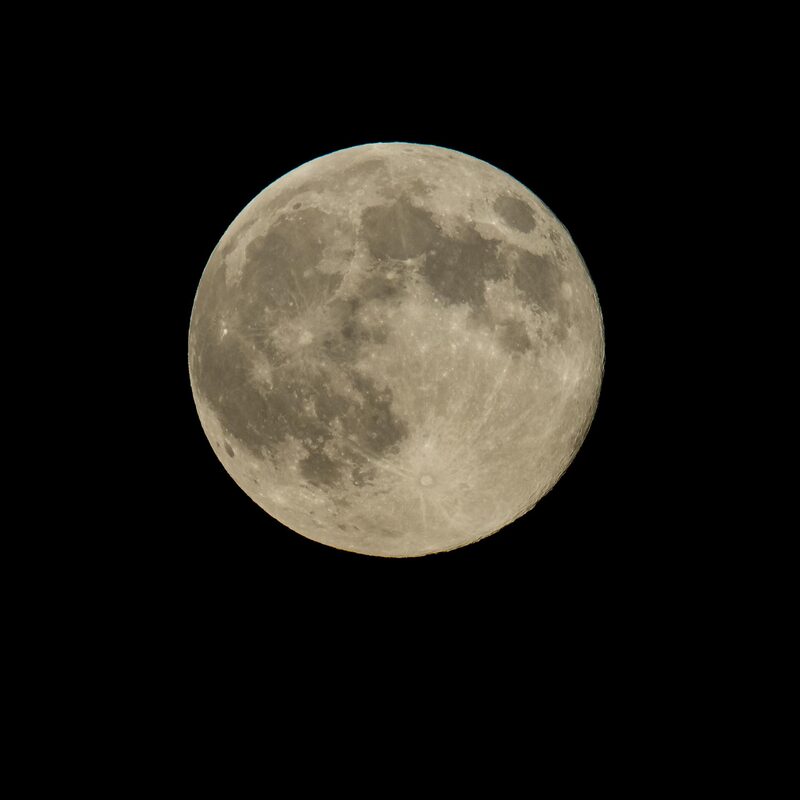
The full Moon that rose over skywatchers this week was a supermoon. November's Beaver Moon reached full phase on November 24 at 14:54 UTC, which was 9:54 a.m. on the U.S. East Coast. That means the moment of fullness happened in daylight for North America, and the best viewing came the evenings before and after. According to Space.com, it was "the opening salvo in a series of four dazzling supermoons." If you missed it, you have three more chances over the next three months, and the next one is the closest of 2026.
Below is a guide to what a supermoon is, what you can and can't expect to see, and when the rest of the run arrives.
What makes a full Moon "super"?
The Moon's orbit is an ellipse, so its distance from Earth changes over the month. A supermoon is a full Moon that happens while the Moon is near the close end of that orbit. EarthSky gives the Moon's average distance as 384,472 km. Using figures from eclipse expert Fred Espenak, it puts the November 24 full Moon at 360,768 km from Earth. That is about 23,700 km closer than average, or a little over 6 percent.
That is a real difference, but it is smaller than the word "super" suggests. EarthSky notes that supermoons do not look bigger to the eye than other full Moons, though they do look brighter. NASA says a full supermoon is "a bit brighter" than other Moons through the year, and that a supermoon might be hard to detect visually. Without a side-by-side comparison photo taken with the same lens, most people could not tell a supermoon from an ordinary full Moon.
The effect is easier to see at the shoreline. NASA points out that when the Moon is at its closest, it can cause higher tides than usual. EarthSky adds that these especially high tides depend heavily on local coastlines and weather, and that flooding typically needs a strong weather system as well.
The four-supermoon run, by the numbers
EarthSky's list, based on Espenak's calculations, gives these distances for the full supermoons around this stretch:
- January 3, 2026: 362,312 km
- November 24, 2026: 360,768 km (the Beaver Moon)
- December 24, 2026: 356,740 km
- January 22, 2027: 357,644 km
- February 20, 2027: 363,306 km
The last four entries are the consecutive run. EarthSky puts it plainly: "there'll be four supermoons in a row: November and December 2026, and January and February 2027." The run gets closer before it gets farther. December's full Moon comes about 4,000 km nearer than November's. January's is almost as close as December's. February's is the most distant of the four, about 21,000 km inside the average distance. It is also slightly farther away than the January 3, 2026 supermoon that opened this year.
December 24 is the one to circle. EarthSky calls it the closest full supermoon of 2026, at 356,740 km, roughly 27,700 km closer than average. NASA gives its full-phase time as 01:28 UTC on December 24. For observers in the Americas, that moment falls on the evening of December 23 local time (8:28 p.m. Eastern). So the night before Christmas Eve is the natural time to look up.
A note on counting
Readers comparing sources may find different totals. NASA's supermoon page currently lists only two upcoming dates: November 24 and December 24, 2026. EarthSky's 2027 entries extend the sequence to four. Space.com also describes the Beaver Moon as the first of four. A list that stops at the end of the calendar year gives a shorter count. The Espenak-based distances show January and February 2027 also qualify, so this story uses the four-in-a-row count.
Why "Beaver Moon"?
Like most traditional full-Moon names, this one comes from the season, not from astronomy. Space.com ties the name to beavers preparing for winter and to trappers historically setting beaver traps before waterways froze. These names come from folk calendars and do not appear in orbital tables. They are still a good shorthand for the time of year.
How people photographed it
Space.com collected photos from around the world. They included the Moon rising over a temple in Chiang Mai Province, Thailand, and Gary Hershorn's shot of it rising over the Chrysler Building in New York. A distant Moon behind a familiar landmark is a big part of why supermoons look so dramatic in photos, and the landmark likely does more of the work than the Moon's extra closeness.
One shot from Nottingham, UK, holds a useful lesson for the rest of the run. Space.com's Daisy Dobrijevic used a Sony A7IV and a Tamron 50-400mm lens. She took the photo on November 23, a day before full phase, because the forecast for full-Moon night looked disappointing. A Moon a day from full looks nearly the same as one at full. So if clouds threaten your viewing night in December, January or February, shooting a night early or late is a sensible fallback.
Practical tips for December through February
- Watch the moonrise. The size boost is too small to see, but a Moon low on the horizon next to trees or buildings tends to look impressive. That is a good time to see it with the naked eye.
- Use the nights on either side. Full phase is one instant. The Moon looks essentially full for a night or so around it, which gives you room to work around the weather.
- Don't expect to see a size difference. EarthSky says most people can't tell a supermoon's size from an ordinary full Moon, though the extra brightness may be noticeable. Enjoy the full Moon for what it is rather than hunting for a size change.
- Check local tide tables. If you live on the coast, the higher-than-usual tides NASA describes may matter more than anything you will see in the sky.
Why It Matters
Supermoons are often oversold, but they are a good introduction to how the Moon's orbit works. The distances above show an elliptical orbit in concrete numbers. The Moon's distance swings by tens of thousands of kilometers, and those swings line up with the full phase in a pattern that clusters supermoons together, as this four-month run shows. The tidal effect is real, though how much it matters depends on local coastlines and weather. The supermoon label is also not exclusive. NASA notes that a supermoon can sometimes also be a blue moon, which shows these names describe different, overlapping things rather than one kind of rare event.
Most of all, a predictable run of four bright full Moons over the darkest months of the year gives people a reason to step outside and look up. If the Beaver Moon was clouded out where you are, Christmas Eve's closer Moon is a month away.
