
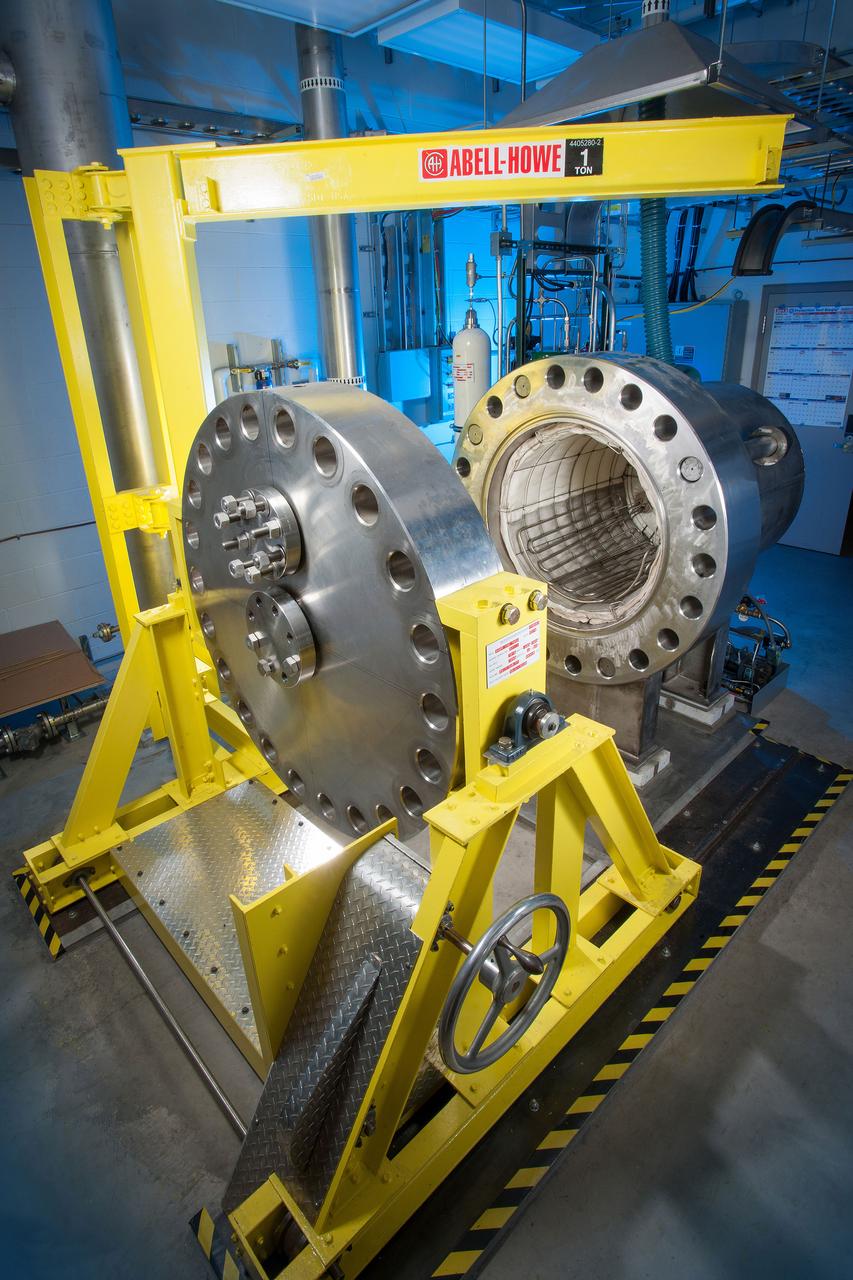
To learn whether Venus was ever wet, you have to know what its rocks look like after billions of years in one of the most corrosive environments in the solar system. Waiting that long isn't an option, so a team working at NASA's Glenn Research Center in Cleveland did the next best thing. They sealed a set of minerals inside a steel vessel built to reproduce the Venusian surface, held them there for two months, and then checked what had changed.
The results, published in the Planetary Science Journal, show some of the minerals breaking down and others reorganizing in ways that could help them survive. The authors argue that magnesite and fluorinated micas are what future missions should look for.
The Rig
The experiment ran in the Glenn Extreme Environments Rig, or GEER. According to NASA's facility page, GEER is a pressure vessel with an internal volume of 811 liters. It is currently configured to simulate Venus and is rated for 1,365 psia (about 94 bar) and 1,000°F (538°C). It has logged more than 6,600 hours of simulated Venus surface time across various tests and experiments, including weathering and geology work of the kind described here.
Those numbers are set by Venus itself. The planet's surface averages around 460°C, and the atmospheric pressure is roughly 93 times what we feel at sea level on Earth, as Universe Today notes in its coverage. The atmosphere is not just thick but chemically aggressive. It is dominated by carbon dioxide and, according to the paper, contains reactive gases including sulfur dioxide, hydrogen fluoride and hydrogen chloride.
What Went Into the Chamber
The study's lead author is Sara Taeko Port, now a postdoc at the University of Texas at San Antonio. She did the work as a NASA Postdoctoral Program fellow at Glenn. The team picked six minerals in two groups.
- Carbonates: calcite, siderite and magnesite
- Hydrous minerals (minerals with water or hydroxyl built into their structure): phlogopite, muscovite and brucite
The choice is deliberate. On Earth, hydrous minerals such as these generally form where water is present. If any of them could last at the Venusian surface, they could serve as physical evidence of an earlier, wetter era. If they break down quickly, finding them would mean something different, or they wouldn't be found at all.
The test, designated GEER MMT, ran from July to October 2022. The samples sat at 460°C and 93 bar in a gas mixture made from the nine most abundant species in Venus's atmosphere: carbon dioxide, nitrogen, sulfur dioxide, carbonyl sulfide, carbon monoxide, hydrogen sulfide, hydrogen fluoride and hydrogen chloride. They stayed in for 60 days.
What Came Out
Two reactions stood out.
The first involved brucite, a magnesium hydroxide. In the Venus-like atmosphere it lost its water and took up carbon from the CO2-rich air, forming magnesite, a magnesium carbonate. The reaction had not finished within 60 days, since some brucite remained. In other words, a hydrous mineral turned into a carbonate. Universe Today adds that once the magnesite formed, it didn't change much.
The second involved the two micas, phlogopite and muscovite. Both reacted with hydrogen fluoride in the gas mix. Fluorine replaced hydroxyl (OH) groups in their crystal structures, producing fluorophlogopite and fluoromuscovite. The authors note that fluorine substitution can increase the thermal stability of micas, so the reaction may help preserve hydrous minerals that formed during an earlier, water-rich period of Venus's history.
It's a counterintuitive result. The fluorinated micas are still minerals that originally formed with water in their structure. A trace gas that might be expected to destroy them may instead be helping them last.
Why It Matters
The question of Venus's past habitability rests on indirect evidence. One clue, highlighted in the Universe Today piece, is a significantly high ratio of deuterium to hydrogen in the planet's atmosphere, which points to Venus having lost a massive amount of water over time. What that ratio can't say by itself is where the water was, or whether it ever pooled on the surface.
Rocks could fill in some of that. According to the paper, identifying magnesite and fluoro-micas on the surface could provide indicators of current volatile cycles and of Venus's past geological and atmospheric evolution. Universe Today adds a caution: magnesite can also form without water, so a find would need to be read against the surrounding geology. That gives mission planners and instrument designers something concrete to look for. They can search for specific mineral signatures that the lab has shown can form, or persist, under simulated Venusian conditions, instead of hoping to find pristine water-bearing minerals.
The timing is useful too. As Universe Today points out, upcoming missions including NASA's DAVINCI and VERITAS and ESA's EnVision are headed to Venus, and it describes the paper as a roadmap for what their scientists should look for.
The Caveats
Sixty days is a long experiment by lab standards, but it is nothing next to geologic time. The run shows which reactions start and which direction they go. It cannot by itself show whether a fluorinated mica would last a hundred million years or a billion. The experiment also used a fixed temperature, pressure and gas mixture, so it cannot capture every variation in Venusian terrain, where conditions and local chemistry may differ from the global picture.
Still, this is the kind of groundwork that surface missions depend on. Interpreting a lander's measurements requires knowing what minerals look like after exposure to Venus conditions, and Universe Today describes GEER as one of the only places in the world where those conditions can be reproduced. This study suggests that the planet's harsh surface may preserve some evidence of its past instead of destroying all of it.
Sources
- New Insights into Venus's Volatile Cycles Revealed by the Formation of Magnesite and Fluoro-Micas, Planetary Science Journal (IOPscience)
- Glenn Extreme Environments Rig (GEER), NASA Glenn Research Center
- NASA's Giant Pressure Cooker Reveals How Venus Hides Clues to Its Potential Watery Past, Universe Today
