
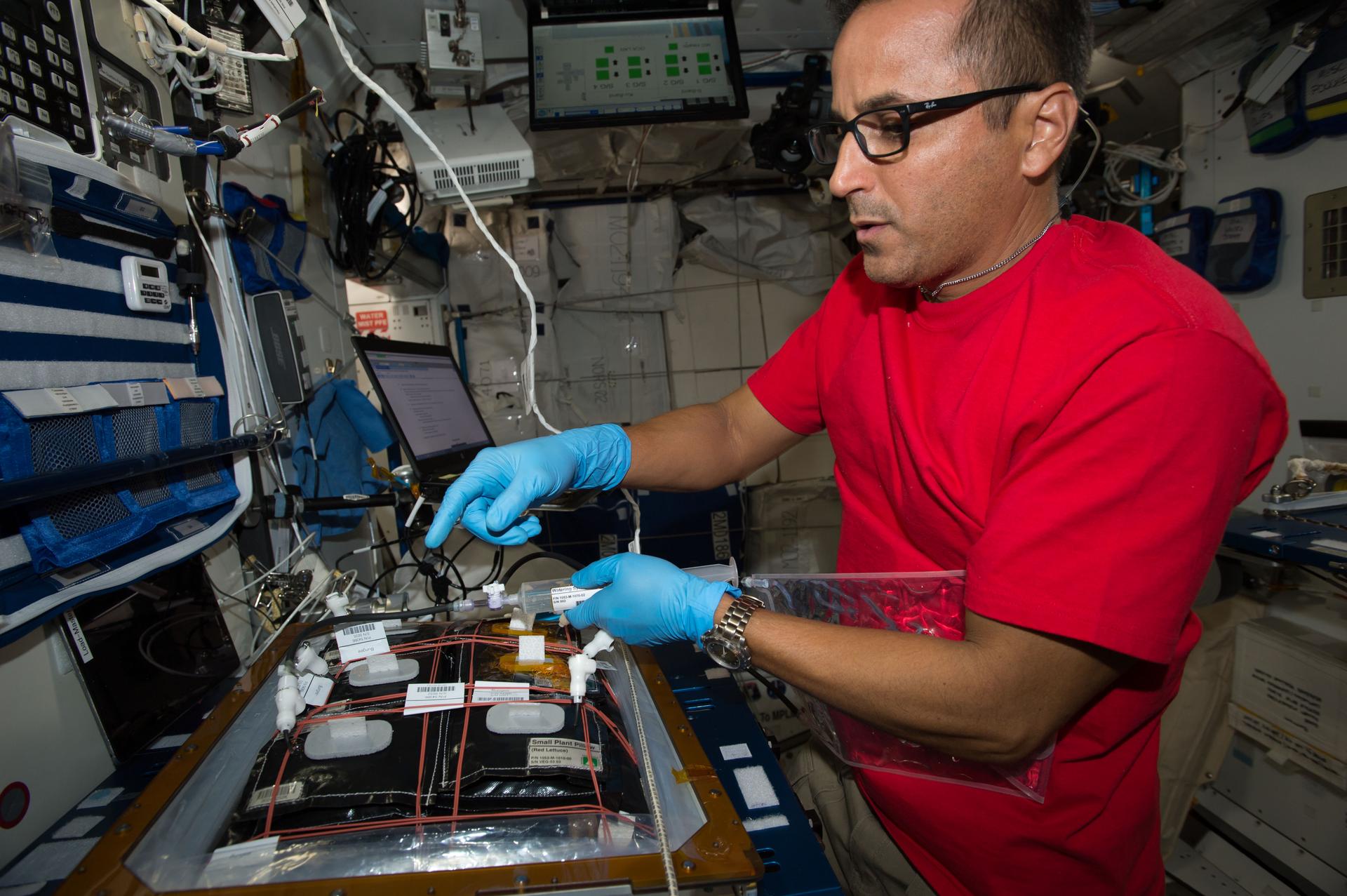
For Thanksgiving, the crew aboard the International Space Station had an ordinary holiday spread planned. In a video released November 23, NASA astronaut Jessica Watkins listed roasted turkey, mac and cheese, mashed potatoes and candied yams. They also had some greens grown on the station. NASA astronaut Anil Menon showed off station-grown plants he planned to eat with tortilla, pasta and hot sauce. Canadian Space Agency astronaut Joshua Kutryk said he would eat his raw, because it reminds him of Earth.
A few leaves at a holiday meal don't sound like much. But they belong to a long-running effort to decide which plants are worth taking on missions far from Earth. This week NASA reported new results from that work. The candidates now include strawberries, cucumbers and lemon basil.
The strawberry that lost by winning
The strawberry study is the most interesting of the three, because the losing plant had the better harvest. Researchers at NASA's Kennedy Space Center, the University of Melbourne and the University of Western Australia published the study in Life Sciences in Space Research in September. They compared a wild strawberry with 'Delizz', the variety NASA calls its leading strawberry candidate. Both were grown under simulated space conditions.
The two plants produced very different fruit. Delizz grew large, red fruit, while the wild strawberry produced small, yellow fruit because of a recessive genetic mutation. Grown from seed, the wild strawberry made about twice as many buds, flowers and fruit as Delizz. On Earth, that might settle it. But the wild plant also grew too many runners, the horizontal stems strawberries use to spread, and those would take up valuable room aboard a spacecraft. Delizz kept its top spot.
The result shows that a space crop isn't judged on yield alone. Growth habit and footprint count too, and a plant that out-produces its rival can still lose if it takes up too much room.
Cucumbers: possibly a first for the gourd family
The cucumber work appeared in HortScience in August. NASA-funded researchers evaluated cucumbers for growth, yield and nutrition under spaceflight conditions. The plants showed some signs of enlarged leaves, but they produced a steady stream of edible fruit. "Steady" is the key word: for a crew living off a closed system, a plant that keeps fruiting is worth more than one that fruits in a single burst.
Many crops have been grown in space, but none so far have come from the gourd family, according to NASA. Cucumbers could be the first. So the ground results are promising, but the real test of whether cucumbers behave the same way in orbit hasn't happened. NASA also says a wider variety of crops benefits astronauts' diets and mental well-being, and increases plant biodiversity, which can improve the likelihood of crop success on long-duration missions.
Lemon basil: the seed question
Lemon basil, an edible herb with a citrus scent and taste, has passed its preliminary round of space crop testing at Kennedy. It also successfully underwent seed sanitization, a step required before spaceflight to remove microorganisms from the seeds. That step gets less attention than yield, but it matters. Its next steps include assessing its growth in plant pillows, which can house plants aboard the space station. NASA says menu fatigue can quickly become a problem for astronauts, and fresh herbs like lemon basil help transform packaged meals into something new and satisfying.
The hardware heading up on NG-25
The crop results come out as Northrop Grumman's 25th Commercial Resupply Services mission gets ready to carry a prototype crop production system to the station. NASA calls it first-of-its-kind, and its Ohalo III facility is meant to validate the system's water delivery and volume optimization technology. The goal is to provide insights for crop production systems for future Moon Base habitats and Mars missions. NASA says the knowledge may also help inform vertical farming and indoor growing systems on Earth.
The crop selection and the hardware go hand in hand. Ohalo III is a test of the growth chamber itself, while the strawberry, cucumber and basil trials are about which plants might eventually be grown in systems like it. NG-25 is also carrying a follow-up to the miBrains experiment, which will validate a miniature fluid-handling system for keeping human brain tissue models alive.
Why It Matters
NASA's case for space crops goes beyond fresh food. Space crops can absorb carbon dioxide, produce oxygen and recycle water, capabilities NASA says will become increasingly important as crewed missions extend farther from Earth. A good crop could do part of the work of the life-support system as well as feeding the crew. That makes crop choice an engineering decision as much as a culinary one, and it helps explain why a high-yield strawberry can lose on growth habit.
Resupply is the other reason. As Universe Today notes in coverage of related work, the space station is resupplied regularly and emergency supplies can be dispatched within hours, while missions to the Moon will take at least three days to arrive. In that same work, Oregon State University researchers grew potatoes in lunar soil simulant mixed with organic matter and reported that they were safe to eat and grew as well as potatoes produced on Earth. That points to the in-situ approach, where crops are grown in amended local material instead of relying only on what gets shipped from Earth.
Put together, the potato work deals with the growing medium, Ohalo III with water and volume, and the Kennedy trials with which plants to grow. None of it is ready for a lunar base yet. The cucumbers haven't flown, the prototype chamber is still headed to the station, and the strawberry results came from simulations. But NASA is now picking crops with specific trade-offs in mind, not just testing whether plants can grow in space at all.
For now, the station's greens are still a garnish next to the turkey. The research is aimed at a time when they would be a real part of the crew's food supply.
Sources
- NASA Eyes Crop Candidates for Future Menus (NASA Science)
- NASA's NG-25 Mission to Launch Pioneering Space Crops Research (NASA Science)
- Space plants with hot sauce: what ISS astronauts will be eating on Thanksgiving (Space.com)
- Study Finds Artemis Astronauts Will Enjoy Moon-Grown Potatoes (Universe Today)
