
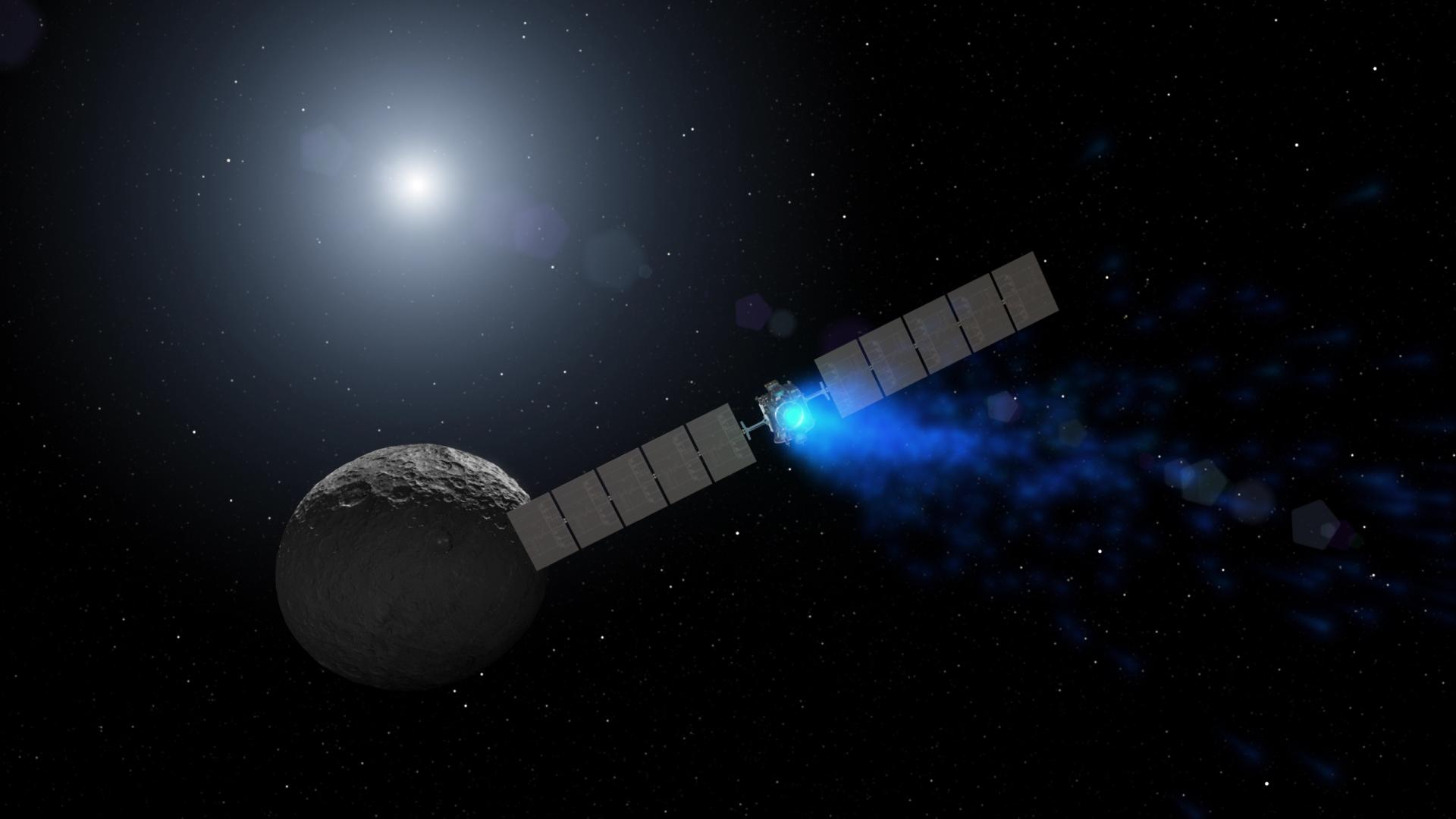
Most proposals to mine the asteroid belt start with the product. A new paper by Pete Worden and Fred Kennedy starts with the trip. Their argument is that a fuel depot at Ceres only makes sense if you can get there, work there and come back on a reasonable schedule. Having run the orbital mechanics for a full decade of launch windows, they conclude that only one kind of propulsion manages all three: nuclear thermal.
The concept is called Project CERES, short for Ceres-Earth Resource Exchange System. It is described in a 14-page paper submitted to The Journal of the British Interplanetary Society on Sept. 28 and posted to arXiv on Sept. 30. It is a proposal, not a funded mission. It drew wider attention this week when Universe Today covered it on Nov. 28, laying out the authors' plan for a Pathfinder flight and the transport network they hope would follow.
Who is pitching this
The authors are not newcomers. Worden chairs the Breakthrough Prize Foundation and is affiliated with the University of Arizona. Kennedy is CEO of Dark Fission and previously led the Space Development Agency. Their paper reads less like a mission brochure and more like a trade study: it sets out the requirements, compares the propulsion options and reports which ones work.
The numbers behind the pitch
The core of the paper is a survey of every direct Earth-to-Ceres opportunity between 2032 and 2042, computed with ephemeris-based Lambert analysis. That is the standard method for finding the trajectory that links two planetary positions on given dates. The result is a velocity budget. Across the decade, the impulsive delta-v required ranges from 10.2 to 14.1 km/s depending on the window.
That is a hard budget to meet, and the paper tests three propulsion classes against it:
- Chemical rockets: delivery is described as "marginal." It might close in a good window, with no margin for error.
- Nuclear-electric propulsion: it can do the job, but a one-to-two-year trip would need multi-megawatt electrical power, far beyond anything that has flown.
- Nuclear thermal propulsion (NTP): a stage with a specific impulse of 900 seconds delivering 35 metric tons to Ceres closes at roughly 220 tons in low Earth orbit, and it does so in every window surveyed.
That consistency is the paper's strongest claim. A mission architecture that only works in one or two lucky years cannot support a transport system. One that works at every opportunity across a decade might.
NTP is not exotic physics. A fission reactor heats liquid hydrogen to about 2,700 K and expels it through a nozzle, producing exhaust roughly twice as fast as the best chemical engines. The technology also has a substantial test history. NASA's Rover and NERVA programs ran more than 20 reactors and engines between 1959 and 1972. What NTP has never done is fly.
Refueling changes the math
The second key number concerns the return trip. The authors calculate that refueling at Ceres, rather than carrying return propellant from Earth, cuts the launch mass of an Earth-Ceres-Earth sortie by 61 percent. Carrying fuel for the trip home means launching that fuel and also the extra fuel needed to push it outward. Making it at the destination removes both.
This is why the paper concludes that NTP is the only propulsion class that closes "mass, time and the return leg together." Chemical systems struggle with mass, and electric systems struggle with time unless they get a huge power supply. NTP, combined with propellant made on Ceres, meets all three constraints in the authors' analysis.
The Pathfinder timeline
According to Universe Today's account, the first mission would launch in January 2037 and arrive at Ceres a little over a year later. The spacecraft would pair a Dawn-class orbiter with a five-metric-ton lander and a sample return capsule. The planned sequence:
- Arrival plus 4–5 months: the orbiter maps volatiles and sounds the depth of subsurface ice.
- Surface operations: the lander sets down at an ice-rich, high-latitude site and extracts water as a demonstration.
- Extended survey: about 20 more months of investigation.
- June 2040: departure from Ceres.
- May 2041: samples land on Earth in a capsule similar to the one flown on Stardust.
From launch to sample delivery, that is a little over four years. For comparison, NASA's Dawn mission launched on Sept. 27, 2007, and did not enter orbit around Ceres until March 6, 2015, although it also explored the giant asteroid Vesta.
Why Ceres, specifically
Ceres is the largest object in the asteroid belt between Mars and Jupiter and the only dwarf planet in the inner solar system. Giuseppe Piazzi discovered it in 1801, and it was reclassified as a dwarf planet in 2006. When Dawn reached it in 2015, it became the first dwarf planet orbited by a spacecraft, about four months before New Horizons flew past Pluto.
Dawn's data are the reason Ceres keeps appearing in resource proposals. According to Worden, the spacecraft found roughly 10 percent water ice by weight in the top meter of soil at mid-to-high latitudes. It also detected ammoniated clays, carbonates, organic compounds and sodium carbonate brines in Occator crater. Water is the key ingredient for propellant. The high-latitude ice is the reason the Pathfinder lander is aimed where it is.
Why It Matters
The argument for in-situ propellant has been around for decades. Project CERES makes it specific by tying it to a particular destination and a particular engine, backed by trajectory data for every window over a decade. Worden claims a refueling node at Ceres would pay for itself within the operating life of its first fleet. That is an economic projection, not a demonstrated result, and the paper's main contribution is the transport analysis rather than a business case.
The proposal also depends on several things that do not yet exist. Nuclear thermal propulsion has been tested on the ground but never flown. The water extraction at Ceres is a proposed demonstration, not an established capability. And moving 220 metric tons into low Earth orbit for a single mission is a major launch campaign in its own right. The paper says NTP is the propulsion class that makes the Ceres trip work. It does not show that the engine, the mining hardware or the funding will be ready by January 2037.
Still, the analysis is useful because it is a constraint study: it identifies which approaches cannot do the job. If its numbers hold up, anyone serious about an economy in the asteroid belt has to account for the result that chemical rockets barely make the trip and electric propulsion needs power systems nobody has built.
